

Elefloor — SPC Flooring Manufacturer
We make SPC, LVT, and wood veneer SPC flooring across two production hubs — Changzhou, China and Rayong, Thailand. You buy factory-direct, choose the origin that fits your import duty structure, and get OEM or private-label production with samples in 7 days.

SPC, LVT, and Wood Veneer SPC —
Three Product Lines, One Factory Source
Three distinct flooring formats, each serving a different channel and margin tier. All manufactured at the same source, with the same QC protocols, available for OEM or private-label production.
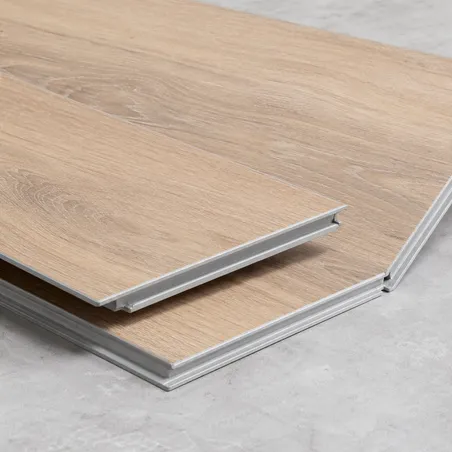 Core Volume Line
SPC Flooring
Our core volume line, in production since 2012. Rigid core, click-lock, 4mm–8mm thickness range — the format steadily replacing laminate and WPC in residential and commercial distribution. We run the full surface range: wood-look, marble, herringbone, deep emboss, and EIR textures. Enough SKU depth to fill a showroom or stock a warehouse without splitting across multiple factories.
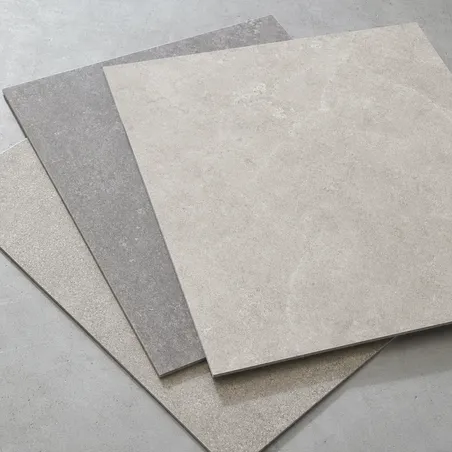 Commercial Spec
LVT Flooring
Luxury vinyl tile for glue-down and loose-lay applications. Wood-look, tile-effect, and geometric patterns across multiple thickness and wear-layer configurations. LVT still dominates in commercial specification work where architects want thinner profiles and glue-down stability — if your business serves that channel, this line gives you a product the SPC catalog doesn't cover. LVT also tends to carry higher per-square-meter margins than entry-level SPC.
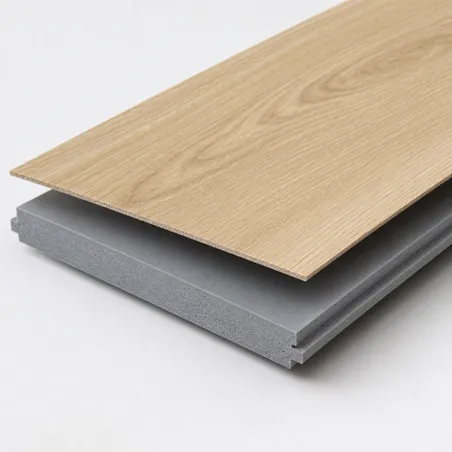 Premium Tier
Wood Veneer SPC Flooring
Real wood veneer bonded to an SPC rigid core — the look and feel of hardwood with the dimensional stability and waterproof performance of SPC. We produce WSPC and VSPC formats. This lets you compete in the hardwood market without the moisture and cupping risks of solid or engineered wood. Wood veneer SPC typically commands 2–3x the retail price of standard printed-film SPC, while your manufacturing cost increase is far smaller than that multiplier.
Dual-Origin Production —
Choose the Shipping Origin That Protects Your Margin
Most SPC flooring manufacturers operate from a single country. We run two factories — Changzhou, China and Rayong, Thailand — producing identical product on the same equipment with the same formulations and QC protocols.
The reason we built the Thailand plant wasn't expansion for its own sake — it was a direct response to anti-dumping duties that were eating into our buyers' landed costs on Chinese-origin flooring.
When you place an order, we route production to whichever facility gives you the best combination of import duty rate and freight cost for your destination market. Importing into a market with anti-dumping duties on Chinese flooring? Your order ships from Rayong with Thai origin documentation, and your landed cost drops by the full duty differential — which on SPC flooring can be 15–25% of product value depending on the market. Importing into a market where Chinese origin carries no penalty? Your order ships from Changzhou, where we have more line capacity and shorter lead times for large runs.
This isn't a theoretical advantage. We've had buyers shift entire programs from China-origin to Thailand-origin mid-year when duty rates changed, without any disruption to their product specs, packaging, or quality. The Rayong plant exists specifically so you never have to choose between the product you want and the origin you need.
Because both facilities draw from the same approved raw material suppliers and run the same inline QC checks, your downstream customers won't see any difference between a plank made in Changzhou and one made in Rayong.

- More line capacity for large runs
- Shorter lead times at volume
- Optimal for duty-neutral markets
- Thai origin documentation
- Avoids anti-dumping duties on CN flooring
- Now ~40% of total export volume
How Origin Routing Works in Practice
We started the Thailand operation in response to one specific buyer's tariff problem. Within two years, it became the primary shipping origin for about 40% of our total export volume. Trade policy moves fast — having two origins already in place means you're not scrambling when the next tariff announcement hits. Mid-year program shifts between origins are handled without disruption to product specs, packaging, or quality.
Full OEM/ODM — Your Brand, Your Specs, Manufactured at the Source
We do private-label manufacturing from concept through container loading. You bring your brand identity, your target specs, and your market positioning — we handle formulation, décor selection, surface texturing, packaging design, and production. Or you select from our existing collections and we relabel and repackage to your specifications. Either path gets you a product that's yours in every way your customer sees it.
The depth of customization goes further than most factories offer because we control the critical steps in-house.
Learn More About OEM/ODM Services
Core Formulation Control
Our R&D team of 15+ engineers manages formulation in-house — adjusting the calcium carbonate-to-PVC ratio to hit your target balance of rigidity, weight, and cost. No outsourced compounding, no black-box specs.
CNC-Milled Click-Lock Profiles
We mill click-lock profiles on our own CNC machines, so we can tune locking tension for your specific channel — tighter engagement for DIY retail where installers are less experienced, standard tension for professional crews who want speed.
200+ Décor Library + Custom EIR
Décor film selection draws from a library of 200+ patterns. We develop custom EIR texture plates to match specific wood species when your product line demands it — not just a catalog pick.
7-Day Sample Lead Time
Sample lead time is within 7 days from design confirmation. That matters when you're evaluating décors against your market feedback and need to iterate quickly rather than waiting 3–4 weeks per round.
Most of our OEM buyers go through 2–3 sample rounds before locking a collection, so the cumulative time savings across a product development cycle is significant.
Flexible MOQ — Test New SKUs Without Overcommitting Inventory
Minimum order starts at 1,000 sqm per SKU for standard collections. That's roughly half a 20-foot container for a single décor, which means you can test a new pattern or thickness in your market with real customer feedback before scaling to full container volumes.
If you're entering a new product segment — say, adding wood veneer SPC to an existing LVT program — you don't need to bet five containers on an unproven SKU.
1,000 sqm Minimum Per SKU
Standard collections start at 1,000 sqm — roughly half a 20-foot container for a single décor. Enough to run a real market test without locking up capital in unproven inventory.
Test Before You Scale
Validate a new pattern or thickness with real customer feedback before committing to full container volumes. The low entry point is designed for product development cycles, not just reorders.
Expand Product Lines Incrementally
Adding wood veneer SPC to an existing LVT program? You don't need to bet five containers on an unproven SKU. Enter a new segment at low risk, then scale what performs.
- Real market test with actual customer feedback
- New pattern or thickness validation before scaling
- New product segment entry without full container commitment
- Incremental SKU expansion across product lines
Once a SKU proves out in your market, scaling to full container volumes is straightforward. Same factory, same specs, same production team — no re-qualification required.
Discuss your MOQ requirementsCompliance Pre-Qualified for Your Target Market
We hold ISO 9001:2015, CE, SGS, FloorScore, and REACH certifications. Your product arrives with the documentation your market requires already in place — you're not chasing test reports after the container lands.
North America
FloorScore and TSCA Title VI certifications included. Meets California Air Resources Board requirements for formaldehyde emissions.
Europe
CE marking and REACH registration in place. Documentation ready for EU market entry without additional testing delays.
Global Markets
SGS third-party test reports available for markets that require independent verification. No additional testing lead time required.
ISO 9001:2015
Quality management system certification covering the full production process — from raw material intake through finished goods inspection.

What "pre-qualified" means for your timeline
No waiting for test labs after your container ships
No customs holds for missing documentation
No re-testing costs when entering a new market
Documentation ships with the product. Your market's requirements are already met.
Export Packaging Configured by Destination
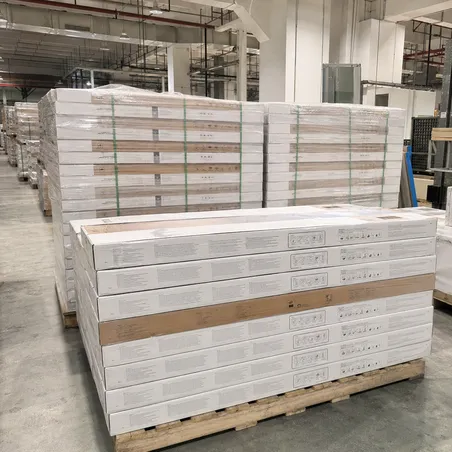
Packaging isn't one-size-fits-all. We configure packaging per your market requirements so the product is shelf-ready or warehouse-ready on arrival — not sitting in your facility waiting for relabeling.
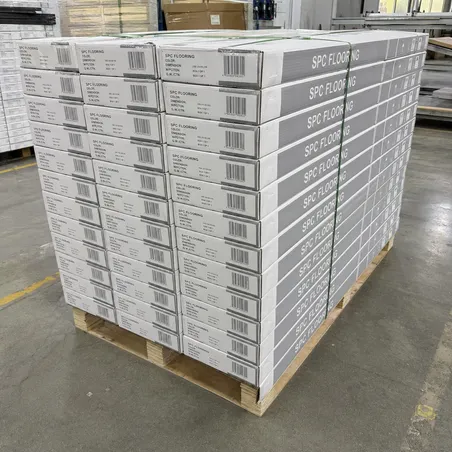 North America
Retail-Ready for North America
- Retail-ready cartons with UPC barcodes
- Pallet-stacked for direct warehouse receiving
- No relabeling or repackaging required on arrival
 Europe
Adjusted for European Racking
- Carton dimensions adjusted for local racking systems
- Multilingual care instructions included
- Compliant labeling for EU retail and distribution
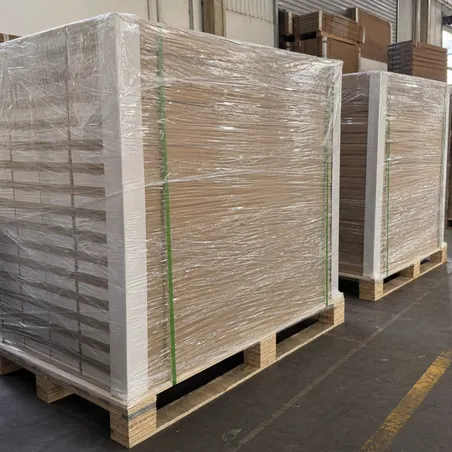 Middle East
Moisture-Protected for Humid Ports
- Extra moisture barrier wrapping applied
- Protects product integrity during humid port storage
- Configured for extended dwell times at regional ports
The cost of wrong packaging
When packaging doesn't match the destination, product sits. Relabeling costs labor and time. Racking mismatches mean manual restacking at the warehouse. Moisture damage at port means claims and replacement orders. We configure packaging before the container loads — not after it arrives.
Tell us your destination market and distribution channel. We'll confirm the packaging configuration before production starts.
The Production Behind Those Commitments
Eight fully automated calender lines across two facilities. 12 million square meters per year. Here's the infrastructure that makes the delivery dates, tolerances, and QC claims real.

Dual-Facility Overflow Protection
The Changzhou plant runs 5 lines across 15,000 sqm. Rayong runs 3 lines across 7,000 sqm. That's enough combined capacity to supply multiple large distributors simultaneously — your reorder doesn't queue behind someone else's production run.
When one facility is running at capacity during peak season, we shift overflow to the other. Your delivery date holds either way.
Why ±0.1mm Matters at Installation Scale
When your contractor is clicking together 2,000 sqm on a single job site, thickness variation means lippage between planks and callbacks to your phone. Inline thickness gauges and real-time density monitoring run continuously on every line, flagging drift before it becomes a defect in your shipment.
Four-Stage QC Process
We reject 3–5% of CaCO3 and PVC resin shipments that don't meet spec before they enter production.
Continuous thickness gauging and density monitoring on every active line.
This step sounds standard — it's the one most factories quietly skip when production is running hot. We don't.
SGS or Bureau Veritas third-party inspection available on request. We're set up to accommodate your inspectors on short notice.
260 people run production, QC, R&D, logistics, and export operations. Large enough to handle container-volume orders on schedule. Small enough that your account manager actually knows your SKU list.
Learn more about our factory and teamMarkets Where SPC and LVT Flooring Move Volume
SPC and LVT serve distinct buyer types with different order patterns, specification requirements, and margin profiles. Here's how each segment works and where Elefloor's production setup fits.
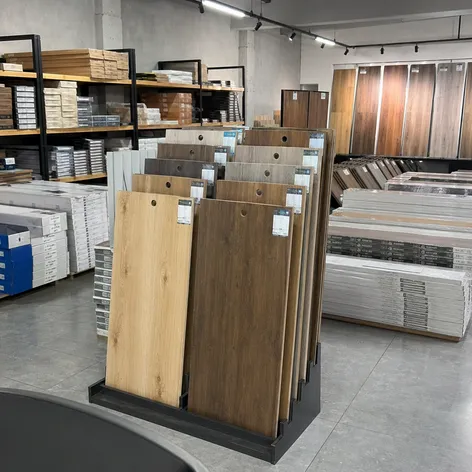
Residential Distribution and Retail
The largest single channel for SPC flooring. Distributors and retailers serving homeowners and renovation contractors order in container volumes, typically reordering quarterly on their top-selling décors.
Wood-look SPC in the 5–6mm range with attached IXPE pad is the volume sweet spot — it covers the broadest residential demand at a price point that protects your retail margin.
If you're already in this channel, adding 3–5 new décors per season keeps your catalog fresh without inventory risk at our 1,000 sqm MOQ.
Commercial Fit-Out and Tenant Improvement
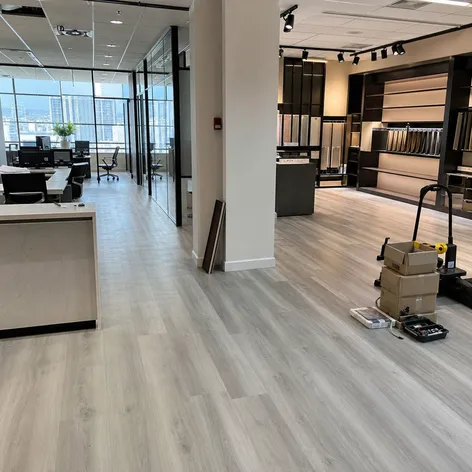
Office buildings, retail spaces, hotels, and restaurants specify SPC and LVT for renovation cycles that run every 5–8 years. Orders tend to be project-based — 2,000–10,000 sqm per job — with tight delivery windows tied to construction schedules.
Commercial buyers value thicker cores (6–8mm), higher wear layers, and FloorScore certification for LEED-qualifying projects.
This segment rewards suppliers who can deliver on schedule and provide project-specific documentation without delays.
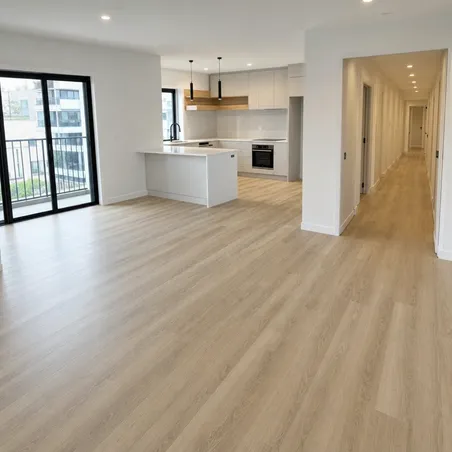
Multi-Family and Property Development
Apartment complexes, condominiums, and build-to-rent developments install flooring across hundreds of units per project. Orders are large — often 5,000–20,000 sqm — and developers typically standardize on 2–3 SKUs across an entire property.
Once you're specified into a developer's standard, reorders follow with each new phase or property. Our dual-origin production is particularly relevant here — large developers are sensitive to landed cost shifts from tariff changes mid-project.
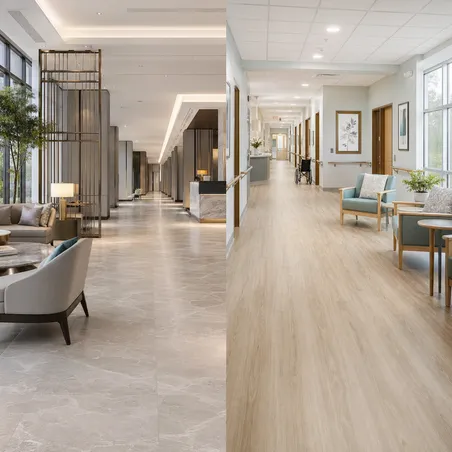
Hospitality and Healthcare
Hotels, clinics, and senior living facilities need waterproof, low-VOC flooring that meets strict indoor air quality standards. FloorScore and REACH compliance are often non-negotiable in these specifications.
Order volumes are moderate per project but the reorder cycle is predictable — hospitality properties typically replace flooring on a 7–10 year rotation, healthcare on tighter cycles in high-traffic areas. Margins tend to be stronger here because compliance requirements narrow the field of qualified suppliers.
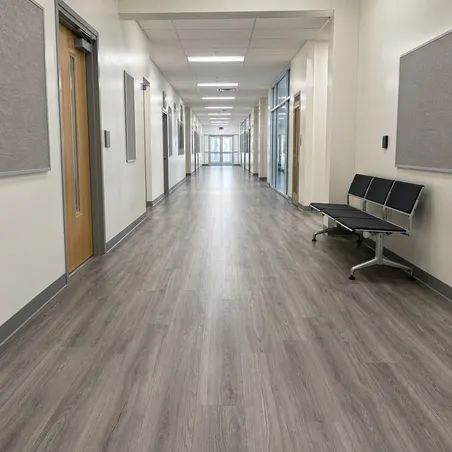
Education and Government
Schools, universities, and government buildings purchase through institutional procurement channels with annual budget cycles. Orders are planned months in advance, volumes are consistent year over year, and the specification process — once you're approved — creates a recurring revenue stream.
SPC's waterproof and low-maintenance properties make it an easy specification win over carpet and VCT in these environments. This segment has grown steadily for us over the past three years, particularly in Southeast Asia and the Middle East.
Start with Your Target Market — We'll Handle the Production
Tell us your destination market, target product specs, and volume expectations. We'll come back with a sourcing proposal that includes pricing from the optimal production origin, sample timeline, and packaging configuration for your channel.
Destination Market
Share your target country or region. We'll align production origin, compliance pre-qualification, and export packaging to match.
Product Specs
Thickness, wear layer, format, surface finish, locking system — tell us what your channel requires and we'll match it to the right line.
Volume Expectations
Initial order size, reorder cadence, and growth targets help us configure MOQ tiers and reserve production capacity accordingly.
Sourcing Proposal
We return with pricing from the optimal production origin, a sample timeline, and packaging configuration built for your distribution channel.
Explore Elefloor