

SPC Flooring — Rigid Core Vinyl Flooring from the Production Source
7 product lines covering waterproof click-lock, herringbone, wood-look, marble-look, thick-core, gym, and kitchen SPC — all produced under one roof with full OEM/ODM capability.

What We Make and How You Source It
SPC flooring — stone polymer composite, rigid core vinyl flooring, whatever your market calls it — is the only product category we've manufactured since 2012. We don't make laminate on the side. We don't run LVP on the same lines and call it SPC. Every calender line, every formulation batch, every QC protocol in our two factories is built around rigid core vinyl flooring production.
You're buying from Elefloor, which means you're buying from the factory floor in Changzhou, China or Rayong, Thailand — not from a trading company sourcing from three different mills and hoping the quality matches across shipments. We produce 4mm through 8mm SPC with click-lock profiles, attached underlayment options, and surface treatments ranging from standard EIR to deep emboss and hand-scraped textures. Your brand goes on the box. Your décor selections go on the plank. We handle the manufacturing, QC, and container loading.
Our 260-person operation runs 8 fully automated calender lines across 22,000 square meters of combined factory space. Annual capacity sits at 12 million square meters — enough to supply multiple large distributors simultaneously without your reorder competing for line time. (We've had months where three separate North American accounts were running production at the same time across different lines. Nobody waited.)
If you're evaluating SPC flooring manufacturers, the rest of this page walks you through our product lines, production specs, the applications your buyers can profit from, and how we handle OEM/ODM. Think of it as the factory tour you'd get if you flew to Changzhou — except you can do it from your desk.

Two production origins, one quality standard. Changzhou, China and Rayong, Thailand — both factories run the same formulations, the same QC protocols, and the same calender line specs. You choose origin based on tariff exposure and freight routing, not quality trade-offs.
SPC Product Lines — 7 Categories, One Production Standard
We organize our SPC flooring into seven product lines. Each targets a different segment of the market, so you can build a catalog that covers residential, commercial, and specialty applications without sourcing from multiple factories.
 Core Line
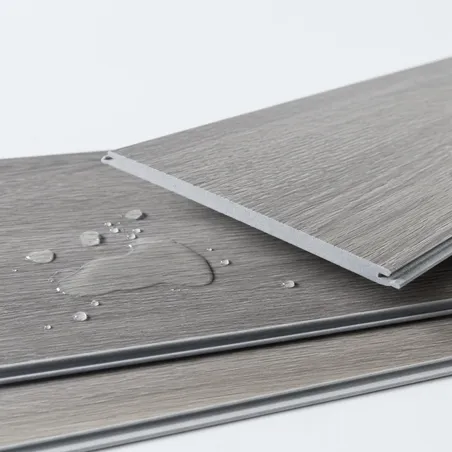
Waterproof SPC Flooring
Zero water absorption rigid core with click-lock installation — the product line that replaced laminate in wet-adjacent spaces and gave distributors a flooring they could sell without worrying about moisture claims. Available in 4mm–6mm cores with IXPE or EVA attached pad.
View Product Line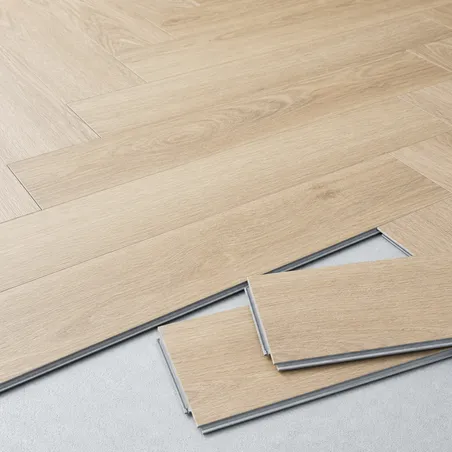 Premium
Herringbone SPC Flooring
Herringbone and chevron patterns command a higher retail price point than standard plank, and the installation complexity keeps your margin protected from commodity pricing pressure. Precision-milled click-lock profiles allow tool-free installation — your buyers get the premium look without the glue-down labor cost.
View Product Line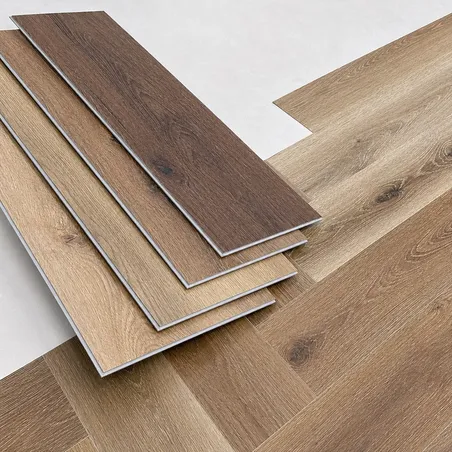 Best Seller
Wood-Look SPC Flooring
Oak, walnut, hickory, and ash reproductions with embossed-in-register textures. The volume line — wood-look SPC accounts for the largest share of residential and light commercial projects. 200+ décor films in our library, with EIR texture plates that align surface grain to the printed pattern underneath.
View Product Line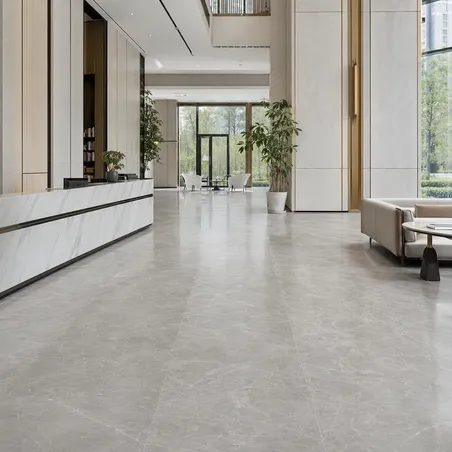 Commercial
Marble SPC Flooring
High-gloss and matte stone-look SPC for commercial lobbies, retail spaces, and high-end residential. Lets you sell into segments where ceramic tile has traditionally dominated — but with faster installation, lower subfloor prep cost, and no grout maintenance for the end user.
View Product Line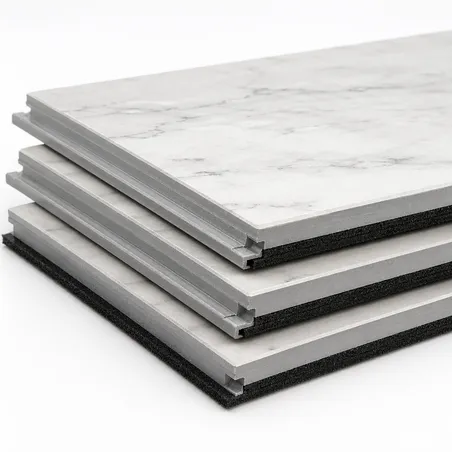 Thick Core
8mm SPC Flooring
Thick-core SPC for buyers who need the rigidity and underfoot feel of laminate without the moisture vulnerability. 8mm core with attached pad brings total thickness to 9.5–10mm — it can go over imperfect subfloors that thinner SPC would telegraph. Strong fit for renovation and remodel distribution channels.
View Product Line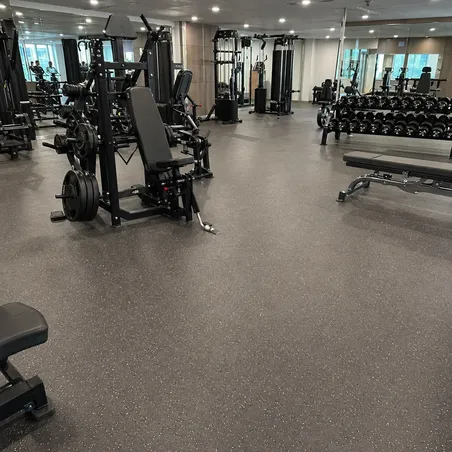 Specialty
Gym SPC Flooring
Commercial gym and fitness center flooring with enhanced indentation resistance and slip-rated surface treatments. Facility owners are moving away from rubber rolls and interlocking tiles toward rigid core click-lock — faster to install and easier to maintain. A growing segment worth stocking if you supply the fitness or recreation market.
View Product Line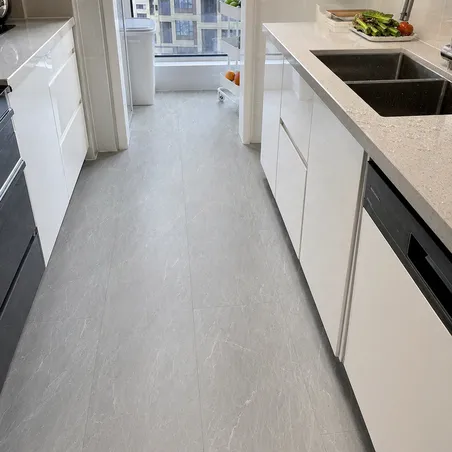 Wet Area
Kitchen SPC Flooring
Waterproof rigid core SPC engineered for wet-area applications — kitchens, laundry rooms, bathrooms, and commercial food service. The zero water absorption core handles standing water and spills without swelling or delamination, which keeps warranty claims out of your service queue.
View Product LineNeed help selecting the right product lines for your market?
Tell us your target segments — residential, commercial, specialty — and we'll map the right lines to your distribution channel.
Production Specs Across the SPC Range
Here's what our calender lines produce. These are category-wide ranges — individual product pages carry the exact specs for each line.

| Parameter | Range |
|---|---|
| Core thickness | 4mm – 8mm |
| Total thickness (with pad) | 4.5mm – 10mm |
| Core composition | Stone polymer composite (CaCO₃ + PVC resin, rigid core technology) |
| Wear layer | 0.3mm – 0.7mm (12 mil – 28 mil) |
| Surface treatments | EIR (embossed-in-register), crystal, deep emboss, hand-scraped |
| Click-lock systems | Unilin-type and Valinge-type, CNC-milled in-house |
| Attached underlayment | IXPE or EVA pad, factory-attached |
| Plank dimensions | Width 150mm–230mm, Length 600mm–1800mm |
| Dimensional tolerance | ±0.1mm thickness, ±0.15mm width |
| Fire rating | Bfl-s1 (EN 13501-1) |
| Slip resistance | R9–R11 depending on surface treatment |
In-House CNC Click-Lock Milling
We mill click-lock profiles in-house on CNC profiling machines rather than outsourcing to a third-party shop. This controls locking geometry tolerance to ±0.05mm and lets us adjust engagement tension for your specific channel.
Choosing Your Wear Layer Thickness
The wear layer thickness you choose depends on your target market segment.
Dual-Origin Manufacturing — Your Tariff and Freight Advantage
We operate two production hubs: Changzhou, China (15,000 sqm, 5 calender lines) and Rayong, Thailand (7,000 sqm, 3 calender lines). Both run the same equipment, the same core formulations, and the same QC protocols. Your product is identical regardless of which facility ships it.

Changzhou, China
Optimal routing for North American and European buyers. Efficient transit through Shanghai port with competitive freight rates on high-volume lanes.
Rayong, Thailand
Shorter transit and lower freight for Oceania and Southeast Asian buyers. Southeast Asian origin certificate changes your landed cost equation when anti-dumping duties apply on Chinese-origin flooring.
15–25% Import Duty Savings via Southeast Asian Origin
When your import market applies anti-dumping duties on Chinese-origin flooring, a Southeast Asian origin certificate changes your landed cost equation. We've had buyers save 15–25% on import duties by shifting production to Rayong — on a 40HQ container of SPC, that's a significant number on your cost sheet.
Logistics Flexibility by Design
Your order routes through whichever facility gives you the best combination of production availability and shipping cost. Changzhou serves North America and Europe more efficiently through Shanghai. Rayong is closer to Oceania and Southeast Asian ports — shorter transit, lower freight. The dual-factory setup is a logistics tool, not just a tariff workaround.
Your compliance documentation is consistent regardless of origin. We set it up this way deliberately — having to re-qualify a product because it shipped from a different plant is exactly the kind of supply chain headache we wanted to eliminate for you.
What Happens to Your SPC Before It Ships — QC from Raw Material to Container
Certifications get you in the door. ISO 9001:2015, CE, SGS, FloorScore, REACH — we hold all of them. But what actually keeps defective product off your shelves is the inspection process running behind those certificates.
Raw Material Gate
Every batch of calcium carbonate, PVC resin, and plasticizer gets tested before it touches a calender line. We check CaCO₃ purity and particle size distribution, PVC K-value, and plasticizer viscosity.
A bad batch of calcium carbonate — wrong particle size, too much calcite content — makes the core brittle. We reject roughly 3–5% of incoming raw material shipments. It's a cost we absorb because a brittleness claim six months after installation costs everyone more.
Inline Monitoring
Thickness gauges run continuously on every calender line, measuring core thickness at multiple points across the plank width. If thickness drifts outside ±0.1mm, the line flags it automatically.
We also monitor core density in real time — density variation means the CaCO₃-to-PVC ratio has shifted, which affects both rigidity and click-lock engagement strength. Catching it on the line means we don't discover it during profiling.
100% Visual Inspection
Every plank passes through a visual inspection station before packing. Surface defects, edge quality, click-lock fit — inspectors check all three. We pull samples from every production run for lab testing.
Many factories skip the visual station when production is running hot. We don't — the defects that slip through at this stage are the ones that show up in your customer's living room.
Pre-Shipment AQL Audit
Before containers load, we run a final inspection per ISO 2859-1. Carton drop tests, pallet stacking tests, random plank pulls for click-lock engagement testing.
If you require SGS or Bureau Veritas third-party inspection, we're set up to accommodate their inspectors on short notice — many of our North American buyers make this standard practice, and our facility is audit-ready at all times.

Every Plank. Every Run. Every Container.
Four-stage QC from raw material intake to container seal — no shortcuts when production runs hot.
Where Your Buyers Deploy SPC — Market Segments Worth Stocking
SPC flooring sells across residential, commercial, and specialty segments. Here's how the product lines map to the markets your buyers serve — and where the volume sits.
Residential New Construction & Renovation
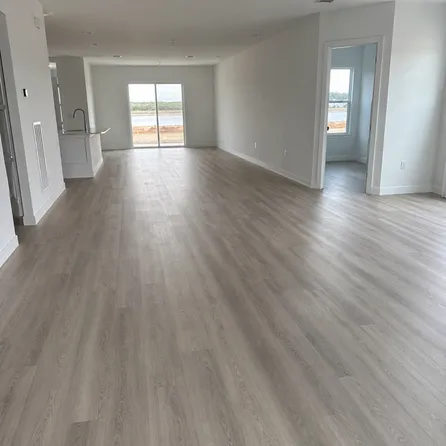
The largest volume segment. Builders and renovation contractors specify SPC because it installs over most existing subfloors without extensive prep, handles moisture in kitchens and bathrooms, and comes in at a lower installed cost than hardwood or engineered wood.
For your distribution business, residential SPC is the baseline catalog — wood-look and waterproof SPC in 4mm–6mm cores cover the majority of residential demand.
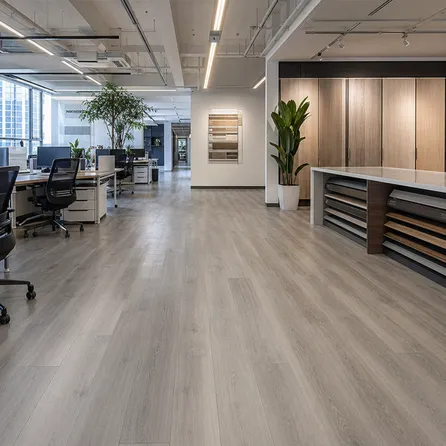
Commercial Office & Retail
Office fit-outs and retail spaces need flooring that handles rolling chair loads, high foot traffic, and frequent cleaning without showing wear. Specify 0.5mm–0.7mm wear layers and commercial-rated surface treatments.
Marble SPC moves well in retail and hospitality lobbies where the visual needs to compete with ceramic tile but the budget and timeline don't allow for wet installation.
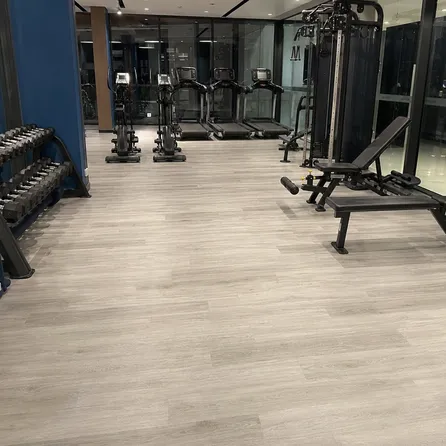
Fitness & Recreation Facilities
A segment that's been growing steadily as gym owners move away from rubber flooring toward rigid core click-lock. Gym SPC with enhanced indentation resistance handles dropped weights and heavy equipment without permanent denting.
If you supply the fitness channel, this is a product line with less price competition than standard residential SPC.
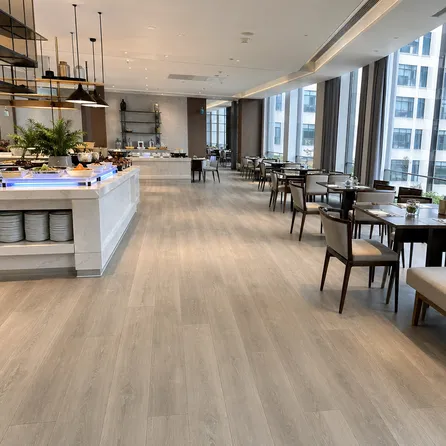
Hospitality & Food Service
Hotels, restaurants, and commercial kitchens need waterproof flooring that survives daily mopping, grease exposure, and heavy foot traffic. Kitchen SPC with slip-rated surfaces (R10–R11) and 0.5mm+ wear layers fits this segment.
The click-lock installation means your hospitality buyers can refloor a restaurant dining room over a weekend shutdown instead of a week-long closure.
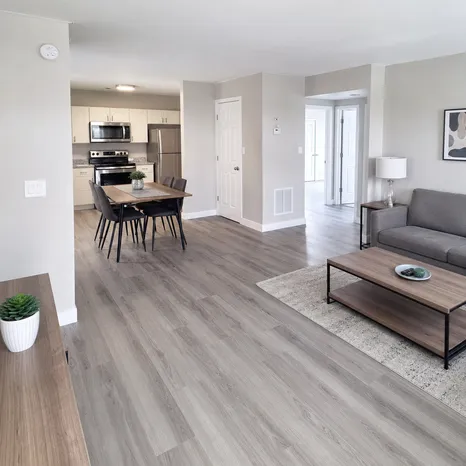
Multi-Family & Rental Property
Property managers and multi-family developers buy SPC for the same reason: it survives tenant turnover. Waterproof core means no swelling from unreported spills. Click-lock means faster unit turns between tenants.
For this segment, 4mm SPC with 0.3mm wear layer hits the price point — your buyers aren't looking for 20-year warranties, they're looking for 5–7 year performance at the lowest installed cost per square meter.
One Production Standard Across All Five Segments
Whether you're stocking for residential builders or commercial fit-out contractors, the same four-stage QC process applies. The product specs change — wear layer thickness, surface treatment, core density — but the inspection rigor doesn't. That consistency is what lets you sell across segments without managing separate supplier relationships.
OEM/ODM — Your Brand, Our Production Lines
We do full OEM and ODM for SPC flooring. You bring your brand identity, your target market specs, and your packaging requirements — we manufacture to your specifications and ship under your label.
Décor Selection
Our library holds 200+ décor films — oak, walnut, hickory, ash, stone, marble, concrete, and abstract patterns. Pick from existing options or we develop custom décor films to match a specific wood species or design concept your market demands.
For embossed-in-register textures, we produce custom EIR plates that align the surface grain to your chosen décor pattern.
Core & Wear Layer Configuration
Tell us your target market and price point, and we'll recommend the formulation. Lighter-weight core for residential distribution where freight cost per square meter matters. Denser core for commercial projects where indentation resistance is the priority.
Wear layer from 0.3mm to 0.7mm depending on the warranty position you want to offer your buyers.
Packaging & Labeling
Private-label cartons with your branding, UPC barcodes for retail channels, multilingual care instructions for European markets, moisture barrier wrapping for humid-climate destinations.
We configure packaging per your specs and per destination requirements.
MOQ and Samples
Starts at 1,000 sqm per SKU for standard collections — low enough to test a new décor in your market without committing a full container to a single pattern.
Within 7 days from design confirmation, so you can evaluate the product in hand before placing a production order.
R&D Engineering Team
Our R&D team of 15+ engineers handles core formulation adjustments, click-lock profile optimization, and new surface treatment development. When you need a product that doesn't exist in our current catalog, they're the ones who make it happen — from concept through sampling to production-ready specification.

Your Brand. Our Factory.
From décor film selection through core formulation, click-lock profile, wear layer spec, and final carton labeling — every variable is configurable to your market position. We've run OEM programs for distributors in North America, Europe, and Australia, and we understand what each channel requires.
The 1,000 sqm MOQ per SKU means you can build a multi-SKU private-label collection without the capital exposure of a full-container commitment per pattern. Start with your two or three strongest décors, validate sell-through, then expand.
Start Your OEM/ODM Project — Send Us Your SpecsCommon Failure Modes in SPC — and the Manufacturing Decisions That Prevent Them
If you've been sourcing SPC for any length of time, you've probably encountered at least one of these problems. We've spent 14 years engineering them out of our production process.
Core Brittleness and Cracking
Calcium carbonate ratio too high relative to PVC resin — the core becomes rigid but fragile, especially in cold climates. Planks crack during installation or after temperature cycling in unheated spaces.
Incoming CaCO₃ purity testing and real-time density monitoring on the calender line. Our formulation targets the balance point where the core is rigid enough for dimensional stability but retains enough flexibility to survive cold-weather handling and installation. We reformulated twice in our first three years of production to get this right — the early SPC industry had a lot of cracking claims before manufacturers figured out the CaCO₃ ceiling.
Click-Lock Disengagement
Planks that unlock after installation — usually caused by loose locking geometry tolerance or inconsistent profile milling. Generates installer callbacks and service claims.
We mill click-lock profiles in-house on CNC machines rather than outsourcing, controlling tolerance to ±0.05mm. Every profiling run gets checked with go/no-go gauges before the batch moves to packing. Loose profiles get re-milled or rejected. Your installers shouldn't be fighting with planks that won't stay locked, and your service team shouldn't be fielding callbacks.
Wear Layer Delamination
The wear layer separating from the décor film or the décor film lifting from the core. This is a hot-press adhesion failure — insufficient temperature, pressure, or dwell time during lamination.
We monitor press temperature and pressure continuously, and pull adhesion test samples from every production run. The UV coating line applies 6–8 coats cured individually under UV lamps rather than all at once, producing a harder, more uniform bond between layers.
Dimensional Instability — Gapping and Peaking
SPC is marketed as dimensionally stable — and it is, compared to laminate or WPC. But poorly formulated SPC still expands and contracts enough to cause visible gaps in winter and peaking in summer.
Inline thickness monitoring catches density variation that would lead to inconsistent thermal expansion behavior. We test dimensional stability per EN 434 on every production run, and our formulation is optimized for the ±0.1% dimensional change threshold that keeps your warranty claims at zero.
14 Years of Failure-Mode Engineering
Every control point described above — CaCO₃ purity testing, CNC profile milling to ±0.05mm, continuous press monitoring, UV coat-by-coat curing, EN 434 dimensional testing — exists because we or someone in the industry learned the hard way what happens when it's skipped. We document these controls so you can ask your other suppliers the same questions.
Container Loading and Landed Cost Factors
SPC flooring is a volume product — freight cost per square meter directly affects your margin. Here's how our packaging and loading works.

Container Capacity Reference
| Container | Product | Capacity (sqm) |
|---|---|---|
| 20GP | 4mm–6mm standard planks | 1,200–1,400 sqm |
| 40HQ | 4mm–6mm standard planks | 2,400–2,800 sqm |
| 40HQ | 8mm with attached pad | 1,800–2,200 sqm |
Capacity varies by plank thickness and pallet configuration. Standard planks: 2.2–2.4 sqm per carton.
Packaging Standard
Palletized with corner protectors and stretch wrap as standard. Moisture barrier wrapping added for shipments to humid-climate destinations. Every carton is labeled for carton count, sqm, and batch traceability.
Thickness vs. Load Density Trade-off
Thicker core means higher retail price point but fewer square meters per container. We help you model the landed cost per sqm for different thickness and configuration options so you can make the margin calculation before committing to a production run.
Dual-Factory Freight Routing
The dual-factory setup affects your freight routing. Orders ship from the facility closest to your destination market.
Australia, New Zealand, Southeast Asia. Ships via Laem Chabang port — shorter transit, Thailand-origin certificate.
North America and Europe. Ships via Shanghai — optimized for transatlantic and transpacific lanes.
Incoterms Available
We coordinate with your freight forwarder or use our own logistics partners depending on your preference.
Frequently Asked Questions About SPC Flooring
Decision-support answers for distributors, importers, and retail buyers evaluating SPC sourcing.
What thickness of SPC flooring should I stock for residential vs. commercial distribution?
For residential channels, 4mm–6mm core thickness covers the majority of demand. The 5mm sweet spot balances installed feel, subfloor tolerance, and freight cost per square meter.
For commercial projects — offices, retail, hospitality — specify 6mm–8mm core with 0.5mm+ wear layer. The thicker core handles rolling loads and heavy foot traffic, and the heavier wear layer supports the 15–20 year commercial warranties your buyers need to offer.
What is the difference between SPC and WPC flooring for sourcing purposes?
SPC uses a calcium carbonate and PVC composite core — denser, thinner, and more dimensionally stable. WPC (wood polymer composite) uses a foamed core — lighter, thicker, and softer underfoot but more susceptible to denting and temperature-related expansion.
SPC loads more square meters per container — higher density means more product per shipment
Lower warranty claim rates on dimensional stability
Wider application range including commercial — industry trend has moved decisively toward SPC
WPC retains a niche in residential markets where underfoot comfort is the primary selling point
How does the click-lock system affect my return and complaint rates?
Significantly. Click-lock failure — planks that won't engage properly or disengage after installation — is the number one source of installer complaints and product returns in the rigid core flooring category.
The variables are profile tolerance and engagement tension. We mill profiles in-house to ±0.05mm tolerance and adjust engagement tension based on your target channel (tighter for DIY, standard for professional).
If you're currently sourcing SPC with outsourced profiling, ask your supplier about their profile tolerance — anything above ±0.1mm will show up in your return rates.
What certifications do I need for SPC flooring in North American and European markets?
- FloorScore (SCS Global Services indoor air quality)
- TSCA Title VI (formaldehyde emissions)
- ASTM F3261 (rigid core standard)
- Big-box retail: carton labeling + UPC compliance
- CE marking (EN 16511)
- REACH registration (chemical safety)
- EN 14041 (essential characteristics)
We hold ISO 9001:2015, CE, SGS, FloorScore, and REACH certifications — your product ships pre-qualified for both markets with test reports available on request.
What is the minimum order quantity, and can I test a new décor before committing to volume?
MOQ starts at 1,000 sqm per SKU for standard collections. For custom OEM/ODM décors, the same 1,000 sqm minimum applies once the décor is confirmed.
We ship samples within 7 days of design confirmation so you can evaluate surface texture, color accuracy, and click-lock feel before placing a production order.
Most new buyers start with 1–2 SKUs at minimum quantity to test sell-through in their market, then scale to container volumes on reorder.
How do I choose between China-origin and Thailand-origin SPC for my market?
It depends on your import duty structure and freight routing. If your market applies anti-dumping duties on Chinese-origin vinyl flooring — several North American and European markets do — Thailand origin from our Rayong facility can reduce your landed cost by 15–25% on duties alone.
- Anti-dumping duty relief
- Oceania & Southeast Asia routing
- Laem Chabang port
- North America & Europe routing
- Shanghai port
- Optimal where duties aren't a factor
The product is identical from both facilities. Only the origin certificate and freight cost change.
Start Sourcing SPC Flooring from Elefloor
You've seen the product lines, the production specs, and how we handle quality. The next step is specific to your business.
I know what I need
Send us your target SKUs, thickness, wear layer, décor preferences, and estimated volume. We'll come back with pricing, a sample timeline, and a production schedule.
- Target SKUs and thickness spec
- Wear layer and décor preferences
- Estimated volume for accurate pricing
Still figuring out the right product mix
Tell us your target region, distribution channel, and price positioning. We'll recommend a starter SKU selection based on what's moving for our existing distributors in similar markets.
- Target region and distribution channel
- Price positioning in your market
- Starter SKU recommendation from live distributor data
Reach us directly
Explore product lines