

LVT Flooring Direct From Factory
LVT flooring manufactured in-house across two production hubs, shipped factory-direct to your warehouse.
Five distinct LVT product lines — wood-look, tile-effect, geometric, kitchen/bath, and premium luxury — covering the décor segments your customers actually buy. Produced on our own calender lines in Changzhou, China and Rayong, Thailand.

What We Mean by LVT — and What It Means for Your Product Line
LVT flooring — luxury vinyl tile — is the thinner, more design-flexible side of our vinyl flooring production. Where our SPC lines produce rigid-core planks built around dimensional stability, our LVT production focuses on the décor layer: high-definition printing, textured surfaces, and format variety that lets you build a product catalog your customers can't get from a single SPC range alone.
We manufacture LVT in both click-lock and dry-back formats, in thicknesses from 2mm dry-back through 5mm click-lock with attached pad. The core difference for your business: LVT gives you SKUs that hit lower price points than SPC while still carrying the "luxury vinyl" positioning that supports healthy retail margins. A well-curated LVT collection alongside an SPC range means you cover both the value-conscious renovation market and the premium new-build segment without sourcing from two separate factories.
Our LVT production runs on the same calender and UV coating infrastructure as our SPC lines — same facility, same QC team, same export logistics. You consolidate your vinyl flooring supply chain into one factory relationship, one set of quality standards, one shipping schedule. (We've had distributors come to us buying SPC only, then add LVT after realizing they were paying a second factory's margin for what we already produce in-house.)

LVT Product Line Overview
Five LVT collections, each targeting a distinct market segment. Every line is available for OEM/ODM — your brand, your packaging, your décor selections.
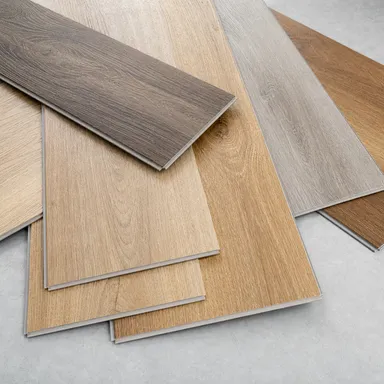 Premium Tier
Luxury LVT Flooring
Our premium tier. Thicker wear layers (0.5mm+), embossed-in-register surfaces, and the widest plank formats in our LVT range. This is the line you position against engineered hardwood and high-end laminate — the décor realism and underfoot feel justify a retail price point that protects your margin.
Best suited for distributors serving interior designers, upscale renovation contractors, and hospitality procurement.
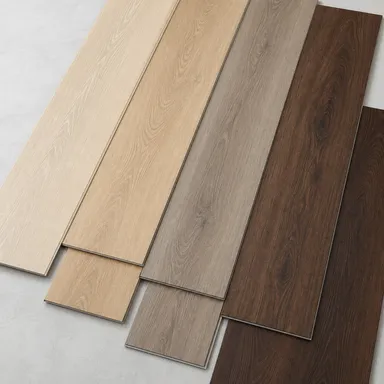 Volume Driver
Wood-Look LVT Flooring
Oak, walnut, hickory, ash — the wood species that move volume in every market we export to. Available in light, mid-tone, and dark colorways with grain textures ranging from smooth satin to hand-scraped.
Wood-look LVT is the workhorse of most distributors' vinyl catalogs, and we keep the most popular décors in continuous production so your reorders don't wait for a new print run.
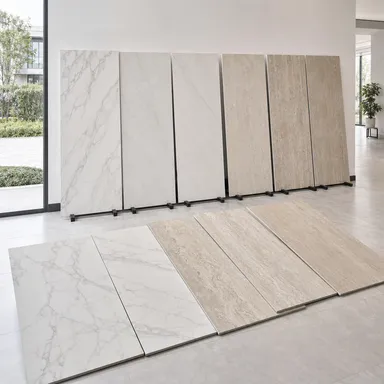 Commercial Ready
Tile-Effect LVT Flooring
Marble, travertine, slate, and concrete visuals in square tile and large-format rectangular formats. Tile-effect LVT opens a market segment that wood-look alone can't reach — commercial lobbies, retail spaces, and the growing demand for stone-look floors in residential kitchens and bathrooms.
Lighter than ceramic, faster to install, and no grout maintenance for the end user, which translates to fewer callbacks for your contractor customers.
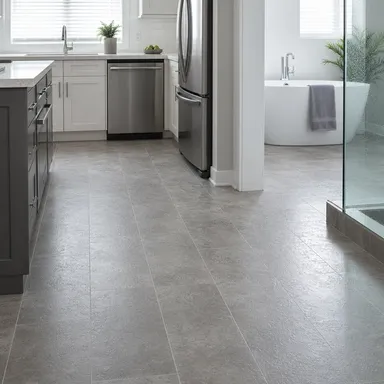 Wet Area Spec
Kitchen & Bathroom LVT Flooring
Engineered specifically for wet areas. Enhanced surface texture for slip resistance, tighter click-lock tolerances to prevent moisture wicking between planks, and décor selections curated for the spaces where waterproof performance is non-negotiable.
If you supply renovation contractors or retail home improvement channels, this is the LVT sub-line that answers the most common end-user question: "Can I put this in my bathroom?"
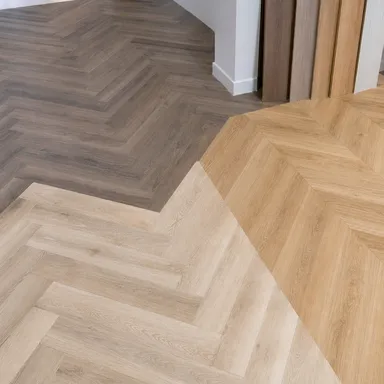 Design Premium
Geometric LVT Flooring
Herringbone, chevron, hexagon, and abstract pattern formats for design-led projects. Unlike commodity wood-look planks, geometric LVT is specified for visual impact, giving distributors a specialty line that supports premium positioning.
Best suited for hospitality designers, retail fit-out contractors, boutique renovation channels, and private-label catalogs that need differentiated, higher-margin SKUs.
How LVT Is Built — Layer by Layer, Line by Line
Understanding the construction helps you spec the right product for each market segment and answer your customers' technical questions with confidence.
Flexible Vinyl Core
Our LVT starts with a flexible vinyl core — not the rigid stone-polymer composite used in SPC, but a more pliable PVC-based substrate that allows for thinner overall profiles and easier handling during installation.
High-Resolution Décor Film
We apply a high-resolution décor film using rotogravure printing at up to 180 DPI. The décor film is what gives LVT its visual identity — wood grain, stone veining, geometric patterns — and print quality directly affects how your product is perceived at the point of sale.
Wear Layer — The Spec Lever That Matters Most
Above the décor film sits the wear layer — a clear PVC or PU-enhanced layer that determines scratch resistance, stain resistance, and long-term appearance retention. We produce LVT with wear layers from 0.2mm (light residential) through 0.7mm (heavy commercial).
For your product strategy, wear layer thickness is the single biggest spec lever: it defines which warranty tier you can offer and which application segments you can credibly target.
UV Coating — Multiple Coats, Individually Cured
The UV coating goes on last — multiple coats, individually cured, producing a surface that resists scuffing and simplifies maintenance. We apply ceramic-bead-enhanced UV coatings on our commercial-grade LVT lines for additional scratch resistance.
The ceramic bead addition costs marginally more per square meter but measurably extends the floor's appearance life — which is what keeps warranty claims from eating into your margin.

Installation Format: Click-Lock vs. Dry-Back
Locking profiles milled in-house on CNC machines — same equipment and precision as our SPC click profiles. Dominates retail. Pre-attached IXPE or EVA underlayment (1.0–1.5mm) saves installation labor.
Ships without locking profiles, designed for full-spread adhesive installation in commercial settings where the installer wants permanent bond and zero plank movement.
Specification Ranges Across the LVT Category
These are category-wide ranges. Each sub-product page provides exact specifications for that line. If your project requires a spec outside these ranges, contact our engineering team — custom formulations and dimensions are part of what we do.
| Parameter | Range | Notes |
|---|---|---|
| Overall thickness | 2.0mm – 5.0mm | 2.0–3.0mm typical for dry-back; 4.0–5.0mm for click-lock with pad |
| Wear layer | 0.2mm – 0.7mm | 0.2–0.3mm residential; 0.5–0.7mm commercial |
| Plank dimensions | 152×914mm to 228×1524mm | Wide-plank formats available in luxury and wood-look lines |
| Tile dimensions | 305×305mm to 457×914mm | Square and rectangular formats for tile-effect and geometric |
| Installation method | Click-lock / Dry-back / Loose-lay | Click-lock dominates retail; dry-back for commercial glue-down |
| Surface treatments | EIR, crystal, hand-scraped, matte, semi-gloss | EIR available on wood-look and luxury lines |
| Attached underlayment | IXPE or EVA (1.0–1.5mm) | Pre-attached on click-lock SKUs; saves installation labor |
| Fire rating | Bfl-s1 (EN 13501-1) | Standard for commercial applications in European markets |
| Slip resistance | R9–R11 (DIN 51130) | R10+ on kitchen/bathroom line |
Wear Layer Is Your Primary Spec Decision
Wear layer thickness defines which warranty tier you can offer and which application segments you can credibly target. It's the single biggest lever in your LVT product strategy.
Discuss Wear Layer Options- Bedrooms
- Low-traffic retail
- Light residential use
- Commercial office
- Hospitality projects
- Heavy-traffic segments
Explore Specifications by Product Line
Each sub-product page provides exact specifications for that line — dimensions, wear layer, surface treatment, and available formats.
Three Installation Systems — One Product Family
LVT ships in three installation formats. Each targets a different end-use scenario and buyer profile. Understanding the differences helps you position SKUs correctly and avoid returns from misapplication.
Click-Lock
Floating installation — no adhesive
Planks or tiles interlock via a tongue-and-groove profile. The floor floats over the subfloor, typically on an underlayment. Fastest installation method and the dominant format in retail and DIY channels.
Dry-Back (Glue-Down)
Full-spread adhesive — permanent bond
Tiles or planks are adhered directly to the subfloor using pressure-sensitive or hard-set adhesive. Preferred in commercial environments where dimensional stability and heavy rolling loads are critical.
Loose-Lay
Friction-grip backing — no adhesive, no click
Heavy planks with a textured rubber or fiberglass backing grip the subfloor through friction. No adhesive and no locking profile. Popular in commercial fit-out where access to underfloor services is needed.
Subfloor Compatibility at a Glance
| Subfloor type | Click-lock | Dry-back | Loose-lay |
|---|---|---|---|
| Concrete (dry) | Yes | Yes | Yes |
| Plywood / OSB | Yes | Yes | Yes |
| Existing ceramic tile | Yes | Conditional | Yes |
| Existing vinyl / LVT | Conditional | Conditional | Yes |
| Underfloor heating | Yes | Yes | Check spec |
| Raised access floor | Not recommended | Conditional | Yes |
Need Installation Guides for Your Buyers?
We supply co-branded installation documentation, subfloor prep guides, and technical data sheets for all three methods. Available in multiple languages for export markets.
Certifications That Open Market Doors
Buyers in Europe, North America, and Australia increasingly require documented compliance before placing orders. The certifications below are standard across our LVT range — and available on request for your product documentation.
Mandatory for LVT sold in the EU and EEA. Covers reaction to fire, slip resistance, thermal resistance, and electrical behavior. Required by most European distributors and specification projects.
Third-party certification for VOC emissions compliance with California Section 01350. Required for LEED v4 credit and increasingly specified by US commercial buyers and healthcare projects.
Confirms absence of substances of very high concern (SVHCs) above threshold limits. Required for EU import and increasingly demanded by sustainability-focused buyers globally.
International standard specifying dimensional stability, flexibility, residual indentation, and wear layer thickness requirements. Provides a common technical baseline for global procurement.
Bfl-s1 rating confirms limited flame spread and low smoke production. Required for commercial and public building applications across European markets and increasingly referenced in Middle East specifications.
Factory-level certification confirming environmental management processes are in place. Supports buyers' ESG reporting requirements and is increasingly a prerequisite for European public procurement tenders.
Certification Documentation Available on Request
Full test reports, declaration of performance (DoP) documents, and third-party audit certificates are available for all standard LVT lines. If your target market requires a certification not listed here — such as Australian AS/NZS 4586 or GreenGuard Gold — contact us to confirm availability before sampling.
Request certification packWhere Your Customers Install LVT — Market Segments Worth Stocking
LVT's commercial value to your business depends on which end-use segments you're targeting. Here's where we see the strongest pull from our distribution partners, and why each segment sustains reorder volume.
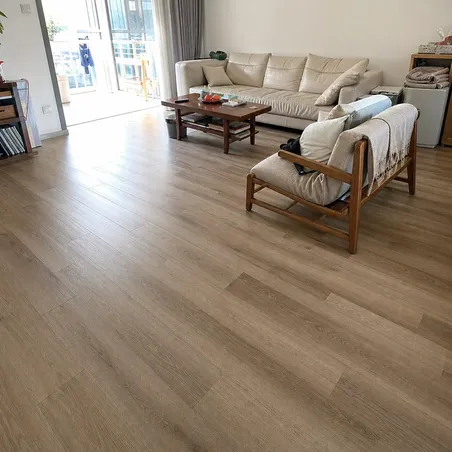 Volume Driver
Residential Renovation
Homeowners replacing carpet, laminate, or aging ceramic tile represent the largest single market for LVT globally. Your retail and contractor customers in this segment want wood-look and tile-effect décors in mid-range wear layers (0.3–0.5mm), click-lock installation for DIY-friendly positioning, and price points that undercut engineered hardwood by 30–40%.
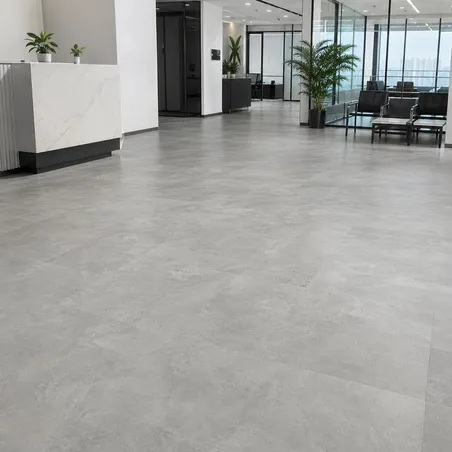 Project-Based
Commercial Office & Retail
Property managers and fit-out contractors specify 0.5mm+ wear layers, fire ratings, and slip resistance documentation. The buying cycle is project-based — larger orders, longer lead times, but higher per-square-meter margins. Tile-effect and geometric LVT perform particularly well in commercial lobbies and retail environments where the floor is part of the brand experience.
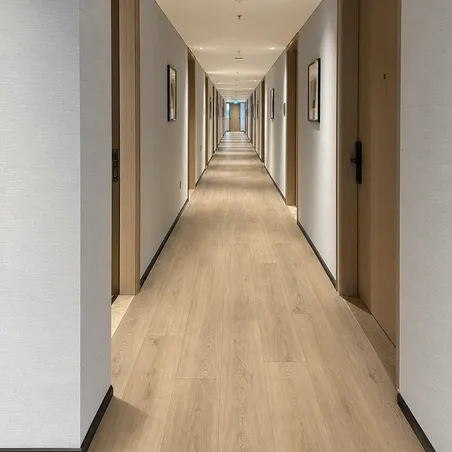 Spec-Driven
Hospitality — Hotels, Restaurants, Serviced Apartments
Interior designers spec LVT because they can get the exact wood species or stone visual they want without the maintenance burden of natural materials. For your business, hospitality projects mean specification-driven sales with less price sensitivity and strong potential for repeat orders across property portfolios.
 Growing Segment
Multi-Family & Rental Housing
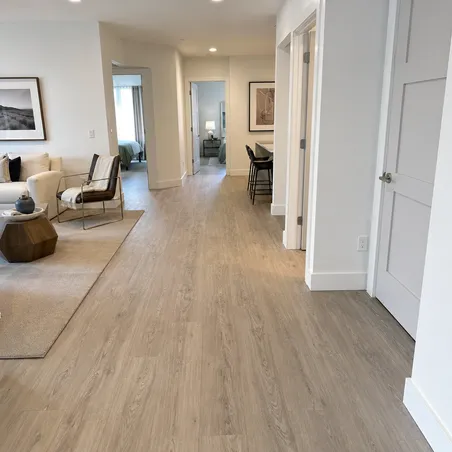
Property developers need durable, attractive flooring at scale. They buy on landed cost per unit, want consistent availability across large projects, and value the speed of click-lock installation over glue-down. Our 12 million sqm annual capacity means we can supply multi-phase development projects without production gaps between phases.
 Compliance-Led
Healthcare & Education
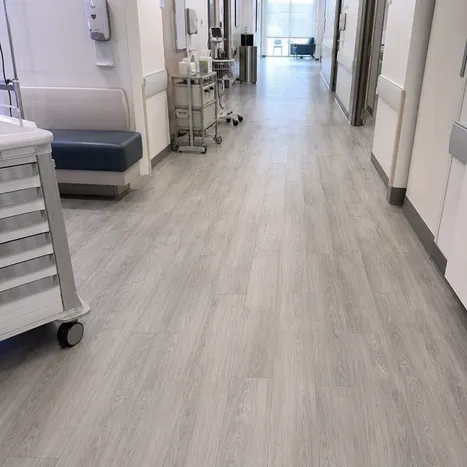
These segments require specific compliance documentation — FloorScore for indoor air quality, slip resistance certifications, and in some markets, antimicrobial surface treatments. Longer sales cycles, but high loyalty once you're specified into a facility standard.
High loyalty once specified into a facility standard. Longer initial sales cycle is offset by predictable, recurring procurement.
OEM and ODM — Your Brand, Our Production Floor
We manufacture LVT under your brand. That's the core of our business model, and it's how most of our distribution partners work with us.
OEM
Select from our existing LVT collections — décors, specs, formats already in production — and we package them under your brand with your carton design, your care instructions, your UPC codes.
You're choosing from proven products, so sample approval is straightforward and production lead times are shorter.
Carton design, care instructions, UPC codes — all customised to your brand identity.
Most distributors launching a new LVT line start here — lower risk, faster revenue.
ODM
You bring us a concept — a specific wood species visual, a custom colorway, a plank dimension that doesn't exist in our standard range — and our R&D team develops it from scratch.
Décor film sourcing, EIR texture plate development, wear layer and core specification, packaging design — all handled in-house.
Custom print development available. Sample lead time within 7 days from design confirmation for existing décor films or close variants.
Custom-developed patterns can be locked to your brand. Your investment in décor development stays yours — competitors can't source the same visual.
Custom Décor Development
Custom décor development is where many of our long-term partnerships started. You identify a gap in your market — maybe your competitors all carry the same three oak colorways and you want something distinct — and we develop exclusive décors that your competitors can't source.
Exclusivity agreements are available on custom-developed patterns, so your investment in décor development stays yours.

Flexible MOQ — Starting at 1,000 sqm per SKU
For standard collections. For custom ODM projects, MOQs depend on the complexity of the development, but we work to keep them reasonable — we'd rather help you test a new product in your market than price you out of trying.
Ready to discuss your OEM/ODM project?
Whether you're launching a new LVT line under OEM or developing an exclusive décor under ODM, our team can walk you through options, timelines, and MOQs specific to your market.
Choosing the Right LVT Spec for Your Market
Not all LVT is interchangeable. The wrong spec for your target market either costs you margin or costs you warranty claims. Here's how we guide our distribution partners through the selection.
Wear Layer Is the First Decision
Determines performance tier, warranty length, and price positioning
Click-Lock vs. Dry-Back Depends on Your Sales Channel
Installation method drives channel preference — not product quality
We produce both. Many distributors carry parallel SKUs in the same décor — click-lock for retail, dry-back for commercial.
Thickness and Attached Pad Affect Your Freight Economics
Profile choice has a direct impact on landed cost per square meter
The right profile depends on whether your market competes on landed cost or on perceived quality. Both are valid strategies — they just require different SKU decisions.
Décor Selection Should Match Your Regional Market
We've shipped LVT to 30+ countries — décor preferences vary more than you'd expect
Our sales team can share current décor trend data for your specific market. It's worth a conversation before you commit to a 10-SKU collection.

What Goes Wrong with LVT — and How We Prevent It
We've been manufacturing vinyl flooring since 2012. In that time, we've seen every failure mode the category produces — and we've engineered our process to prevent the ones that generate warranty claims for our buyers.
Curling and Edge Lift
Most common complaint in thin LVT, especially dry-back products installed over radiant heat or in rooms with large temperature swings. Dimensional instability in the core — the vinyl substrate expands and contracts unevenly, and edges lose adhesion or curl upward.
We control the plasticizer ratio in the core formulation to optimize flexibility without sacrificing dimensional stability. Every batch runs through a heat-cycling test — 6 hours at 60°C, then ambient cooling. If a formulation shows more than 0.1% linear change, we adjust before it reaches your container.
Print Delamination
The décor film separating from the core. Happens when hot-press bonding temperature or pressure is off, or when the primer coat between core and film is insufficient. Some manufacturers skip the primer to save cost.
We monitor press temperature and dwell time continuously on every line, and we apply a dedicated primer layer before the décor film lamination step. We tried skipping the primer in 2014. The delamination claims that came back six months later cost more than a decade of primer would have.
Wear Layer Inconsistency
Shows up as uneven gloss or premature scratching in specific areas of the plank. Happens when the wear layer calender doesn't maintain uniform thickness across the full width.
Inline thickness gauges measure the wear layer at multiple points across the plank. The line auto-corrects if variation exceeds ±0.02 mm. The result: consistent scratch resistance across every plank in your order, which means consistent performance across every installation your customers do.
Click-Lock Failure
Planks that won't engage properly or disengage after installation. Almost always a profiling tolerance issue. Outsourced profiling shops often run looser tolerances because they're optimizing for throughput, not for your return rate.
We mill click profiles in-house on CNC machines with ±0.05 mm tolerance, and we pull samples from every production run for engagement strength testing. In-house profiling means we control the tolerance — not a third-party shop optimizing for throughput.
Manufacturing since 2012 — every failure mode is a lesson we've already paid for
The controls above aren't theoretical. They're the direct result of warranty claims, customer feedback, and production failures we've worked through over more than a decade. When you source from Elefloor, you're buying into a process that has already absorbed those costs — so your buyers don't have to.
Dual-Origin Production — Changzhou and Rayong
We operate two LVT production facilities: 15,000 sqm in Changzhou, China (5 calender lines) and 7,000 sqm in Rayong, Thailand (3 calender lines). Same equipment suppliers, same raw material specifications, same QC protocols. Your product is identical regardless of which plant produces it.
Changzhou, China
Primary facility — Shanghai port
Ships through Shanghai — more efficient for North America and Europe. ISO 9001:2015 certified. Same 4-stage QC process as Rayong.
Rayong, Thailand
Secondary facility — Laem Chabang port
Ships through Laem Chabang — shorter transit to Oceania, Southeast Asia, and parts of the Middle East. ISO 9001:2015 certified. Identical QC protocols to Changzhou.

Why Two Factories?
The reason for two factories is straightforward: tariff exposure. If your market imposes anti-dumping duties on Chinese-origin vinyl flooring, Thai origin changes your landed cost equation.
4-Stage QC Process — Both Facilities
North America & Europe
Route through Changzhou → Shanghai for optimized freight cost and transit time.
Oceania & Southeast Asia
Route through Rayong → Laem Chabang for shorter transit and lower freight cost.
Tariff-Sensitive Markets
Your order routes through whichever facility optimizes your landed cost and delivery timeline.
Certifications That Pre-Qualify Your Product
Our LVT flooring carries the certifications your market requires — tested and documented before your container ships, not scrambled for after it arrives.
FloorScore
Indoor Air QualitySCS Global Services certification meeting CDPH Section 01350 VOC emission thresholds. Required for LEED-contributing projects and increasingly expected by North American distributors as a baseline.
CE Marking
EU ConstructionConformity with EU construction product regulations, including EN 16511 testing for dimensional stability, residual indentation, and slip resistance.
REACH
EU Chemical SafetyEU chemical safety compliance, confirming restricted substance levels are below regulatory thresholds. Non-negotiable for European import.
SGS Testing
Third-Party VerifiedThird-party verification of physical performance, chemical composition, and safety standards. Test reports available per batch on request.
ISO 9001:2015
Both FacilitiesQuality management system certification covering both Changzhou and Rayong facilities.

Pre-Qualified for Commercial Bids
For your commercial project bids, these certifications mean your LVT is pre-qualified for specification. You submit the documentation with your tender, not after you've won the job and realized the product doesn't have the paperwork.
We keep current test reports organized by product line and batch. Your compliance team can request what they need and get it the same day.
Frequently Asked Questions About LVT Flooring
Answers to the specification, sourcing, and installation questions we hear most from distributors and importers.
What wear layer thickness should I specify for commercial LVT projects?
For standard commercial environments — offices, retail, light hospitality — 0.5mm wear layer meets EN ISO 10582 Class 34 requirements and supports a 10–15 year commercial warranty.
For heavy-traffic applications like hotel corridors, airports, or healthcare facilities, specify 0.7mm. We don't recommend 0.3mm for any commercial application — the warranty exposure isn't worth the per-square-meter savings.
How does LVT compare to SPC for my product catalog?
They serve different price points and performance profiles. Most of our distributors carry both: SPC as the premium line, LVT as the volume line. We produce both on the same factory floor, so you consolidate supply chain and logistics.
- Rigid stone-polymer core
- Superior dimensional stability
- Better over uneven subfloors
- Temperature-variable environments
- Flexible vinyl core
- Thinner profiles available
- Lower per-sqm cost
- Entry-level & mid-range positioning
What is the MOQ for custom-décor LVT orders?
Standard collections start at 1,000 sqm per SKU. For custom ODM projects — new décor films, custom dimensions, or exclusive patterns — MOQ depends on the development scope, but we typically work within 2,000–3,000 sqm per SKU for initial orders.
We'd rather help you test a new product at reasonable volume than set a barrier that prevents you from trying.
Can LVT be installed over radiant heating systems?
Yes, with the right specification. We recommend click-lock LVT with a maximum surface temperature of 28°C (82°F) and a minimum 0.3mm wear layer. Our core formulations are tested for dimensional stability under sustained heat — we run thermal cycling tests at 60°C to verify performance before production approval.
- Maximum surface temperature: 28°C (82°F)
- Gradual temperature ramping — no more than 5°C per day when first activating
- Maintain consistent humidity levels throughout
- Use click-lock format, minimum 0.3mm wear layer
What causes LVT to develop gaps between planks after installation?
Almost always one of three things. Our click-lock profiles are engineered for tight engagement that resists separation under normal conditions, but no click system can overcome a fundamentally unsuitable installation environment.
We include detailed installation guidelines with every shipment — written to prevent the callbacks that cost your contractor customers time and reputation.
How many square meters of LVT fit in a 20GP container?
It depends on thickness and format. We optimize carton dimensions and pallet configurations for maximum container utilization — our logistics team provides exact loading plans with every quotation so you can calculate your landed cost accurately before committing.
Most partnerships start the same way — samples first, volume when you're ready.
You tell us your target market, your price positioning, and the décor direction you're interested in. We send samples within 7 days — actual production samples, not marketing mock-ups — so you can evaluate print quality, surface texture, click engagement, and overall build quality against whatever you're currently sourcing.
If the samples work, we move to a trial order. With MOQs starting at 1,000 sqm per SKU, you can test a new LVT line in your market without overcommitting warehouse space or capital. Once you've validated sell-through, scaling up is straightforward — 8 calender lines and 12 million sqm of annual capacity mean your reorders don't wait.
Send us your target specs, volume expectations, and destination market. We'll come back with a detailed proposal, pricing, and a sample timeline.
