

LVT Kitchen & Bathroom Flooring
LVT flooring built specifically for kitchens, bathrooms, and commercial wet areas — not general-purpose LVT with a waterproof label added after the fact.
Tighter click-lock tolerances, R10+ slip-rated surfaces, and décor selections curated for the spaces where moisture performance is non-negotiable. Manufactured on our own lines in Changzhou and Rayong.

What Makes This a Wet-Area LVT —
Not Just a Waterproof Claim
Most LVT on the market is technically waterproof — the vinyl core doesn't absorb water. That's table stakes. The problem in kitchens and bathrooms isn't the plank itself; it's the seams.
The Real Failure Mode: Seam Penetration, Not Plank Absorption
Water wicks between planks through click-lock gaps, gets under the floor, and creates mold conditions or subfloor damage that generates callbacks for your contractor customers and warranty claims for your distribution business. A waterproof core label doesn't address this — seam engineering does.
Three Engineering Changes That Separate This From Standard LVT
1. Tighter Click-Lock Milling Tolerance
We tighten the click-lock milling tolerance to ±0.03mm versus ±0.05mm on our standard lines. This produces a measurably tighter seam that resists moisture penetration under standing water conditions.
Verification method: Every production run undergoes a 24-hour water column test on assembled panels — water sits on the joined seams for a full day, then we check for any sub-surface penetration.
2. Sealed Micro-Bevel Edge Profile
We apply a micro-bevel edge profile with a sealed UV coating that wraps into the bevel channel, eliminating the exposed core edge that's the typical entry point for moisture. This seals the one area standard LVT leaves vulnerable.
3. Engineered Slip-Resistance Surface Texture
Not just a rougher finish — a controlled micro-texture pattern that achieves R10 to R11 ratings under DIN 51130 testing while still being comfortable underfoot and easy to clean. The ceramic bead enhancement in the UV coating maintains slip performance over the product's service life.

Why This Matters for Your Business
These aren't just spec differences — they're the features that let you sell LVT into wet-area projects with confidence, back it with a meaningful warranty, and avoid the moisture-related claims that erode margin on standard LVT sold into the wrong application.
- Sell into wet-area projects with documented performance backing
- Reduce moisture-related warranty claims and contractor callbacks
- Differentiate your LVT offering with verifiable engineering specs
Technical Specifications for Kitchen and Bathroom LVT
Specifications shown are standard production values for this product line. Actual specifications may vary by SKU and order configuration.
| Parameter | Specification | Notes |
|---|---|---|
| Overall thickness | 4.0mm – 5.0mm (click-lock with pad) | Thicker profiles for dimensional stability in temperature-variable wet areas |
| Wear layer | 0.3mm – 0.55mm | 0.3mm for residential bath/kitchen; 0.55mm for commercial wet areas |
| Core type | Flexible PVC with enhanced plasticizer formulation | Optimized for dimensional stability under humidity cycling |
| Click-lock tolerance | ±0.03mm | Tighter than standard LVT (±0.05mm) for moisture seam resistance |
| Slip resistance | R10–R11 (DIN 51130) | R10 standard; R11 available for commercial kitchen applications |
| Plank dimensions | 152×914mm – 228×1220mm | Standard plank formats; custom dimensions available on ODM orders |
| Tile dimensions | 305×305mm – 457×457mm | Square formats for bathroom installations |
| Surface treatment | Micro-textured UV with ceramic bead enhancement | Slip-rated surface that maintains cleanability |
| Attached underlayment | IXPE 1.0–1.5mm pre-attached | Provides moisture barrier and sound dampening |
| Fire rating | Bfl-s1 (EN 13501-1) | Standard for commercial applications in European markets |
| VOC emissions | FloorScore Certified (CDPH Section 01350) | Required for LEED-contributing projects |
| Installation method | Click-lock (primary); dry-back available | Click-lock recommended for wet areas due to sealed seam performance |
| Dimensional stability | ≤0.15% (EN 434) | After 6h at 80°C; tested under accelerated heat cycling |
* Highlighted rows indicate specifications that exceed standard LVT industry minimums and are specific to wet-area performance. All values are nominal production targets; confirm exact values on product data sheets for your SKU.
Certifications & Compliance
How This LVT Is Engineered for Wet-Area Performance
Standard LVT fails in kitchens and bathrooms for predictable reasons. Each engineering decision below addresses a specific failure mode.
Tighter Click-Lock Tolerance
Failure mode: Water infiltrates seams when click-lock profiles have standard ±0.05mm tolerance, causing subfloor damage and plank lifting.
Engineering response: ±0.03mm tolerance on locking profile dimensions. Tighter die control during extrusion produces a seam that resists lateral water migration under normal wet-area splash conditions.
Flexible Core Formulation
Failure mode: Rigid cores (SPC) expand and contract with temperature swings common in kitchens, stressing locking joints and opening seams over time.
Engineering response: Enhanced plasticizer formulation in the flexible PVC core absorbs dimensional movement without transmitting stress to the locking profile, maintaining seam integrity through humidity and temperature cycling.
Micro-Textured UV Coating
Failure mode: Smooth LVT surfaces become dangerously slippery when wet, creating liability exposure in commercial kitchens and residential bathrooms.
Engineering response: Ceramic bead-enhanced UV topcoat creates micro-texture that channels water away from the contact surface. Achieves R10–R11 DIN 51130 rating without sacrificing cleanability.
Pre-Attached IXPE Underlayment
Failure mode: Separate underlayment in wet areas can trap moisture between layers, promoting mold growth and adhesive failure.
Engineering response: Factory-bonded IXPE (1.0–1.5mm) eliminates the separate underlayment layer. Closed-cell structure resists moisture absorption while providing acoustic dampening and minor subfloor irregularity compensation.
Accelerated Stability Testing
Failure mode: Products that pass standard dimensional stability tests still fail in real wet-area conditions because standard tests don't replicate kitchen/bathroom thermal cycling.
Engineering response: EN 434 testing at 80°C for 6 hours with ≤0.15% dimensional change target. Accelerated protocol simulates years of kitchen heat exposure in a compressed test window.
Application-Matched Wear Layer
Failure mode: Specifying a single wear layer thickness across residential and commercial wet areas leads to premature wear in high-traffic commercial kitchens or over-engineering cost in residential baths.
Engineering response: 0.3mm wear layer for residential kitchen and bathroom applications; 0.55mm for commercial wet areas. Allows buyers to match cost to application without compromising performance.
Why Flexible PVC, Not SPC, for Wet Areas
SPC (stone plastic composite) cores are marketed as waterproof, and the core itself is. But in kitchens and bathrooms, the failure point is rarely the core — it's the locking joint under thermal stress. SPC's rigidity means temperature-driven expansion and contraction is transmitted directly to the locking profile. Over time, this opens seams. Flexible PVC absorbs that movement, keeping joints tight.
- Rigid core transmits thermal stress to locking joints
- Seam gaps develop over repeated heat/cool cycles
- Higher risk of joint failure near heat sources (dishwashers, radiators)
- Core absorbs dimensional movement without joint stress
- Seam integrity maintained through humidity and temperature cycling
- Better performance near heat sources common in kitchen environments
Where This LVT Is Specified
Documented application categories with the specific performance requirements that make wet-area LVT the appropriate specification choice.
Residential Kitchen
High-frequency water exposure from sink splash, appliance condensation, and spills. Temperature cycling from dishwasher and oven proximity.
- Seam water resistance at sink perimeter
- Dimensional stability near heat sources
- R10 slip resistance minimum
Residential Bathroom
Sustained humidity from shower and bath use. Standing water risk at shower exit. Subfloor moisture from below-grade installations.
- 100% waterproof core and seam performance
- Humidity cycling stability
- Slip resistance at shower exit zone
Commercial Kitchen
Continuous wet-area exposure, floor wash-down protocols, and heavy rolling load traffic. Regulatory slip resistance requirements in most jurisdictions.
- R11 slip resistance for wash-down areas
- 0.55mm wear layer for heavy traffic
- Chemical resistance to cleaning agents
Hotel & Hospitality Bathroom
High-turnover wet-area use with daily cleaning cycles. Aesthetic requirements for wood-look or stone-look finishes in premium properties.
- Durability under daily cleaning protocols
- Aesthetic range for design specifications
- Bfl-s1 fire rating for commercial compliance
Laundry & Utility Room
Appliance leak risk, high humidity from dryer operation, and subfloor moisture in below-grade utility spaces. Often overlooked in standard LVT specifications.
- Subfloor moisture tolerance
- Seam integrity under appliance vibration
- Leak containment without subfloor damage
Healthcare & Wet Clinical
Wet clinical zones, patient bathrooms, and sluice rooms require hygienic seam performance and resistance to hospital-grade disinfectants.
- Hygienic seam performance, no moisture ingress
- Chemical resistance to disinfectant protocols
- R10–R11 slip resistance for clinical safety
This LVT is not specified for full wet-room shower floors with continuous standing water, swimming pool surrounds, or exterior applications. These environments require tile or specialist wet-room sheet vinyl with fully bonded perimeter sealing.
Wet-Area Installation Requirements
Correct installation practice is as critical as product selection. These requirements apply specifically to wet-area and high-humidity environments.
Subfloor Preparation
- Test subfloor moisture using calcium chloride or RH probe. Maximum 75% RH or 5 lbs/1000 sq ft/24hr for floating installation.
- Level subfloor to within 3mm over 1.8m. High spots cause locking joint stress; low spots cause flex and joint fatigue.
- Remove all existing adhesive residue, wax, and contaminants that could affect bond or create high spots.
- In below-grade installations, apply DPM (damp-proof membrane) if subfloor RH exceeds product threshold.
Acclimatisation
- Store planks flat in the installation room for a minimum of 48 hours at 18–27°C and 25–70% RH before installation.
- Do not acclimatise in unheated spaces or directly on cold concrete. Temperature differential causes pre-installation dimensional change.
- In wet areas, ensure the room is at operational humidity levels during acclimatisation, not construction-phase humidity.
Expansion Gaps & Perimeter Sealing
- Maintain minimum 8–10mm expansion gap at all fixed perimeters: walls, door frames, pipes, and cabinetry.
- In wet areas, seal the perimeter gap with a flexible, waterproof silicone sealant after installation. This prevents water ingress at the wall-floor junction.
- Do not use rigid caulk or grout at perimeter. These crack under thermal movement and defeat the purpose of the expansion gap.
- Install T-mouldings or transition strips at doorways and room breaks exceeding 8m in any direction.
Underlay in Wet Areas
- Use only closed-cell foam or moisture-barrier underlay in wet areas. Open-cell foam retains moisture and promotes mould growth beneath the floor.
- Many wet-area LVT products include a pre-attached underlay. Do not add additional underlay unless the manufacturer explicitly permits it — excessive cushioning causes locking joint stress.
- Tape underlay seams with moisture-resistant tape to prevent moisture migration between sheets.
Pre-Installation Wet-Area Checklist
Wet-Area Market Segments Worth Building Inventory For
Every LVT product page on a competitor's site says "suitable for kitchens and bathrooms." The question for your business isn't whether the product works in wet areas — it's which wet-area market segments generate profitable, repeatable orders.

Residential Renovation — Kitchens and Bathrooms
Kitchen and bathroom renovations account for the highest per-project spend in residential remodeling, and flooring is specified on nearly every job. Your contractor and retail customers need a floor that handles splashes, spills, and standing water around tubs and sinks without the installation complexity of ceramic tile. LVT kitchen flooring in click-lock format installs in a fraction of the time, requires no grout, and costs less per square meter installed — which means your contractor customers complete more jobs per month and your retail customers get a product they can confidently recommend for the room where flooring failures are most visible.
Renovation contractors buy 50–200 sqm per project, reordering monthly across their active job pipeline. Retailers stock 3–5 décor options in the kitchen/bath category and reorder based on sell-through. This is steady, predictable volume.

Commercial Washrooms and Restrooms
Office buildings, hotels, restaurants, retail stores — every commercial property has washrooms, and they all need flooring that handles constant moisture, heavy foot traffic, and frequent cleaning with commercial-grade chemicals. LVT bathroom flooring with 0.55mm wear layer and R10+ slip rating meets the specification requirements for commercial washroom projects.
Commercial washroom flooring is a specification-driven sale: once you're written into a property management company's approved materials list, you supply every renovation and new build across their portfolio.

Hospitality Wet Areas — Hotel Bathrooms and Spa Facilities
Hotel bathroom renovations happen on a rolling cycle — properties refresh rooms every 5–8 years, and bathroom flooring is replaced on nearly every refresh. Interior designers spec LVT for hotel bathrooms because it delivers the stone or wood visual they want without the cold feel, grout maintenance, or cracking risk of ceramic.
Project-based orders of 500–2,000 sqm per property, with repeat business across hotel chains and management groups. Slip resistance documentation (R10/R11 test reports) is typically required at the specification stage — we provide these with every quotation so you can submit complete tender packages.

Commercial Kitchen Flooring
Restaurant kitchens, institutional food service, catering facilities — these are high-abuse environments where the floor faces grease, water, thermal shock from hot spills, and rolling cart traffic daily. Commercial kitchen LVT with R11 slip rating and 0.55mm wear layer handles these conditions while being faster and cheaper to install than quarry tile or epoxy coatings.
Shorter replacement cycle in commercial kitchens (3–5 years in high-volume restaurants) means recurring reorder volume. Distributors who build dedicated food-service flooring programs around this segment find the reorder frequency makes it worth the focused sales effort.
Multi-Unit Residential — Apartments and Student Housing
Property developers building or renovating apartment complexes and student housing need a single flooring product that works in kitchens, bathrooms, and living areas without transitions. Wet-area LVT installed throughout the unit simplifies their procurement (one SKU instead of three), reduces installation labor (no material transitions at doorways), and eliminates the ceramic tile cracking that generates maintenance calls.

Tell us which segment you're targeting — we'll match you with the right product spec and documentation package.
How We Build LVT Differently for Wet Areas
The general LVT construction process covers our calender lines, décor film lamination, UV coating, and click-lock milling. Here, we focus on what changes when we're producing specifically for kitchen and bathroom applications.
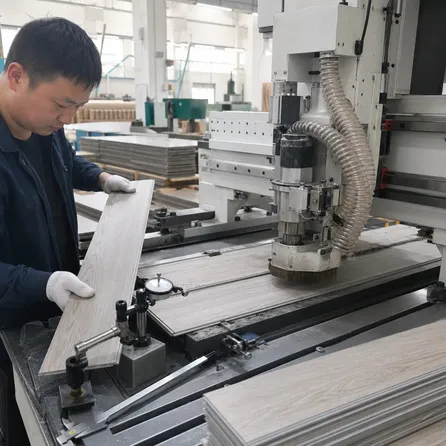
Click-Lock Profile Tolerance
On our standard LVT lines, we mill click profiles at ±0.05mm tolerance — tight enough for living rooms and bedrooms where occasional spills are wiped up quickly. For the kitchen and bathroom line, we run the CNC profiling machines at ±0.03mm, which requires slower feed rates and more frequent tool changes.
The tighter tolerance produces a click joint that engages with noticeably more resistance — installers feel the difference — and creates a seam that resists moisture wicking under prolonged water exposure.
Every batch undergoes the 24-hour water column test: six assembled panels, water pooled on the seams, inspected for any sub-surface penetration after 24 hours. If a batch fails, we re-profile before it ships.
The slower milling speed costs us about 12% more production time per square meter on this line. We absorb that because the alternative — loose tolerances leading to moisture claims in wet installations — costs everyone more.
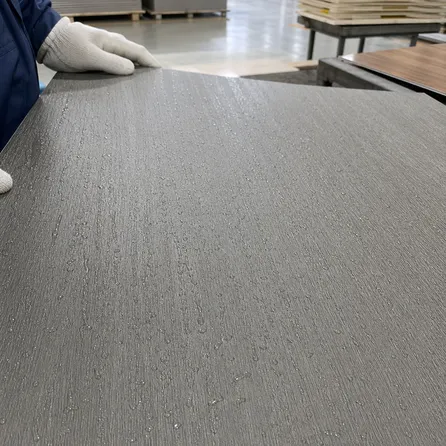
Surface Texture Engineering
Standard LVT surfaces are designed primarily for visual appeal — the texture matches the décor pattern. On our wet-area line, we use texture plates engineered for slip resistance first, visual appeal second.
The micro-texture pattern creates channels that displace water film under foot pressure, achieving R10–R11 ratings without making the surface feel abrasive or difficult to mop.
We test slip resistance on every texture plate before it enters production, using the ramp test method per DIN 51130 with a calibrated oil-wet surface.
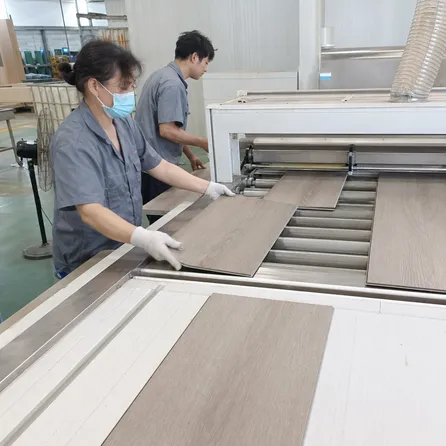
UV Coating and Sealed Bevel
We apply an additional coat on the wet-area line — typically 8–9 coats versus 6–7 on standard LVT — with the final coat wrapping into the micro-bevel edge.
This sealed bevel is critical: on standard LVT, the bevel cut exposes raw core material at the plank edge, which is the first point of moisture entry. Sealing it adds a production step but eliminates the most common moisture ingress pathway.
Final coat wraps into micro-bevel edge, sealing the most common moisture ingress point.
Three Production Changes. One Consistent Goal.
Tighter click tolerances, slip-resistance-first surface engineering, and additional UV coating with sealed bevel edges — each change addresses a specific failure mode in wet-area installations. Together they produce a plank that performs differently from standard LVT in the environments where flooring failures are most visible and most costly.
What Changes When You Install in a Kitchen or Bathroom
The plank is engineered for wet areas. The installation still needs to be. Here are the points where kitchen and bathroom installs diverge from standard LVT practice — and why each one matters.
Subfloor Flatness and Moisture Testing
LVT is unforgiving of subfloor irregularities because it conforms rather than bridges. The standard tolerance is 3mm over 1.8m — any high spots or dips beyond that will telegraph through the plank and stress the click joints over time. In wet areas, stressed joints are moisture pathways.
For concrete subfloors, test moisture content before installation. We recommend a maximum of 75% relative humidity using the in-situ probe method (ASTM F2170). Calcium chloride tests are acceptable but less reliable for thick slabs. If moisture is elevated, a moisture mitigation membrane is required — not optional.
- Concrete (cured minimum 60 days)
- Plywood (min. 18mm, fastened at 150mm centres)
- Existing ceramic tile (flat, fully bonded)
- Existing LVT (single layer, no cushion backing)
- OSB or particleboard (moisture-sensitive)
- Existing vinyl with cushion or foam backing
- Subfloors with active moisture issues
- Radiant heat above 27°C surface temperature
Expansion Gaps and Perimeter Sealing
LVT expands and contracts with temperature. In kitchens and bathrooms, temperature swings are more pronounced — ovens, dishwashers, and hot showers all affect the ambient temperature of the room. We specify a minimum 8mm expansion gap at all fixed vertical surfaces: walls, cabinets, door frames, and pipe penetrations.
The gap itself is not the moisture risk — the transition between the flooring and the wall or cabinet base is. We recommend filling the expansion gap with a sanitary-grade silicone sealant (not standard caulk) before fitting skirting boards or trim. This prevents water from running under the floor at the perimeter, which is the second most common moisture ingress point after the click joints.
Common Installer Mistake
Skipping the silicone at the perimeter because "the skirting covers it." The skirting is decorative, not waterproof. Water from mopping, dishwasher leaks, or splashing runs along the wall base and finds the gap. Silicone takes five minutes per room and prevents the most common wet-area warranty claim we see.
Pipe Penetrations and Appliance Cutouts
Every pipe penetration — toilet base, sink supply lines, dishwasher drain — is a potential moisture entry point. Cut the hole 10–12mm larger than the pipe diameter to allow for expansion, then seal the annular gap with sanitary silicone before fitting the escutcheon plate.
For toilet flanges, the flooring should run under the toilet base, not butt up to it. This is a common shortcut that creates a visible gap over time as the floor moves and the toilet does not.
Run flooring under base. Seal flange gap with silicone. Do not butt flooring to toilet.
10–12mm oversize hole. Silicone annular gap. Escutcheon plate over sealed gap.
Flooring runs under appliance. Leave 8mm gap at cabinet sides. Seal perimeter.
Transition Strips at Doorways
Where the kitchen or bathroom floor meets an adjacent room, a transition strip is required — not just for aesthetics, but to allow independent movement of each floor section. Without a transition, the two floors act as a single connected field, and thermal expansion in the wet area transfers stress into the adjacent room's flooring.
Use a T-moulding or reducer strip depending on whether the adjacent floor is the same height or lower. The transition channel should be mechanically fixed to the subfloor, not glued to the flooring surface, so both floors can move independently beneath it.
In open-plan layouts where the kitchen flows into a living area without a door, install a transition strip at the boundary anyway. The kitchen zone experiences more temperature variation than the living zone, and the strip gives each section room to move without stressing the other.
Installation Checklist for Wet-Area LVT
We put together a one-page checklist covering subfloor prep, moisture testing, gap requirements, and sealing steps. It's what our technical team walks through on site visits — available to download with any sample order.
Full Technical Specifications
Numbers your procurement team, architect, or contractor can use directly. All figures are verified against production batches, not marketing estimates.
Physical Dimensions
| Plank Length | 1220mm / 1524mm |
| Plank Width | 180mm / 228mm |
| Total Thickness | 5.0mm / 6.0mm / 8.0mm |
| Wear Layer | 0.5mm (20 mil) residential / 0.7mm (28 mil) commercial |
| Core Type | SPC (Stone Plastic Composite) |
| Bevel Profile | Micro-bevel, UV-sealed on all four edges |
| Click System | Uniclic® compatible, ±0.03mm tolerance |
| Weight | ~4.2 kg/m² (6mm) |
Performance Ratings
| Slip Resistance | R10–R11 (DIN 51130) |
| Water Resistance | 100% waterproof core; 24hr water column seam test |
| Abrasion Class | AC4 (heavy residential / light commercial) |
| Indentation (EN 433) | Residual ≤ 0.1mm |
| Dimensional Stability | ≤ 0.25% change (EN ISO 23999) |
| Radiant Heat Compatible | Yes, max 27°C surface temperature |
| UV Coating Layers | 8–9 coats (vs. 6–7 standard) |
| Formaldehyde Emission | CARB2 / E0 compliant |
Installation Parameters
| Installation Method | Floating (click-lock); glue-down available on request |
| Expansion Gap | Minimum 8mm at all fixed vertical surfaces |
| Subfloor Flatness | Max 3mm deviation over 1.8m |
| Subfloor Moisture (RH) | Max 75% (ASTM F2170 in-situ probe) |
| Acclimation | 48 hours at installation temperature (15–27°C) |
| Max Room Size (floating) | 20m in any direction without expansion joint |
| Underlay Required | Pre-attached IXPE; no additional underlay needed |
Certifications and Compliance
| European Standard | EN ISO 10582 (heterogeneous PVC floor coverings) |
| Slip Resistance Standard | DIN 51130 (ramp test, oil-wet) |
| Formaldehyde | CARB Phase 2 / E0 (≤ 0.05 ppm) |
| Phthalate-Free | DEHP, DBP, BBP, DINP — all below detection limit |
| Heavy Metals | RoHS compliant; lead and cadmium-free |
| Fire Classification | Bfl-s1 (EN 13501-1) |
| Test Reports | Available on request with sample order |
Need the full spec sheet as a PDF?
Includes all tables above plus cross-section diagrams, packaging data, and third-party test report references. Sent with any sample request.
Where This Product Performs
Wet-area LVT is specified across a wide range of project types. Below are the environments where it consistently outperforms alternatives — and the specific reasons buyers choose it for each.
Residential Bathrooms
The most common application. SPC core eliminates the subfloor moisture risk that causes tile grout failure and laminate swelling. Warm underfoot compared to ceramic, and far easier to replace a single plank than re-tile.
- Suitable over existing tile without height issues (5mm profile)
- R10 slip rating meets residential building codes
- Compatible with electric underfloor heating mats
Hotel Bathrooms & En-Suites
Hospitality buyers specify this product for refurbishment programmes where speed of installation and durability under daily housekeeping traffic are the primary constraints. The 0.7mm commercial wear layer handles trolley and cleaning equipment contact.
- AC4 abrasion class rated for light commercial use
- Consistent batch colour for multi-room projects
- Floating install reduces room downtime vs. adhesive methods
Kitchens
Spill resistance and comfort underfoot make LVT a practical kitchen choice. The sealed micro-bevel prevents liquid ingress at joints — the failure point on standard click LVT in high-splash zones.
- UV-sealed edges resist cooking oil and cleaning chemicals
- Runs continuously from kitchen into open-plan living areas
- Indentation resistance handles appliance feet and chair legs
Gyms & Changing Rooms
Changing rooms and wet-side gym areas combine high foot traffic with persistent moisture. The R11 slip rating and 100% waterproof core address both. Phthalate-free formulation is relevant for facilities with health and wellness positioning.
- R11 rating exceeds minimum requirement for wet barefoot areas
- Resistant to chlorine-based cleaning agents
- IXPE underlay provides cushioning for standing fatigue
Care Homes & Healthcare
Specifiers in this sector prioritise slip resistance, chemical resistance, and low VOC emissions. The E0 formaldehyde rating and phthalate-free composition support indoor air quality requirements common in care and clinical environments.
- E0 / CARB2 emission compliance for sensitive occupants
- Smooth surface supports wheelchair and mobility aid movement
- Test reports available for procurement documentation
Student & Multi-Unit Residential
Developers and fit-out contractors running multi-unit programmes need consistent supply, predictable installation times, and a product that holds up through tenant turnover. Bulk pricing and batch consistency are the key commercial factors here.
- MOQ from 500m² with fixed batch colour matching
- Click-lock system reduces skilled labour requirement
- Individual plank replacement without full floor removal
Not sure if this product fits your project? Send us the room type, expected foot traffic, and any existing subfloor conditions. Our technical team will confirm suitability and recommend the right thickness and wear layer grade before you commit to a sample order.
Customization for Your Wet-Area LVT Program
Every parameter below is adjustable. Standard ranges ship from existing tooling with no MOQ penalty. ODM ranges require dedicated production runs — the table below shows exactly where the thresholds are.
Décor Options
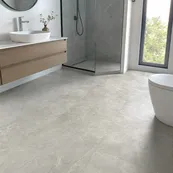
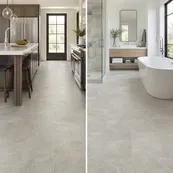
We curate the décor selection for this line around what actually sells in kitchen and bathroom applications. Light oak and grey wood tones dominate residential kitchen flooring. Marble and concrete visuals lead in bathrooms. Neutral stone-look patterns perform well across both spaces.
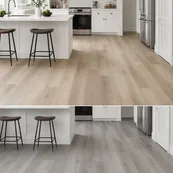
Light Oak & Grey Wood
Kitchen-dominant
Marble & Concrete
Bathroom-dominant
Neutral Stone-Look
Both spaces
Active Production Library
15–20 active décors in continuous production for this line. Full library of 200+ patterns available for ODM orders.
Private Label and Packaging
Full OEM packaging — your brand, your carton design, your installation instructions, your UPC codes. We produce retail-ready cartons configured for your warehouse racking and pallet specifications.
Retail-Ready Cartons
Configured for your warehouse racking and pallet specifications. Standard collections start at 1,000 sqm per SKU.
FBA-Compliant E-Commerce Packaging
For Amazon and similar platforms, carton construction is built to survive individual parcel shipping — not just palletized container freight. Mention this upfront when you enquire.
Sample Lead Time
Within 7 days from confirmation.
Specification Customization
| Customizable Parameter | Standard Range | Custom Range (ODM) | Impact on MOQ |
|---|---|---|---|
| Wear layer thickness | 0.3mm, 0.55mm | 0.2mm – 0.7mm | No change for standard; custom adds 500 sqm to MOQ |
| Overall thickness | 4.0mm, 4.5mm, 5.0mm | 3.5mm – 6.0mm | Custom thickness: 2,000 sqm MOQ |
| Plank dimensions | 3 standard sizes | Custom within 150–230mm width | Custom dimensions: 2,000 sqm MOQ |
| Slip resistance grade | R10 | R11 | No MOQ change — texture plate swap |
| Attached pad | IXPE 1.0mm | IXPE or EVA, 1.0–1.5mm | No MOQ change |
| Surface finish | Micro-textured matte | Semi-gloss, crystal (reduced slip rating) | No MOQ change |
Compliance Documentation That Closes Your Tenders
Wet-area flooring projects face stricter compliance scrutiny than general-purpose installations. Building codes, health regulations, and insurance requirements all apply more rigorously in spaces with water exposure. Our kitchen and bathroom LVT ships with the documentation you need to submit complete tender packages and clear import compliance without delays.
FloorScore (SCS Global Services)
VOC EmissionsVOC emissions below CDPH Section 01350 thresholds. Required for LEED-contributing projects and increasingly a baseline expectation from North American distributors. Test reports available per batch.
CE Marking (EN 16511)
EU ConstructionDimensional stability, residual indentation, slip resistance, and fire behavior tested per EU construction product regulations.
REACH Compliance
EU ImportRestricted substance levels confirmed below EU regulatory thresholds. Non-negotiable for European import.
Slip Resistance Test Reports (DIN 51130)
R10 & R11R10 and R11 ratings documented per SKU. These are the reports your commercial project customers need at the specification stage.
SGS Third-Party Testing
Per BatchPhysical performance and chemical composition verification. Available per batch on request.

Market-Specific Requirements
For markets with specific requirements beyond these — ASTM F1700 for North American commercial specification, AS/NZS 4586 for Australian slip resistance, or local building code documentation — contact our compliance team to confirm availability.
- ASTM F1700 — North American commercial specification
- AS/NZS 4586 — Australian slip resistance
- Local building code documentation on request
Consistent Documentation Across Both Facilities
Both our Changzhou and Rayong facilities hold ISO 9001:2015 certification and run identical QC protocols, so your compliance documentation is consistent regardless of production origin.
We maintain current test reports organized by product line and batch, so your compliance requests get same-day responses.
Learn more about our manufacturing and QC processPackaging and Container Loading for Wet-Area LVT
Planning estimates based on standard carton configurations. Use these figures to calculate landed cost per square meter before committing — we provide detailed loading plans with every quotation.
| Format | Carton Size (typical) | Sqm per Carton | Cartons per 20GP | Sqm per 20GP | Cartons per 40HQ | Sqm per 40HQ |
|---|---|---|---|---|---|---|
| 4.0mm click-lock plank | 1220×230×140mm | ~2.2 sqm | ~550 | ~1,210 sqm | ~1,200 | ~2,640 sqm |
| 4.5mm click-lock plank | 1220×230×155mm | ~2.0 sqm | ~490 | ~980 sqm | ~1,070 | ~2,140 sqm |
| 5.0mm click-lock tile | 460×460×160mm | ~1.7 sqm | ~580 | ~986 sqm | ~1,260 | ~2,142 sqm |
Destination-Configured Packaging
North America
Retail-ready cartons with UPC barcodes. Configured for direct shelf placement and distributor racking systems.
Europe
Multilingual care instructions included. Carton dimensions matched to your racking systems for efficient warehouse handling.
Humid-Climate Destinations
Moisture barrier wrapping added — a lesson learned from early shipments to the Gulf region where cartons sat in non-climate-controlled port warehouses.
Dual-Origin Shipping

Rayong → Laem Chabang
Shorter transit to Oceania and Southeast Asia. Optimized for regional freight cost and delivery timeline.
Changzhou → Shanghai
Primary route for North America and Europe. Your order routes through whichever facility optimizes freight cost and delivery timeline.
Detailed Loading Plans With Every Quotation
Exact loading depends on your carton dimensions, pallet requirements, and destination port regulations. We provide detailed loading plans with every quotation so you can calculate landed cost per square meter before committing.
If This Line Doesn't Fit — Other LVT Options Under the Same Roof
Our kitchen and bathroom LVT is engineered for wet-area performance. If your project or product program needs something different, these sibling lines may be a better match — all produced on the same factory floor with the same QC standards.
Luxury LVT Flooring
0.5mm+ wear layer, EIR surfaces, and the widest formats in our range. Positioned against engineered hardwood for upscale residential and hospitality.
Wood-Look LVT Flooring
Oak, walnut, hickory, and ash in the full range of colorways. The volume workhorse for most distributors' LVT catalogs — general living spaces.
Tile-Effect LVT Flooring
Marble, travertine, slate, and concrete in square and large-format rectangular tiles. Stone and marble visuals for commercial lobbies and high-traffic areas.
Geometric LVT Flooring
Hexagons, chevrons, herringbone-ready planks. Higher margin per square meter on niche décor demand — specialty patterns for design-driven projects.
One Relationship. Five LVT Lines.
All five LVT lines are produced on the same factory floor with the same QC standards. You can mix SKUs across lines in a single order — consolidate your LVT supply chain into one relationship instead of managing multiple factories for different product segments.
Consistent QC standards across all five product lines. No quality variance between segments.
Combine kitchen LVT, wood-look, luxury, tile-effect, and geometric in a single consolidated shipment.
One point of contact, one set of payment terms, one logistics relationship for your full LVT catalog.
Stop managing multiple factories for different product segments. Simplify procurement without sacrificing range.
Frequently Asked Questions About LVT for Kitchens and Bathrooms
Technical and commercial questions we hear from distributors, developers, and specification buyers — answered with the detail you need to make a confident sourcing decision.
What slip resistance rating should I specify for commercial bathroom and kitchen LVT?
R10 (DIN 51130) is the standard requirement for commercial washrooms, residential kitchens, and hotel bathrooms in most European and Australasian markets. For commercial kitchens, food service areas, and pool surrounds, specify R11 — the higher rating accounts for grease and water film that R10 surfaces can't adequately displace.
We produce both ratings on this line. Switching between R10 and R11 is a texture plate change, not a reformulation, so it doesn't affect your MOQ or lead time.
How does wet-area LVT compare to ceramic tile for kitchen and bathroom projects?
Installed cost is where LVT wins the comparison. Ceramic tile requires substrate preparation, adhesive application, grouting, and curing time — a typical bathroom takes 2–3 days to tile. Click-lock LVT installs over a flat subfloor in hours, with no adhesive and no grout. For your contractor customers, that's more jobs completed per month. For property developers, it's faster unit turnover.
The trade-off: ceramic has higher indentation resistance and handles direct heat better (think a hot pan dropped on a kitchen floor). For most residential and light commercial wet areas, LVT's installation speed and cost advantage outweigh ceramic's edge cases.
Can LVT kitchen flooring handle underfloor heating?
Yes, with limits. We recommend a maximum surface temperature of 28°C (82°F) and gradual temperature ramping — no more than 5°C per day when first activating the system. Our wet-area LVT core formulation is tested for dimensional stability under sustained heat (6 hours at 80°C, ≤0.15% linear change per EN 434).
The heating system must be water-based (hydronic), not electric mat. Electric mats can create hot spots that exceed the surface temperature limit in localized areas.
What causes LVT to fail in wet areas, and how do you prevent it?
The failure mode isn't the plank — it's the seam. Water enters through click-lock gaps, sits under the floor, and creates mold or subfloor damage.
We address this with tighter click-lock tolerances (±0.03mm versus the industry-typical ±0.05mm), sealed micro-bevel edges that prevent moisture entry at the plank perimeter, and a 24-hour water column test on every production batch.
If you're evaluating wet-area LVT from multiple suppliers, ask for their seam water resistance test data — it's the spec that separates purpose-built wet-area products from standard LVT with a marketing label.
What is the MOQ for kitchen and bathroom LVT, and can I mix décors in one order?
Standard collections start at 1,000 sqm per SKU. You can mix multiple décors and specifications within a single order — there's no requirement to fill a container with one SKU.
For custom ODM projects (new décors, custom dimensions, or exclusive patterns), MOQ is typically 2,000–3,000 sqm per SKU for the initial order. Sample lead time is within 7 days from design confirmation.
Is wet-area LVT suitable for commercial laundry rooms and utility areas?
It handles the moisture exposure, but consider the specific abuse profile. Commercial laundry rooms see rolling cart traffic (heavy wheeled loads), chemical exposure from detergents and bleach, and sustained heat near dryers.
Our 0.55mm wear layer with R10+ slip rating handles the moisture and foot traffic. For rolling load resistance, specify the 5.0mm thickness with IXPE pad — the thicker profile distributes point loads better. Chemical resistance is inherent to the PVC wear layer, but prolonged exposure to industrial-strength bleach concentrations can affect the UV coating over time.
For heavy industrial laundry facilities, we'd recommend discussing the specific chemical exposure with our technical team before specifying.
Start with Samples — Evaluate Before You Commit
Most buyers evaluating wet-area LVT want to test three things: click engagement tightness (you'll feel the difference from standard LVT), surface slip resistance (walk on it wet), and décor quality in the context of kitchen and bathroom design palettes.
We ship production samples — not marketing mock-ups — within 7 days. Tell us your target market, your preferred décor direction, and your destination. We'll send a sample set that matches your application, along with the relevant test reports (slip resistance, VOC emissions, dimensional stability) so you can evaluate performance data alongside the physical product.
Tell us when you reach out:
- Target market — residential renovation, commercial washroom, hospitality, or food service
- Preferred décor direction — wood look, stone look, or specific colorway
- Destination country — for relevant compliance documentation
If the samples work, your trial order starts at 1,000 sqm per SKU. With dual-factory production and 12 million sqm of annual capacity across all lines, scaling from trial to program volume is straightforward — your reorders don't wait for line availability.
