

Gym SPC Flooring Built for the Fitness Channel
Gym SPC flooring with enhanced indentation resistance and slip-rated surfaces — manufactured for the commercial fitness market. A rigid core click-lock floor that handles dropped weights, heavy equipment loads, and daily sweat mopping without denting, delaminating, or becoming a slip hazard.
Built to give you a product line the fitness channel actually reorders.

What Gym SPC Flooring Is and Why It's a Separate Product Line
Standard residential SPC flooring fails in gyms. Not eventually — quickly. Dumbbells dropped from bench height dent a 0.3mm wear layer on the first impact. Treadmill feet and squat rack bases create permanent indentation marks within weeks. Sweat on a smooth crystal surface becomes a liability issue. We've seen it happen with buyers who tried to save money by specifying residential-grade SPC for a fitness center fit-out. The callbacks started within 90 days.
Gym SPC flooring exists because the fitness environment demands a different formulation, a different wear layer spec, and a different surface treatment than what works in a living room or office. We produce this as a dedicated product line — not a residential plank with a "commercial" sticker on the box — because the core density, surface texture, and indentation resistance targets are fundamentally different from our standard SPC range.
The commercial gym flooring market is shifting. Facility owners and fit-out contractors are moving away from rubber rolls and interlocking rubber tiles toward rigid core click-lock flooring. The reasons are practical: click-lock installs faster (no adhesive cure time, no seam welding), it's easier to clean than textured rubber, and it looks better in the front-of-house areas where members form their first impression.
For your business, this shift means a growing segment with less commodity pricing pressure than standard residential SPC — gym operators and contractors buy on performance specs, not on lowest-price-per-sqm.
Why Residential SPC Fails in Gyms
- Dumbbell drops — 0.3mm wear layer dents on first impact from bench height
- Equipment legs — treadmill feet and squat rack bases create permanent indentation within weeks
- Sweat + smooth surface — crystal finish becomes a slip liability under daily moisture
- Callbacks within 90 days — documented outcome when residential-grade SPC is specified for fitness fit-outs
What Makes Gym SPC a Dedicated Product Line
- Higher core density — 1,900–2,050 kg/m³ vs. ~1,800 kg/m³ for standard residential SPC
- Thicker wear layer — 0.5mm (20 mil) or 0.7mm (28 mil) options for heavy-use zones
- Mechanical anti-slip texture — deep emboss R10–R11 surface, not a topical coating that wears off
- Market positioning — buyers in the fitness channel purchase on performance specs, not lowest price per sqm
The Market Shift Working in Your Favor
Facility owners and fit-out contractors are moving away from rubber rolls and interlocking rubber tiles toward rigid core click-lock flooring. Click-lock installs faster (no adhesive cure time, no seam welding), cleans more easily than textured rubber, and performs better in front-of-house areas where member first impressions are formed.
Technical Specifications for Gym SPC Flooring
These are the specs we produce for the fitness channel. If you're building a comparison sheet or writing a project specification, this is your starting point.
Full Specification Table
| Parameter | Specification |
|---|---|
| Core composition | Stone polymer composite (CaCO₃ + PVC resin), high-density rigid core |
| Core thickness | 5.5mm – 6mm (standard gym spec) |
| Total thickness (with pad) | 6.5mm – 7.5mm |
| Core density | 1,900–2,050 kg/m³ (vs. ~1,800 kg/m³ residential) |
| Wear layer | 0.5mm (20 mil) or 0.7mm (28 mil) |
| Surface treatment | Deep emboss anti-slip texture, R10–R11 rated |
| Click-lock system | Unilin-type or Valinge-type, CNC-milled in-house |
| Attached underlayment | IXPE pad, factory-attached |
| Plank dimensions | Width 180–230mm, Length 1200–1500mm (typical) |
| Dimensional tolerance | ±0.1mm thickness, ±0.15mm width |
| Residual indentation | ≤0.10mm (EN 433) — enhanced vs. standard ≤0.15mm |
| Fire rating | Bfl-s1 (EN 13501-1) |
| Slip resistance | R10–R11 (EN 13893 / DIN 51130) |
| VOC emissions | FloorScore certified (CDPH Section 01350 compliant) |
Specifications shown are standard production values for our gym SPC line. Exact specifications may vary by order configuration. Contact us for detailed product data sheets.
Why Residual Indentation Matters in Gyms
Gym equipment sits in place for months. A squat rack, a cable machine, a row of treadmills — each applies concentrated point loads that standard SPC wasn't designed to handle long-term. Our ≤0.10mm residual indentation spec means the floor recovers after the load is removed, with no permanent dent visible when equipment is repositioned.
For your buyers, this translates directly: no visible damage when a gym refits its floor plan, no warranty disputes, no replacement orders eating into margin.
Wear Layer Selection Guide
- Boutique studios, yoga and pilates, cycling rooms
- Light free-weight zones, stretching areas
- Front-of-house, reception, locker room corridors
- Commercial weight rooms, CrossFit boxes, functional training areas
- High-traffic corridors and multi-purpose courts
- Any zone where equipment is dragged or repositioned regularly
Certifications Available for Your Market
Test reports and certificates available on request. We can also support private-label documentation for your brand.
Matching SPC Flooring to Gym Zones
Not every area of a gym has the same demands. Helping your buyers specify the right product for each zone reduces callbacks, builds your reputation as a knowledgeable supplier, and often increases average order value.
- High point-load resistance from racks and machines
- Scratch resistance from weight plates and equipment feet
- Easy cleaning — chalk, sweat, cleaning agents
- Vibration dampening under treadmills and ellipticals
- Dimensional stability — equipment stays level over time
- Moisture resistance from sweat and cleaning cycles
- Slip resistance for barefoot and sock use
- Visual appeal — wood-look or stone-look decor options
- Sound absorption for classes above or below other spaces
- Resistance to dropped weights and impact loads
- Aggressive surface texture for lateral movement grip
- Often paired with rubber platform inserts at drop zones
- 100% waterproof core — no swelling from standing water
- Anti-slip surface for wet foot traffic
- Resistance to cleaning chemicals and disinfectants
- Premium visual finish — wide plank, realistic wood or stone decor
- Scuff and scratch resistance from foot traffic and trolleys
- Consistent appearance across large open areas
Selling Tip: Zone-Based Specification Increases Order Value
When you help a buyer specify by zone rather than quoting a single SKU for the whole facility, average order values typically increase 20–35%. The weight room and functional training zones justify the 0.7mm wear layer premium, while studio and reception areas can use the 0.5mm option — giving the buyer a cost-optimized project spec rather than a one-size-fits-all quote. That's a conversation that builds long-term supplier relationships.
The Core Density Difference — How We Formulate for Impact Resistance
Standard SPC core density runs around 1,800 kg/m³. That's fine for residential and light commercial — office chairs, foot traffic, furniture legs. Gym environments add impact loads that standard-density cores weren't designed for: dropped weights, jumping exercises, heavy equipment repositioned across the floor.
Our Gym-Grade Formulation
We formulate our gym SPC core at 1,900–2,050 kg/m³ by adjusting the calcium carbonate particle size distribution and the CaCO3-to-PVC ratio. Finer CaCO3 particles pack more densely in the matrix, which increases the core's resistance to point-load compression — the kind of force a dumbbell corner delivers on impact.
The trade-off is that denser core is heavier per square meter, which affects your freight cost. A 40HQ container of 6mm gym SPC loads roughly 15–20% fewer square meters than the same container of 4mm residential SPC. We factor this into our quoting so you can model your landed cost accurately.
Dimensional Stability Under Temperature Swings
The higher density also improves dimensional stability under the temperature swings that gym environments produce. A fitness center with large south-facing windows and intermittent HVAC can see floor-level temperature variations of 15–20°C across a day.
Standard-density SPC handles this within spec, but the denser gym formulation provides additional margin — fewer expansion gap callbacks, fewer peaking complaints during summer months.
Batch-Level Quality Control
We test every production batch for core density using inline monitoring on the calender line. If density drifts below our gym-spec threshold, the batch gets flagged and rerouted to standard SPC production rather than shipped as gym-grade product.
This happens occasionally when a new CaCO3 shipment has slightly different particle characteristics. We'd rather downgrade the batch than ship product that doesn't meet the indentation spec.

Core Density Comparison
Fitness Center SPC Flooring in Commercial Projects — Where Your Buyers Deploy It
Gym SPC flooring sells into several distinct sub-segments within the fitness and recreation market. Each has different volume patterns and specification requirements — understanding them helps you stock the right configurations and target the right buyers.
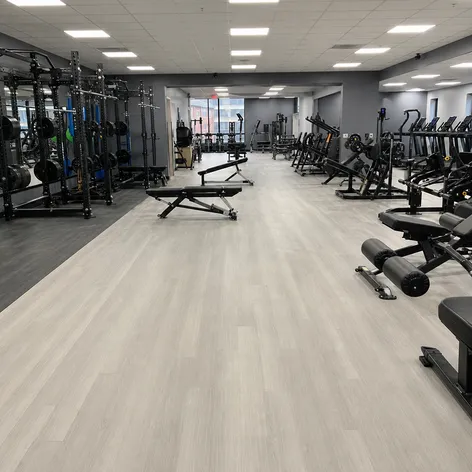
Commercial Gym Chains and Franchise Fit-Outs
Highest VolumeMulti-location gym operators and franchise groups are the highest-volume buyers in this segment. A single franchise rollout can mean 20–50 locations, each requiring 500–2,000 sqm of flooring. They specify centrally and purchase on framework agreements, so once your product is approved, reorders follow on a predictable schedule as new locations open.
These buyers care about installation speed — click-lock SPC installs 3–4× faster than glued rubber, which means their locations open sooner and start generating revenue earlier.
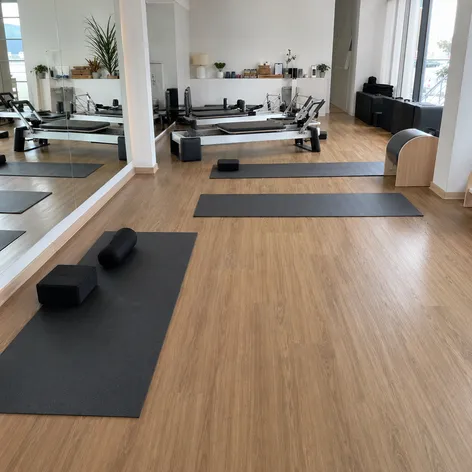
Boutique Fitness Studios
Growing SegmentYoga studios, pilates spaces, cycling studios, CrossFit boxes. Smaller per-location area (typically 100–400 sqm) but higher aesthetic expectations. These buyers want the performance of commercial gym flooring with the visual quality of a retail space — their members are paying premium membership fees and expect the environment to match.
Deep emboss wood-look décors in warm tones sell well here. Order volumes are smaller per project, but the segment is fragmented and growing, so the aggregate opportunity is significant if you're positioned as a supplier who understands the niche.
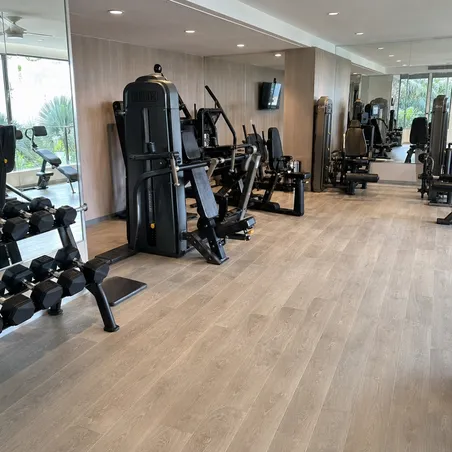
Hotel and Resort Fitness Centers
Hospitality fitness rooms are typically 80–300 sqm, but they're specified by interior designers who demand specific décor matches and won't compromise on aesthetics. The commercial value: hospitality projects often bundle flooring across multiple areas (gym, spa, corridors), so a gym SPC specification can pull through orders for other product lines. Hotels also renovate on 5–7 year cycles, creating repeat business.
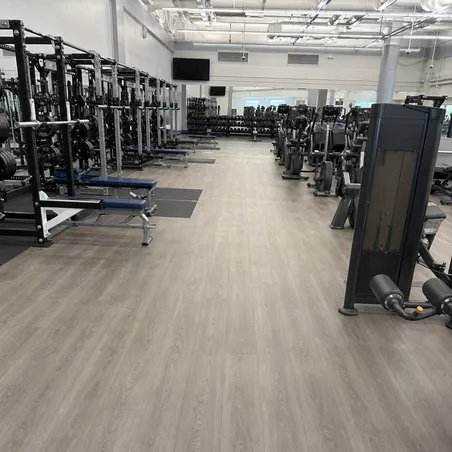
Municipal Recreation Centers and University Gyms
Government and institutional projects move slowly but order in volume. A university recreation center might need 3,000–5,000 sqm across weight rooms, cardio areas, multipurpose courts, and locker room corridors. These projects typically require specific certifications (FloorScore for indoor air quality, fire rating documentation, ADA slip resistance compliance) and go through formal tender processes. Having your test reports and compliance documentation ready before the tender deadline is the difference between winning and missing the bid.
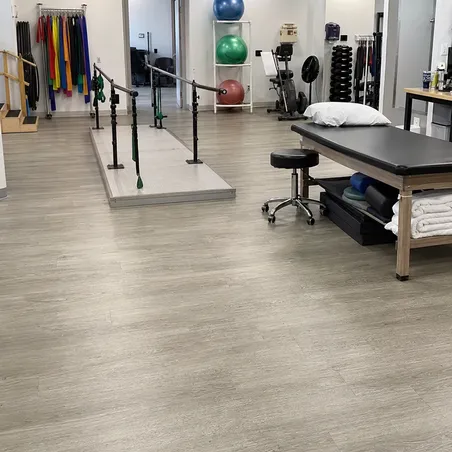
Rehabilitation and Physical Therapy Clinics
A smaller but specialized segment. Rehab facilities need slip resistance (patients with mobility limitations), indentation resistance (therapy equipment), and acoustic comfort (the IXPE pad reduces impact sound transmission). These facilities are often part of hospital or healthcare networks that standardize flooring specifications across locations — one approval can unlock multiple sites.
Tell us which fitness segments you're targeting — we'll recommend the right spec and décor configuration for your market.
Discuss Your Target SegmentsCustomization for the Gym Channel — What You Can Specify
Gym SPC flooring is not a single SKU. Here's what you can configure for your market, and where the boundaries are.
Core and Wear Layer
5.5mm or 6mm core, paired with 0.5mm or 0.7mm wear layer. We don't produce gym SPC below 5.5mm — the indentation resistance drops below acceptable thresholds for commercial fitness use. (We tried 5mm early on. The EN 433 results weren't consistent enough to warrant the risk.)
Surface Texture and Slip Rating
Deep emboss is standard for gym applications. We can adjust the emboss depth and pattern to target R10 or R11 slip resistance.
Crystal and smooth surfaces are not available for the gym line — they can't achieve the required slip ratings.
Décor Selection
Our library includes 200+ décor films, but gym environments tend to cluster around a narrow range. Top sellers:
Custom décor films available for branded gym chains. Minimum order for custom décor development is typically 3,000 sqm to justify the film production run.
Plank Dimensions
Standard gym planks run 180mm–230mm wide and 1200mm–1500mm long. Wider planks (up to 230mm) are preferred for gym environments — fewer seams per square meter means fewer potential failure points under heavy equipment.
Custom dimensions available within our calender line capabilities — discuss requirements with our engineering team.
Attached Underlayment
IXPE pad is standard. EVA pad is available on request for applications where additional acoustic dampening is needed — particularly upper-floor gyms in mixed-use buildings where impact sound transmission to the floor below is a concern.
Pad thickness: 1.0mm to 1.5mm.
Private Labeling and Packaging
Full OEM packaging with your branding, barcodes, and market-specific care instructions. Carton configuration can be adjusted for your warehouse racking and pallet dimensions.
MOQ & Lead Times

Installation Characteristics That Affect Your Project Bids
We're not going to walk you through how to install click-lock flooring — your contractors know the process. What matters for your business is how gym SPC installation differs from standard SPC and how those differences affect your project costing and timeline.
Subfloor Preparation
Gym SPC is more forgiving than thinner residential SPC on subfloor imperfections because the 5.5–6mm core bridges minor irregularities.
In renovation projects, the reduced subfloor prep requirement translates directly to lower installed cost per sqm — less grinding and leveling time.
Expansion Gaps
Standard 8–10mm perimeter expansion gap applies. In large gym spaces (500+ sqm open areas), we recommend transition strips at 15-meter intervals in both directions to manage thermal expansion across the floor plane.
Gym environments with large glass facades and variable HVAC can see wider temperature swings than typical commercial spaces. Transition strips prevent buckling without visible gaps.
Heavy Equipment Zones
Squat racks, Smith machines, and other fixed heavy equipment should sit on the finished floor, not on the subfloor with flooring cut around them. The click-lock system needs continuous engagement across the floor plane to maintain dimensional stability.
Equipment pads (felt or rubber) under point loads are recommended — not because the floor can't handle the weight, but because they distribute the load and prevent localized indentation at leg contact points.
Installation Speed
A two-person crew can install approximately 40–60 sqm per day of gym SPC, depending on room geometry and cutting complexity. For a 1,000 sqm gym fit-out, that's roughly 3–4 weeks of installation.
Glued rubber requires adhesive cure time between sections. Poured polyurethane systems require multi-day cure before the space can be used. Click-lock SPC is ready for use immediately after installation.

Installation Summary for Project Bids
- Subfloor tolerance 3mm/3m — less prep cost vs. thinner SPC
- 8–10mm perimeter gap; transition strips at 15m intervals for 500+ sqm spaces
- Heavy equipment sits on finished floor — continuous click-lock engagement required
- 40–60 sqm/day per two-person crew; 1,000 sqm ≈ 3–4 weeks
- No adhesive cure time — space usable immediately after installation
Compliance and Certification — Pre-Qualifying Your Product for Tender
Gym and fitness facility projects, especially institutional and franchise accounts, require specific compliance documentation. Here's what ships with your order and what's available on request.
Certifications Held
These cover the core compliance requirements for North American and European commercial flooring projects.
Key Test Reports & Standards
Per EN 13501-1. Standard commercial flooring fire classification required in most building codes for fitness facilities. Test reports available on request.
Per DIN 51130 / EN 13893. For North American projects, DCOF (Dynamic Coefficient of Friction) test results per ANSI A326.3 — the standard referenced in ADA compliance for commercial floors — are available on request.
FloorScore certification confirms compliance with California Section 01350 VOC emission limits. REACH registration covers European chemical safety requirements.
TSCA Title VI compliant for U.S. market requirements. SGS test reports available with each shipment.
Need Additional Third-Party Testing?
If your tender requires certifications beyond what we hold, let us know during the quoting phase. We can arrange additional third-party testing through SGS or Bureau Veritas to meet specific project requirements.
Learn About Our Manufacturing & QC ProcessGym SPC vs. Rubber Flooring and Poured Systems — Helping Your Buyers Make the Switch
If you're entering the fitness flooring market, you're competing against two established product categories: rubber flooring (rolls and interlocking tiles) and poured polyurethane/epoxy systems. Understanding the comparison helps you position gym SPC flooring to your downstream buyers.
| Factor | Gym SPC Flooring | Rubber Rolls/Tiles | Poured Polyurethane |
|---|---|---|---|
| Installation method | Click-lock, no adhesive | Adhesive or loose-lay (rolls); interlocking (tiles) | Poured and troweled, multi-day cure |
| Installation speed | 40–60 sqm/day (2-person crew) | 30–50 sqm/day (adhesive cure adds time) | 20–30 sqm/day + 3–5 day cure |
| Maintenance | Damp mop, standard floor cleaner | Requires specialized rubber cleaner; textured surface traps dirt | Damp mop, but scratches show on glossy finishes |
| Aesthetics | Wood-look, stone-look, concrete décors | Black or limited color fleck options | Solid colors, limited pattern options |
| Replacement | Individual plank replacement possible | Full section replacement (rolls) or individual tile swap | Full resurface required |
| Odor | None (FloorScore certified) | Rubber off-gassing, especially in enclosed spaces | Chemical odor during installation and cure |
| Typical lifespan | 8–15 years (depending on wear layer) | 10–20 years | 8–12 years before resurfacing |
Where Gym SPC Wins
Gym owners increasingly want their facilities to look like retail spaces, not industrial warehouses. Wood-look, stone-look, and concrete décors are simply not available in rubber.
Standard floor cleaner and a damp mop. No specialized rubber cleaners, no textured surfaces trapping sweat and debris.
No facility downtime during cure — the gym can open the same day the last plank clicks in. Poured systems require 3–5 days of cure time before the space is usable.
Where Rubber Still Wins
Dedicated free weight drop zones where extreme impact absorption is the primary requirement. Rubber's density and elasticity absorb repeated barbell drops in a way that SPC rigid core is not designed to handle.
We recommend a hybrid approach for your gym operator buyers:
This gives you a larger SPC order for the majority of the floor area while being honest about where rubber is the better tool.
Container Loading and Freight for Gym SPC Orders
Gym SPC is denser and thicker than standard residential SPC, so container loading quantities differ. Here's what to expect for your freight calculations.
Container Capacity by Container Type
Standard 4mm residential SPC loads 2,400–2,800 sqm per 40HQ. Gym SPC loads roughly 20–25% fewer square meters per container due to the thicker, denser core. Factor this into your landed cost calculations.
Packaging, Palletization & Routing
Corner protectors and stretch wrap as standard on all gym SPC shipments.
We add edge protection strips between carton layers because the heavier cartons create more compression during transit. This step was added after a buyer in Australia reported corner damage on bottom-layer cartons in a 40HQ shipment — the product inside was fine, but damaged packaging creates a bad first impression at the warehouse.
Rayong factory serves Oceania and Southeast Asian destinations. Changzhou factory serves North America and Europe. We quote FOB, CIF, or DDP and coordinate with your freight forwarder or our logistics partners.

Request a loading plan and landed cost estimate for your gym SPC order — we'll model it against your destination port and incoterm preference.
Frequently Asked Questions About Gym SPC Flooring
Answers to the specification, performance, and sourcing questions we hear most from fitness channel buyers and project specifiers.
What core thickness should I specify for commercial gym SPC flooring?
5.5mm is the minimum we recommend for commercial gym environments. It provides adequate indentation resistance for machine-based fitness areas — cardio equipment, cable machines, benches.
For facilities with free weight zones, heavy squat racks, or 24-hour operation, specify 6mm. The additional core thickness improves point-load resistance and extends the floor's service life under continuous heavy use.
Note: We don't produce gym SPC below 5.5mm because the EN 433 indentation results aren't reliable enough to warrant a commercial warranty.
Can gym SPC flooring handle dropped weights without permanent damage?
It depends on the weight and drop height. Gym SPC with 0.7mm wear layer and high-density core handles dumbbells up to roughly 20–25 kg dropped from standing height without permanent visible damage.
For heavier drops — Olympic lifts, deadlifts with bumper plates — we recommend rubber drop platforms in those specific zones rather than relying on any rigid flooring to absorb that level of impact.
The honest answer: No rigid core flooring replaces a dedicated drop zone. Gym SPC covers 80–90% of a typical gym floor area; the remaining 10–20% in heavy drop zones is better served by rubber.
What slip rating do I need for fitness center SPC flooring?
R10 covers most indoor dry gym environments — weight rooms, cardio areas, group fitness studios. Specify R11 for wet-adjacent zones: areas near water fountains, smoothie bars, pool-adjacent fitness rooms, or outdoor covered workout areas.
The slip rating on our gym SPC comes from the mechanical emboss texture, not a topical coating, so it doesn't degrade with cleaning cycles.
ADA / North America: For projects referencing ADA compliance, we provide DCOF test results per ANSI A326.3 — the standard most building inspectors reference.
How does gym SPC flooring compare to rubber flooring on total installed cost?
Gym SPC typically comes in at a lower total installed cost than rubber rolls when you factor in adhesive, subfloor prep, and labor time. Rubber roll installation requires adhesive application and cure time, which adds both material cost and labor hours. Click-lock SPC installs dry — no adhesive, no cure wait.
The material cost per sqm is comparable between mid-grade rubber and gym SPC with 0.5mm wear layer. Where SPC pulls ahead is in the installation labor savings and the reduced maintenance cost over the floor's life — no specialized rubber cleaners, simpler daily mopping.
For your project bids: Model the total cost of ownership over 10 years, not just the material price.
What is the minimum order quantity for gym SPC flooring?
1,000 sqm per SKU for standard décors and configurations. If you need a custom décor film — branded gym chain color, specific pattern — the minimum is typically 3,000 sqm to cover the décor film production run.
Samples ship within 7 days of specification confirmation, so you can evaluate the product before committing to a production order.
Typical buyer pattern: Most buyers in the fitness channel start with 1–2 standard décors at minimum quantity to test with their first project, then scale on reorder.
If Gym SPC Isn't the Right Fit — Other Options in Our Range
Gym SPC flooring is purpose-built for fitness environments. If your project or market needs something different, here's where to look within our SPC range.
Offices, Retail, Hospitality Lobbies
Stone-look aesthetics or warm residential-commercial crossover applications. Two product lines cover the full spectrum of commercial interior briefs.
Commercial Kitchens, Bathrooms, Laundry Facilities
Engineered specifically for standing water and chemical exposure environments. Kitchen SPC carries the formulation and surface treatment that wet-area projects require.
Uneven Subfloors
The thickest core in our range. 8mm bridges subfloor imperfections that thinner products would telegraph — the right spec when the substrate can't be fully corrected before installation.
General Catalog Building & Light Commercial
The core product line for residential and light commercial channels. Waterproof SPC is the broadest-application SKU in our range — the right starting point for distributors building a general catalog.
Not sure which product fits your project?
Tell us the application and we'll recommend the right spec.
Start Sourcing Gym SPC Flooring
You've seen the specs, the application segments, and the customization options. If gym SPC flooring fits your market, here's how to move forward.
If You Know Your Specs
Send us your target thickness, wear layer, décor preferences, slip rating requirement, and estimated volume. We'll return a quote with pricing, sample timeline, and production schedule.
- Target thickness and wear layer
- Décor preferences
- Slip rating requirement
- Estimated volume
If You're Entering the Fitness Flooring Segment
Tell us your target market — geography, buyer type, project size range — and we'll recommend a starter configuration based on what's moving for our existing gym channel distributors.
Recommended Starter Configuration
Most new buyers start with grey concrete and light oak in 6mm / 0.5mm spec — the two décors that cover the widest range of gym environments.
Get in Touch Directly