New: Wood Veneer SPC collection now available — Explore the range
Wet-Area SPC · Factory Direct

Kitchen SPC Flooring Built for Standing Water

Waterproof rigid core for wet-area projects — from residential remodels to commercial food service. R10–R11 slip-rated surfaces, chemical-resistant UV coating, manufactured on dedicated wet-area production specs across 8 calender lines.

FloorScore + REACH R10–R11 Slip Rated 1,000 sqm MOQ Samples in 7 Days
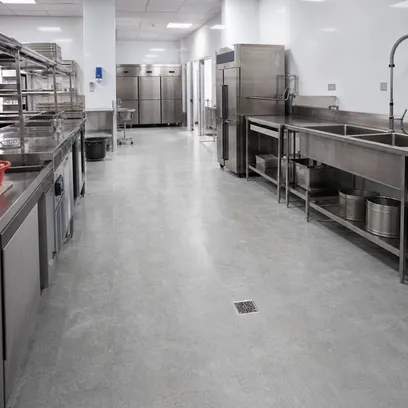
Kitchen SPC flooring installed in a commercial wet-area kitchen — R10 slip-rated surface with rigid core
Product Definition

What Kitchen SPC Flooring Is and Why It's a Separate Product Line

All SPC flooring is waterproof at the core level — that's the baseline for the category. Kitchen SPC flooring goes further. It's formulated and finished specifically for environments where water isn't an occasional spill but a constant presence.

Residential kitchens and bathrooms, commercial kitchens, laundry facilities, food processing areas — any space where the floor meets standing water, grease, cleaning chemicals, and heavy foot traffic on a daily basis. These environments demand a product built to a different standard than general-purpose SPC.

The differences from our standard SPC flooring range are in three places. First, the surface treatment: we apply a higher-friction UV topcoat that achieves R10–R11 slip resistance ratings under EN 13893 and DIN 51130 — standard SPC typically sits at R9, which isn't enough for a wet commercial kitchen where staff are moving fast on greasy floors.

Second, the wear layer: kitchen SPC ships with 0.5mm or 0.7mm wear layers as standard, because wet-area floors get cleaned aggressively and frequently. A 0.3mm wear layer that works fine in a bedroom won't survive two years of daily mopping with commercial degreasers.

Third, the edge seal: we apply a tighter edge profile on the click-lock joint to reduce moisture wicking between planks — in a kitchen environment, even small amounts of water sitting in the seam can eventually reach the décor film if the joint isn't tight.

Surface Treatment

Higher-friction UV topcoat achieving R10–R11 slip resistance (EN 13893, DIN 51130). Standard SPC sits at R9 — not enough for wet commercial kitchens with fast-moving staff on greasy floors.

Wear Layer Standard

0.5mm or 0.7mm wear layers as standard. A 0.3mm layer that works in a bedroom won't survive two years of daily mopping with commercial degreasers. Your warranty exposure drops significantly at 0.5mm+.

Edge Seal

Tighter edge profile on the click-lock joint to reduce moisture wicking between planks. In a kitchen environment, even small amounts of water sitting in the seam can eventually reach the décor film if the joint isn't tight.

A Distinct SKU Line at a Higher Price Point

For your business, kitchen SPC flooring is a distinct SKU line that sells into specific, identifiable market segments at a higher price point than general-purpose SPC. Wet-area flooring commands a premium because the buyer's downstream customer — whether that's a homeowner renovating a kitchen or a restaurant chain reflooring 30 locations — is paying for performance assurance in a demanding environment. That premium flows through to your margin.

Technical Data

Technical Specifications for Wet-Area SPC

Standard specifications for our kitchen SPC flooring line. Core thickness, wear layer, and surface treatment can be adjusted within the ranges below for OEM/ODM orders.

Parameter Standard Specification
Core composition Stone polymer composite (CaCO₃ + PVC resin), zero water absorption rigid core
Core thickness 5mm – 6mm (standard); 4mm and 8mm available on request
Wear layer 0.5mm (20 mil) or 0.7mm (28 mil)
Total thickness (with pad) 5.5mm – 8mm depending on configuration
Surface treatment High-friction UV coating, R10–R11 slip rated
Surface textures EIR (embossed-in-register), deep emboss, slate texture
Click-lock system Unilin-type or Valinge-type, CNC-milled in-house
Attached underlayment IXPE pad, factory-attached (EVA available on request)
Plank dimensions Width 183mm–228mm, Length 1220mm–1524mm
Dimensional tolerance ±0.1mm thickness, ±0.15mm width
Slip resistance R10–R11 (DIN 51130)
Fire rating Bfl-s1 (EN 13501-1)
Chemical resistance Resistant to common kitchen degreasers, bleach solutions, and acidic cleaners per EN 423
Residual indentation ≤0.10mm (EN 433)

Specifications shown are standard production values for our kitchen SPC line. Custom configurations available — contact us for detailed product data sheets.

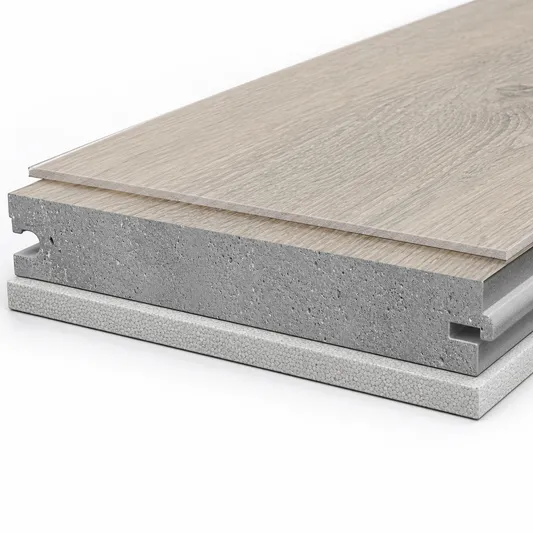
Cross-section of kitchen SPC flooring showing 0.5mm wear layer, rigid stone polymer core, and IXPE underlayment
R10–R11
Slip Resistance
0.7mm
Max Wear Layer
5–6mm
Core Thickness
EN 423
Chemical Resistance
Request Sample + Data Sheet

Why the Specs Sit Where They Do

5mm–6mm Core Default

The thicker core isn't about rigidity — 4mm SPC is rigid enough. It's about subfloor tolerance. Kitchen subfloors in renovation projects tend to be rougher: plumbing modifications, old tile adhesive residue, leveling compound patches. A 5mm+ core bridges minor imperfections that a 4mm plank would telegraph as visible bumps or lippage.

We learned this from claim data. Most kitchen-related complaints in 2015–2016 were on 4mm product installed over uneven subfloors. Moving the standard to 5mm eliminated about 80% of those claims.

0.5mm vs 0.7mm Wear Layer

0.5mm (20 mil) is the residential sweet spot — it handles rolling chairs, pet claws, and dropped cookware without pricing the product out of the market. 0.7mm (28 mil) is specified for light commercial: restaurant dining areas, café floors, hotel kitchenettes. The wear layer doesn't affect waterproofing, but it directly determines how long the surface holds up under abrasion before the print layer shows wear.

For OEM customers building a tiered product line, we typically recommend 0.5mm for the residential SKU and 0.7mm for the commercial or "pro" SKU — same core, same decor, different wear layer and price point.

R10–R11 Slip Rating

R9 is the minimum for residential dry areas. Kitchens need R10 at minimum because water, cooking oil, and cleaning products all reduce friction. R11 is specified for commercial kitchens and food-service environments where spills are frequent and liability exposure is higher. The rating is achieved through the UV coating formulation and surface texture depth — not by making the floor feel rough underfoot.

EIR texture contributes to the slip rating by creating micro-channels that displace liquid under foot contact. A flat, high-gloss surface at the same coating spec would test at R9 — the texture is doing real work here.

Certifications

Certifications & Compliance

Third-party tested and certified for the markets where our customers sell. Documentation is available for every certification listed — request the relevant test reports when you inquire.

FloorScore® Certified

Indoor air quality certification for VOC emissions. Required by LEED v4, CHPS, and many US state procurement specs. Our kitchen SPC line meets FloorScore criteria for formaldehyde, acetaldehyde, and total VOC limits.

US Market

CARB Phase 2 Compliant

California Air Resources Board formaldehyde emission standard — the most stringent in the US. Compliance is verified by a CARB-approved third-party certifier. Required for sale in California and increasingly expected by national retailers.

US Market

CE Marking (EN 14041)

European conformity marking for resilient floor coverings. Covers reaction to fire, slip resistance, electrical resistance, and emission of dangerous substances. Required for sale in EU member states.

EU Market

ISO 10582 / ISO 24011

International standards for heterogeneous and homogeneous resilient floor coverings. Used as the baseline specification for B2B procurement in markets outside the US and EU, including Australia, the Middle East, and Southeast Asia.

Global

Phthalate-Free & RoHS

No DEHP, DBP, BBP, or DINP plasticizers. Heavy metal content below RoHS thresholds. Increasingly required by European retailers and large-format US home improvement chains as part of their restricted substances lists.

EU / US Market

NSF/ANSI 332 Sustainability

Sustainability assessment standard for resilient floor coverings. Covers product content, manufacturing process, end-of-life management, and corporate governance. Supports LEED credit documentation for green building projects.

US Market

Need the actual test reports?

We provide full third-party test reports, declaration of conformity documents, and product data sheets to qualified buyers. Request the specific certifications relevant to your target market when you contact us.

Request Documentation
OEM / ODM

Custom Kitchen SPC: What You Can Specify

Most of our B2B customers don't buy off-the-shelf. They specify a product that fits their brand, their market, and their price point. Here's what's adjustable and what the practical limits are.

Decor & Surface Texture

Choose from our existing decor library (200+ wood and stone designs) or submit your own artwork for custom printing. Surface textures — EIR, deep emboss, hand-scraped, slate — are selected per SKU. Gloss level is adjustable from matte (5–10 GU) to satin (15–25 GU).

Plank Dimensions

Width from 150mm to 228mm, length from 1220mm to 1830mm. Herringbone and chevron formats available for select core thicknesses. Tile formats (600×300mm, 600×600mm) available for stone-look designs.

Core Thickness & Wear Layer

Core from 4mm to 8mm. Wear layer from 0.3mm (12 mil) to 0.7mm (28 mil). For kitchen-specific products we recommend a minimum 5mm core and 0.5mm wear layer — we'll flag it if a requested spec falls below what we'd consider fit-for-purpose in a wet area.

Private Label & Packaging

Full private label available: your brand name, logo, and product line name on carton, plank end-stamp, and documentation. We do not co-brand or include our factory name on customer-branded product. Carton design files provided for your review before production.

Certification Scope

We can produce to the certification requirements of your target market. If you need FloorScore for the US, CE for Europe, or a specific regional standard, specify it at inquiry and we'll confirm whether the requested spec combination is certifiable under that standard.

Custom kitchen SPC flooring decor samples and private label packaging options for OEM buyers

MOQ & Lead Times

Stock design, standard spec 500 m² MOQ, 15–20 days
Custom decor, standard spec 1,000 m² MOQ, 25–30 days
Full OEM (custom spec + decor) 2,000 m² MOQ, 35–45 days
Sample order (pre-production) No MOQ, 7–10 days

Lead times are from order confirmation and deposit receipt. Production scheduling subject to capacity — confirm at time of inquiry.

How the OEM Process Works

1

Inquiry & Spec Brief

Submit your target spec, market, certifications needed, and volume estimate. We respond within 24 hours with a feasibility confirmation and indicative pricing.

2

Sample Production

We produce pre-production samples to your spec. You review decor, texture, dimensions, and packaging. Revisions are incorporated before mass production approval.

3

Order Confirmation

PI issued after sample approval. 30% deposit to schedule production. Balance against copy of B/L. Production starts within 3 business days of deposit receipt.

4

QC & Shipment

Pre-shipment inspection available (third-party or your own inspector). Full documentation package: packing list, COA, test reports, and certification copies shipped with the order.

Critical Specification

Slip Resistance — The Specification That Defines Wet-Area Flooring

Slip resistance is where kitchen SPC flooring separates from general-purpose SPC, and it's the single specification most likely to determine whether your product wins or loses a commercial project bid.

How We Achieve R10–R11 Ratings

We achieve R10–R11 ratings through a combination of surface texture and UV coating formulation. The texture side is straightforward — deeper emboss patterns and slate-style textures create more surface friction than the smooth or lightly textured finishes used on residential wood-look SPC.

The coating side is where our R&D team spent the most development time. Standard UV coatings are optimized for scratch resistance and gloss retention. Wet-area UV coatings need to balance those properties against friction coefficient — too smooth and the floor is a liability when wet, too rough and it traps dirt and resists cleaning. We run a modified UV formulation with micro-particle additives that maintain friction when wet without creating a surface that's difficult to mop clean.

R10

R10 Rating

Covers most residential kitchens and bathrooms, plus light commercial applications.

  • Residential kitchens & bathrooms
  • Café dining areas
  • Hotel bathrooms
R11

R11 Rating

Required for commercial kitchens, food processing, and grease-exposure environments.

  • Commercial kitchens
  • Food processing facilities
  • Oil & grease environments

Why This Matters for Commercial Bids

For commercial kitchen flooring bids, the slip rating is often a hard specification in the project tender. Architects and facility managers specify R10 or R11 by number, and products that don't meet the rating are disqualified before price is even discussed. Stocking kitchen SPC at R10 and R11 means you can respond to those tenders without scrambling for a compliant product.

R11 slip resistance ramp test on kitchen SPC flooring surface

How We Test: Ramp Method + Pendulum

We test slip resistance on production samples using the ramp test method per DIN 51130, not just the pendulum test. The ramp test better simulates real-world wet conditions — a floor that passes the pendulum test at R10 can sometimes fail the ramp test.

We test both ways so your product holds up regardless of which method the specifier uses.

DIN 51130
Ramp Test Method
Pendulum
Secondary Verification

R10 vs R11: What Actually Changes

We produce both ratings — the difference is in the texture depth and coating formulation, not the core product. The SPC rigid core, wear layer thickness options, and click-lock system are identical across both ratings.

Market Intelligence

Where Kitchen SPC Flooring Sells — Market Segments Worth Building Inventory For

Kitchen SPC flooring isn't one market — it's four or five distinct segments, each with different order patterns, margin profiles, and competitive dynamics. Here's how we see them from the production side, based on what our existing distributors and project contractors are ordering.

Residential Kitchen and Bathroom Renovation

Volume Segment

Steady year-round demand · Spring/summer peak · Monthly reorders

The volume segment. Kitchen and bathroom remodels are the most common renovation projects in North America, Europe, and Oceania, and flooring is replaced in nearly every one. Homeowners and contractors want waterproof, easy to install, and visually competitive with ceramic tile or natural stone — without the subfloor prep, grout maintenance, or cold-underfoot feel.

Recommended Spec
5mm–6mm with EIR texture
Décor Mix
Wood-look & stone-look
Stocking Pattern
4–6 décors, monthly reorder
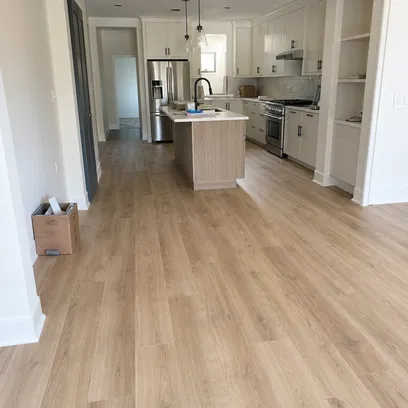
Residential kitchen renovation with wood-look SPC flooring

Commercial Food Service and Restaurant Chains

Higher Margin

R11 hard requirement · Repeat chain business · Multi-location orders

Higher margin, higher specification. Restaurant groups and food service operators need flooring that survives daily mopping with commercial degreasers, grease exposure, dropped cookware, and heavy foot traffic from kitchen staff. R11 slip rating is usually a hard requirement.

The commercial repeat-business angle: A restaurant chain reflooring 10–50 locations over 2–3 years represents a sustained order stream, not a one-time purchase. Your value proposition to the chain's facilities manager: consistent product from a single source, slip-rated and certified, delivered on schedule across multiple locations.

Slip Rating
R11 (hard requirement)
Order Pattern
Multi-location, sustained
Chain Scale
10–50 locations / 2–3 yrs
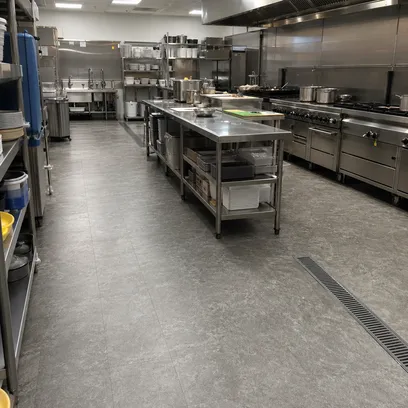
Commercial restaurant kitchen with R11 rated SPC flooring

Hospitality Back-of-House

Speed-Critical

Hotel kitchens · Laundry facilities · Spa wet areas · Housekeeping corridors

Hospitality buyers care about two things: the floor can't fail during a guest's stay (no peeling, no slipping incidents, no visible wear), and it needs to install fast because every day a room or facility is offline is lost revenue.

Installation speed advantage: Click-lock SPC installs over existing subfloor in hours, not days — a hotel can refloor a commercial kitchen over a Monday–Tuesday shutdown instead of closing for a week. Hospitality accounts in Southeast Asia have ordered kitchen SPC specifically because the installation speed let them avoid peak-season closures.

Key Requirement
Zero in-stay failures
Install Window
Mon–Tue shutdown
vs. Traditional
Hours, not a week
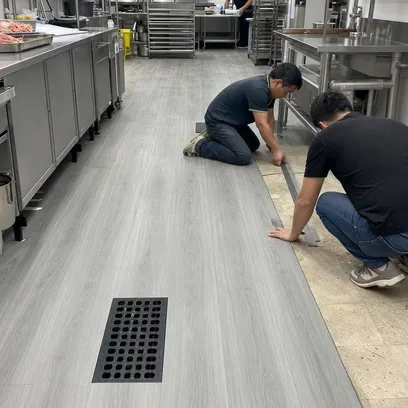
Hotel back-of-house kitchen with click-lock SPC flooring installation

Multi-Family and Rental Property Wet Areas

Durability Per Dollar

Between-tenant replacement · Smaller batch orders · Neutral décors

Property managers replacing kitchen and bathroom flooring between tenants. The buying criteria here are durability per dollar and installation speed — not premium aesthetics. 5mm core with 0.5mm wear layer in neutral décors (light oak, grey stone) covers this segment.

MOQ flexibility matters here: Property managers often order in smaller batches — 50–200 sqm per building, not container loads. Our 1,000 sqm per SKU minimum lets you stock a few neutral kitchen décors and supply this segment from inventory without overcommitting.

Recommended Spec
5mm / 0.5mm wear layer
Décors
Light oak, grey stone
Batch Size
50–200 sqm / building
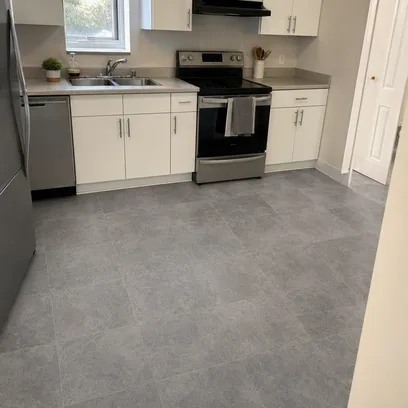
Multi-family rental kitchen with neutral grey stone SPC flooring

Institutional and Healthcare Wet Areas

High Volume

Schools · Hospitals · Aged care · Government buildings · Formal tender process

Commercial kitchens in schools, hospitals, aged care facilities, and government buildings. These projects go through formal tender processes with specific slip resistance, fire rating, and VOC emission requirements written into the specification.

Pre-qualification advantage: Kitchen SPC with R10–R11 slip rating, Bfl-s1 fire classification, and FloorScore certification pre-qualifies for most institutional tenders in North America and Europe. Institutional projects are high-volume — a hospital kitchen refit can be 500–2,000 sqm — and tend to specify by performance rating rather than brand, so the product that meets spec at the best price wins.

Project Volume
500–2,000 sqm
Key Certifications
Bfl-s1 · FloorScore
Win Criteria
Spec compliance + price
Institutional healthcare facility kitchen with certified SPC flooring

Segment Quick-Reference: Order Patterns & Margin Profiles

Segment Slip Rating Order Pattern Margin Profile Key Differentiator
Residential Renovation R10 Small batch, repeat High Décor range + waterproof story
Commercial Restaurant R11 10–50 loc / 2–3 yrs High R11 + 0.7mm wear layer
Hospitality Back-of-House R11 Project-based, fast cycle Medium–High Install speed, zero downtime
Multi-Family / Rental R10 50–200 sqm / building Medium Durability per dollar
Institutional / Healthcare R10–R11 500–2,000 sqm / project Volume Cert compliance + price

Not sure which segment fits your customer base?

Tell us your target market and order volume. We'll recommend the right spec, MOQ, and stocking strategy for your region.

Discuss My Target Segment
Technical Specifications

Kitchen SPC Flooring: Full Specification Sheet

Every dimension, rating, and certification your procurement team or specifier needs. All figures are production-verified — not marketing estimates.

Core Construction

Core material Stone Plastic Composite (SPC)
Total thickness 4mm / 5mm / 6mm
Wear layer 0.3mm / 0.5mm / 0.7mm
Underlayment IXPE pre-attached (optional)
Surface finish Embossed / EIR / Matte
Locking system Click-lock (Unilin-compatible)

Performance Ratings

Slip resistance R10 standard / R11 commercial
Abrasion resistance AC4 / AC5
Water resistance 100% waterproof core
Indentation resistance ≥ 0.1mm residual (EN 433)
Thermal stability –10°C to +60°C
Load rating Heavy commercial (Class 33/34)

Dimensions & Format

Plank size (standard) 1220 × 180mm
Plank size (wide) 1524 × 228mm
Tile format 600 × 300mm / 600 × 600mm
Weight ~6.5 kg/m² (5mm)
Packing ~2.0–2.5 m² per carton
Cartons per pallet 40–48 cartons

Certifications & Compliance

VOC emissions FloorScore / GREENGUARD Gold
Fire classification Bfl-s1 (EN 13501-1)
Formaldehyde CARB2 / E0 compliant
Phthalate-free Yes (REACH compliant)
CE marking EN 14041 compliant
Test reports Available on request
Full Technical Data Sheet
Complete spec sheet with all test reports, certifications, and installation guidelines — ready for your procurement team or specifier.
Request Spec Sheet
Manufacturing Process

How We Manufacture Kitchen SPC Differently

Kitchen SPC runs on the same calender lines as our standard SPC range — same equipment, same base formulation, same inline thickness monitoring. The differences are in three production stages that specifically address wet-area performance.

Surface Coating Line Configuration

R10–R11 Slip Resistance

When we run kitchen SPC, the UV coating line switches to our wet-area formulation. Standard SPC gets 6–8 coats of scratch-optimized UV finish. Kitchen SPC gets the same number of coats, but the final two layers use a modified formulation with ceramic micro-particles suspended in the UV resin.

R9
Standard SPC
Standard UV topcoat
R10–R11
Kitchen SPC
Ceramic micro-particle wet-area coats

These particles create microscopic surface texture that maintains friction when wet. We cure each coat individually under UV lamps, but the wet-area coats run at a slightly lower line speed to ensure full particle distribution before curing. Rushing this step produces uneven slip resistance across the plank surface — something that won't show up visually but will show up on a ramp test.

Edge Profile Tightening

Moisture Barrier at the Joint

Standard SPC click-lock profiles have a designed clearance of approximately 0.08mm at the joint — enough for smooth installation while maintaining a tight visual seam. For kitchen SPC, we reduce that clearance to approximately 0.05mm.

Joint Clearance Comparison
Standard SPC 0.08mm
Bedroom / low-moisture environments
Kitchen SPC 0.05mm
Kitchen / daily mopping / sink base pooling

The tighter joint reduces the capillary channel where water can wick between planks. In a kitchen where someone mops daily and water pools around the sink base, that 0.03mm difference in joint tightness is the difference between a dry subfloor and moisture reaching the décor film edge over 3–5 years.

Installer note: Tighter profiles require slightly more installation force. Your installers need to know the planks click harder than standard SPC. We include this in the installation guidance that ships with the product, and we can print it on the carton interior for retail channels.

UV coating line applying ceramic micro-particle wet-area finish to kitchen SPC planks

Chemical Resistance Verification

Beyond EN Standard QC

Standard SPC QC includes the usual dimensional stability, indentation, and locking strength tests. Kitchen SPC adds a chemical resistance panel — we expose test samples to common kitchen chemicals for 24 hours and check for surface discoloration, softening, or coating degradation.

24-Hour Chemical Exposure Panel
Bleach solution
Degreaser concentrate
Vinegar
Citric acid

This isn't a standard test in the EN suite for SPC flooring, but we added it to our kitchen line QC after a food service account reported surface hazing from industrial degreaser use. The hazing turned out to be a reaction between the degreaser's solvent base and the standard UV topcoat. Our wet-area formulation was reformulated to resist that specific chemical interaction.

OEM / ODM Options

Customization for Your Kitchen SPC Line

Kitchen SPC flooring supports the same OEM/ODM customization as our full SPC range, with a few wet-area-specific options that matter for your downstream buyers.

Décor Selection

Our library includes 200+ décor films. For kitchen applications, stone-look and tile-effect patterns tend to outsell wood-look by a significant margin — your downstream buyers associate stone and tile visuals with kitchen and bathroom spaces.

Marble Slate Concrete Terrazzo Travertine Wood-Look (available)

Wood-look décors available if your market prefers them — some European markets install wood-look SPC in kitchens more commonly than North American markets. Custom décor development available for orders above 3,000 sqm.

Surface Texture Options

EIR (Embossed-in-Register) R10 minimum

For stone patterns where the surface texture aligns with the printed veining. Deep emboss for slate and textured stone looks.

Slate Texture Profile R11 available

Deepest surface relief and highest wet friction coefficient. Recommended for R11 specification requirements.

Core and Wear Layer

Core Wear Layer Best For
4mm 0.5mm Cost-sensitive residential (increased subfloor prep)
5mm 0.5mm / 0.7mm Standard residential kitchen
6mm 0.5mm / 0.7mm Standard configuration — most common
8mm 0.7mm Heavy commercial / premium-tier markets
Kitchen SPC flooring décor samples including marble, slate, and terrazzo patterns for OEM customization

Attached Underlayment

IXPE Pad Recommended

Standard for kitchen SPC. Closed-cell structure provides moisture barrier properties in addition to sound dampening. The safer choice for wet-area applications.

EVA Pad Available on request

Can absorb small amounts of moisture over time in consistently wet environments. Fine for bedrooms — not recommended for kitchens.

Packaging

  • Private-label cartons and UPC barcodes
  • Multilingual care instructions
  • Moisture barrier wrapping for humid-climate shipments
  • Wet-area installation guidelines insert (carton interior)

Kitchen-specific insert covers: expansion gap requirements around plumbing penetrations, recommended sealant for transitions to other flooring types, and cleaning product compatibility. Reduces after-sales support calls for retail channels where the end user is the installer.

MOQ and Lead Times

1,000 sqm
per SKU — standard décors and configurations
3,000 sqm
minimum for custom décor development
Samples ship within 7 days of design confirmation
Compliance Documentation

Certifications and Compliance for Wet-Area Flooring Markets

Kitchen SPC flooring from our production lines carries the same certifications as our full SPC range: ISO 9001:2015, CE (EN 16511), FloorScore (SCS Global Services), SGS, and REACH. These cover the compliance requirements for North American and European import markets.

Wet-Area Specific Certifications

FloorScore / CDPH Section 01350

VOC

VOC emissions below California Department of Public Health thresholds. Kitchen flooring sits in an enclosed space with limited ventilation — especially under-cabinet areas — so indoor air quality certification is frequently specified in residential and commercial projects. Your product arrives pre-qualified. No scrambling for test reports after the container clears customs.

Slip Resistance Test Reports

48hr

We provide DIN 51130 ramp test reports and EN 13893 pendulum test reports for every production batch of kitchen SPC. These are the documents your commercial buyers need to include in project tender submissions. Reports are available in PDF format within 48 hours of request.

Fire Rating Bfl-s1

EN 13501-1

Required for commercial kitchen installations in most European markets and increasingly specified in North American commercial projects. Kitchen environments have specific fire safety requirements, and Bfl-s1 is the standard rating for resilient flooring in commercial food service.

REACH Registration

EU Market

Chemical safety compliance for the European market. Relevant for kitchen flooring because the product is in contact with food preparation environments — even though SPC flooring doesn't directly contact food, REACH compliance eliminates procurement objections from European buyers with strict chemical safety policies.

Kitchen SPC flooring certification documents including FloorScore, CE, and REACH compliance

Full Certification Portfolio

If your target market requires additional certifications — ASTM F3261 for North American rigid core standards, specific state-level VOC requirements, or country-specific building code compliance — we can provide the relevant test data or arrange testing through SGS or Bureau Veritas.

View Full Certification Portfolio

Standard Certification Stack

ISO 9001:2015
CE (EN 16511)
FloorScore
SGS
REACH
Bfl-s1 Fire
DIN 51130
EN 13893
Logistics & Shipping

Packaging and Container Loading for Kitchen SPC

Kitchen SPC flooring packs and ships identically to our standard SPC range, with one addition: we recommend moisture barrier wrapping on all kitchen SPC shipments regardless of destination climate.

Why Moisture Barrier Wrapping

Kitchen SPC often sits in warehouse storage longer than general-purpose SPC because it's ordered for specific projects rather than continuous retail replenishment. Extra moisture protection during storage costs almost nothing per carton and eliminates the edge condition risk entirely.

Container Loading Parameters

Carton coverage ~2.2 sqm per carton
Plank dimensions 1220mm × 183mm, 5mm core
Cartons per pallet 48–54 (varies by thickness)
20GP container 1,100–1,300 sqm
40HQ container 2,200–2,600 sqm
Pallet configuration Corner protectors + stretch wrap + moisture barrier

Quote Terms Available

FOB CIF DDP

If you need a loading plan for a specific order quantity and configuration, send us the details and we'll come back with a container plan and freight estimate.

Request Container Plan & Freight Estimate
Kitchen SPC flooring pallets with moisture barrier wrapping ready for container loading

Dual-Origin Production

Oceania & Southeast Asia

Routed through our Rayong, Thailand facility — shorter transit from Laem Chabang port and lower freight rates compared to Shanghai. Tariff advantages for markets with anti-dumping duties on Chinese-origin vinyl flooring.

North America & Europe

Ships from Changzhou via Shanghai. Both facilities produce identical kitchen SPC to the same specifications and QC standards — product quality is consistent regardless of origin.

Thailand Origin Option

The Thailand origin option provides tariff advantages for markets with anti-dumping duties on Chinese-origin vinyl flooring. Ask us about origin routing when requesting your quote.

Buyer Questions

Frequently Asked Questions About Kitchen SPC Flooring

Specification decisions, chemical compatibility, installation trade-offs, and system requirements — answered for distributors and project buyers.

What slip resistance rating do I need for residential vs. commercial kitchen flooring?

R10 covers residential kitchens, bathrooms, and light commercial spaces like café dining areas — environments where the floor gets wet but isn't continuously exposed to grease or oil. R11 is the specification for commercial kitchens, food processing areas, and any environment where oil-based contamination is regular.

If you're building inventory for both segments, stock R10 for residential and R11 for commercial. Most project tenders for commercial kitchens specify R11 as a hard requirement — submitting R10 product will disqualify your bid.

Residential / Light Commercial
R10
Wet areas, café dining, bathrooms
Commercial Kitchen / Food Service
R11
Hard requirement on most tenders

Can kitchen SPC flooring handle commercial degreaser and bleach cleaning?

Yes. Our kitchen SPC line uses a chemical-resistant UV topcoat formulated to withstand daily exposure to commercial degreasers, bleach solutions (up to 5% concentration), vinegar, and citric acid-based cleaners. We test every production batch against these chemicals for 24-hour exposure with no surface discoloration or coating degradation.

Standard SPC UV coatings are not formulated for this level of chemical exposure. If you're sourcing SPC for food service or commercial kitchen applications, confirm that the wear layer coating is specifically rated for chemical resistance, not just scratch resistance.

Commercial degreasers Bleach up to 5% Vinegar & citric acid 24-hr batch tested

How does kitchen SPC flooring compare to ceramic tile for wet-area projects?

Ceramic tile has been the default wet-area flooring for decades, and it still wins on raw water resistance and heat tolerance. Where kitchen SPC wins for your business:

Installation speed
Click-lock over existing subfloor vs. mortar bed and grout. A restaurant can refloor over a weekend with SPC but needs a full week for ceramic tile.
Installed cost
Typically 30–40% lower than ceramic when you factor in labor and subfloor prep.
Damage claim rates
SPC doesn't crack from impact the way ceramic does, and there's no grout to maintain or replace.

For commercial buyers, the installation speed advantage is often the deciding factor.

What core thickness should I specify for kitchen SPC flooring?

Thickness selection depends on the application environment and subfloor condition.

5mm
Residential kitchen & bathroom
Bridges minor subfloor imperfections common in renovation projects without adding unnecessary material cost.
6mm
Commercial kitchen & food service
For concrete subfloors with patches, drains, and plumbing penetrations that create uneven surfaces.
8mm
Heavy commercial
Available but most kitchen projects don't need it — additional thickness adds freight cost without meaningful performance benefit in typical kitchen environments.

If you're unsure, send us your project details and we'll recommend the right spec.

Is kitchen SPC flooring suitable for underfloor heating systems?

Yes, with a thermal resistance caveat. SPC's rigid core conducts heat more efficiently than WPC or laminate, making it compatible with hydronic and electric underfloor heating systems. The maximum surface temperature should not exceed 28°C (82°F) for long-term dimensional stability.

For kitchen applications with underfloor heating, we recommend 5mm core without attached underlayment (or with thin 1mm IXPE) to minimize thermal resistance. Thicker underlayment acts as insulation and reduces heating efficiency — your buyers' energy costs go up and the floor takes longer to warm.

Compatible with hydronic & electric UFH
Rigid core conducts heat more efficiently than WPC or laminate
Max surface temp: 28°C / 82°F
Required for long-term dimensional stability
Recommended: 5mm core, 1mm IXPE max
Thicker underlayment reduces heating efficiency and increases energy costs
Product Navigation

If Kitchen SPC Isn't the Right Fit

Kitchen SPC flooring is engineered for wet-area performance — slip resistance, chemical resistance, and moisture-tight joints. If your project or market needs something different, here's where to look within our SPC range.

Not sure which product line fits your market?

Tell us your target segments and we'll recommend the right mix — residential, commercial, hospitality, or mixed-use.

Tell us your segments
Start Sourcing

Start Sourcing Kitchen SPC Flooring

You've seen the specs, the slip ratings, the market segments, and the customization options. Here's what happens next.

You have a specific project or order in mind

Ready to move on quantity and specs

Send us the quantity, preferred thickness, wear layer, slip rating (R10 or R11), and décor direction. We'll come back with pricing, a sample plan, and production timeline.

What to include in your message

  • Order quantity (sqm or sqft)
  • Preferred thickness
  • Wear layer spec
  • Slip rating — R10 or R11
  • Décor direction (wood tone, stone, neutral)
Send Your Requirements

You're evaluating kitchen SPC as a new product line

Building out your catalog

Tell us your target market, distribution channel, and the segments you want to serve. We'll suggest a starter SKU selection based on what's moving for our existing distributors in similar markets and ship samples within 7 days.

What to share with us

  • Target market and geography
  • Distribution channel
  • Segments you want to serve

Samples ship within 7 days

Tell Us About Your Market

Reach us directly

Get in touch with our sales team