

Herringbone SPC Flooring Premium Pattern, Click-Lock Production
Precision-milled click-lock parquet planks in 4mm–6mm rigid core — the pattern that commands higher retail margins without glue-down labor cost.
Produced on dedicated pattern lines with ±0.05mm profile tolerance. Your brand, your décor, your packaging.

What Makes Herringbone SPC a Different Business Than Standard Plank
Herringbone SPC flooring is the same rigid core vinyl you already know — stone polymer composite, waterproof, click-lock — but cut into shorter planks and milled with directional locking profiles that create the classic V-pattern when installed. The product itself isn't exotic. What's different is the commercial position it occupies in your catalog.
20–40% Higher Retail Markup Over Equivalent Plank
Standard plank SPC is a volume game. Margins compress because every distributor carries it, every contractor installs it, and your buyers shop on price per square meter. Herringbone pattern vinyl flooring sits above that. Your downstream buyers can mark it up 20–40% over equivalent straight-plank SPC in the same décor and thickness.
Visual Complexity That Justifies the Price Gap
The installation pattern creates a visual complexity that justifies the price gap to the end customer. The perceived difficulty of installation — even though click-lock herringbone is tool-free — keeps commodity pressure lower than it is on standard plank.
The Production Challenge Is the Click-Lock Profile
Herringbone planks engage at 90° angles to each other, which means the locking geometry has to work in two directions with zero play. A tolerance that's acceptable on a straight-run plank will produce visible gaps at the herringbone joint. We mill our herringbone profiles on dedicated CNC stations with tighter QC gates than our standard plank lines — ±0.05mm on the locking profile, checked with go/no-go gauges on every run.
Producing Herringbone SPC Since 2017
We've been producing herringbone and chevron SPC since 2017, when the pattern started gaining traction in European and Australian markets. The production challenge isn't the core or the surface — it's the click-lock profile. That's where we've invested in dedicated tooling and tighter process controls.

Move Out of Pure Price Competition
If you're building or expanding an SPC catalog, herringbone is the line that moves you out of pure price competition. The pattern reads as premium at retail — and the click-lock format means your buyers don't pay glue-down labor costs to get there.
Ready to see the product? We ship herringbone SPC samples within 7 days — including your choice of décor, thickness, and wear layer.
Request Herringbone SPC SamplesTechnical Specifications for Herringbone SPC Flooring
These are the standard configurations we produce. If your market needs a spec outside these ranges, our R&D team can develop a custom formulation — we've done it for buyers targeting specific thickness or wear layer combinations that aren't in the standard catalog.
Standard Production Specifications
| Parameter | Standard Specification |
|---|---|
| Core composition | Stone polymer composite (CaCO₃ + PVC resin, rigid core) |
| Core thickness |
4mm 5mm 6mm
|
| Total thickness (with pad) | 4.5mm – 7.5mm |
| Wear layer |
0.3mm (12 mil) — residential / rental
0.5mm (20 mil) — most popular
0.7mm (28 mil) — heavy commercial
|
| Plank dimensions | 120mm × 600mm, 150mm × 750mm (custom sizes available) |
| Pattern types | Classic herringbone (90° V), chevron (angled cut) |
| Surface treatments | EIR (embossed-in-register), crystal, hand-scraped |
| Click-lock system | Unilin-type and Valinge-type, CNC-milled in-house |
| Attached underlayment | IXPE or EVA pad, factory-attached |
| Dimensional tolerance | ±0.1mm thickness, ±0.15mm width |
| Fire rating | Bfl-s1 (EN 13501-1) |
| Slip resistance | R9–R10 depending on surface treatment |
Specifications shown are standard production values. Contact us for detailed product data sheets and custom configuration options.
Plank Dimensions Matter More for Herringbone
The 120×600mm and 150×750mm formats aren't arbitrary. They're sized so the V-pattern repeats at a visually balanced frequency — too short and the pattern looks choppy; too long and it loses the classic herringbone rhythm. Both formats are optimized for the click-lock joint geometry so the angled seams lock cleanly without stress on the tongue.
Wear Layer Selection by End-Use
The 0.5mm (20 mil) wear layer is the most requested because it covers the widest range of applications — residential, boutique retail, and light commercial — without the cost premium of 0.7mm. If your buyers are specifying hotels, airports, or high-footfall retail, the 0.7mm is the right call.
CNC-Milled Click System — Why It Matters
Herringbone click tolerances are tighter than standard plank because every joint meets at an angle. Our CNC milling holds ±0.1mm on the tongue-and-groove profile, which is what prevents the micro-gaps and height variation that show up in cheaper herringbone products after a few months of foot traffic. We mill both Unilin-type and Valinge-type profiles depending on your market's installer preference.
Dimensional Stability Under Temperature Cycling
SPC's stone-polymer core expands and contracts at roughly 0.04mm per meter per °C — significantly less than WPC or LVT. For herringbone layouts, this matters because the diagonal pattern amplifies any cumulative expansion across the room. Our core formulation is tested to EN ISO 23999 and maintains stability across the –5°C to +60°C range typical of underfloor heating systems.
Herringbone SPC Flooring Décor and Design Options
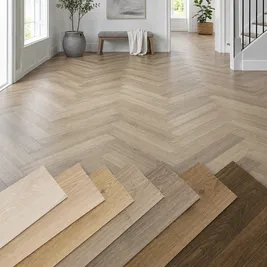
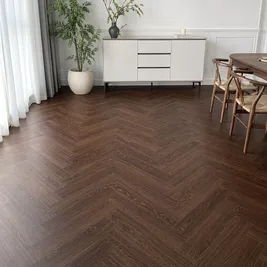
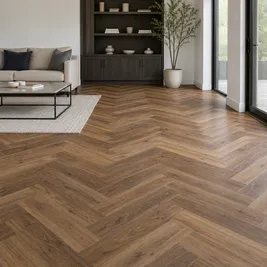
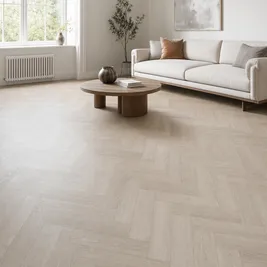
The décor library covers the full range of what buyers are specifying right now — from light Scandinavian oak to dark smoked walnut, with surface textures that match the visual. Private-label décors and custom colorways are available for orders that meet MOQ thresholds.
Light & Natural Oak
Blonde, honey, and whitewashed oak tones. High demand in Scandinavian, Australian, and North American residential markets. EIR texture standard.
Grey & Greige Oak
Cool grey, warm greige, and stone-washed tones. The most consistent seller across European and Middle Eastern commercial projects.
Dark & Smoked Walnut
Espresso, smoked, and charcoal walnut tones. Popular in luxury hospitality and high-end residential. Hand-scraped texture available.
Stone & Concrete Look
Travertine, slate, and polished concrete visuals. Growing demand in commercial and hospitality sectors where stone aesthetics are specified but weight and cost are constraints.
Chevron Pattern Variant
Angled-end planks that form a continuous V without the offset break of classic herringbone. Available in the same décor library with 45° or 60° cut angles.
Custom & Private-Label Décors
Bring your own décor file or work with our design team to develop an exclusive colorway. MOQ applies; lead time is 45–60 days for new décor development.
Surface Texture Options
EIR (Embossed-in-Register)
Texture is registered to the printed grain, so the tactile surface matches the visual. The most realistic wood feel. Standard on most décors.
Crystal / High Gloss
Smooth, reflective finish. Suited to stone and concrete décors. Shows footprints more readily — typically specified for lower-traffic areas.
Hand-Scraped
Irregular, artisan-style texture that adds depth to dark walnut and reclaimed wood décors. Hides minor surface wear well in high-traffic settings.
Certifications and Compliance for Export Markets
Every market has its own compliance requirements. We maintain active certifications for the major import markets and can provide documentation packages tailored to your destination country's requirements.
CE Marking (EU)
ActiveCovers EN 14041 (resilient floor coverings), EN 13501-1 (fire classification), and EN ISO 10874 (usage class). Required for all EU and EEA market entry.
CARB2 / TSCA Title VI (USA)
ActiveFormaldehyde emissions compliance for the US market. Our SPC core is a rigid PVC composite — formaldehyde is not a component — but third-party CARB2 certification is maintained for buyer documentation requirements.
FloorScore® / Indoor Air Quality
ActiveIndependent VOC emissions certification. Relevant for LEED projects and buyers in markets with indoor air quality requirements (California, Australia, parts of Europe).
ISO 9001 Quality Management
ActiveFactory-level quality management certification. Covers incoming material inspection, in-process QC, and outgoing product testing protocols.
REACH Compliance (EU)
ActiveConfirms absence of restricted substances under EU REACH regulation. Full SVHC (Substances of Very High Concern) declaration available on request.
What's Included in the Documentation Package
- Full test reports from accredited third-party labs (SGS, Intertek, or Bureau Veritas depending on destination market)
- Declaration of Performance (DoP) for CE-marked products
- Material Safety Data Sheet (MSDS / SDS) for all components
- CARB2 and FloorScore certificates with current validity dates
- REACH SVHC declaration and RoHS compliance statement
- ISO 9001 factory certificate with scope of certification
- Country-of-origin documentation and HS code classification support
Performance Testing Standards
Market-Specific Requests
If your destination market requires certifications not listed here — such as Australian AS/NZS standards, Middle East GSO compliance, or specific national marks — contact us before ordering. We can advise on current certification status or arrange additional third-party testing as part of your order.
Installation and Subfloor Requirements
Herringbone SPC installs as a floating floor using the same click-lock mechanics as plank SPC — but the diagonal layout requires more careful planning, more cuts, and higher material waste allowances. Understanding the process before ordering prevents costly surprises.
Subfloor Requirements
Flatness Tolerance
Maximum 3mm variation over a 1.8m (6ft) straightedge. Exceeding this causes click joints to stress and can lead to joint separation or hollow spots over time.
Moisture Limits
Concrete subfloors must test below 75% RH (in-slab) or 3 lbs/1000 sq ft/24hr (calcium chloride). Wood subfloors below 12% MC. SPC is waterproof but subfloor moisture can affect adhesion of underlayment and cause hydrostatic pressure issues.
Acceptable Subfloor Types
Concrete slab (on-grade, above-grade, below-grade), plywood (min. 19mm / ¾"), cement board, existing ceramic tile (if flat and firmly bonded), existing vinyl (single layer only).
Radiant Heat Compatibility
Compatible with hydronic and electric underfloor heating. Surface temperature must not exceed 27°C (80°F). System should be running for at least 7 days before installation and turned off 24 hours prior.
Layout Planning & Waste
Starting Point
Herringbone is typically laid from the center of the room outward, or from a feature wall. The starting line must be perfectly square — a 1° error compounds across the room and becomes visible at the perimeter.
Waste Allowance
Budget 10–15% waste for standard rooms. Rooms with many angles, alcoves, or irregular walls may require 15–20%. The 45° diagonal cuts at perimeters generate significant offcuts that cannot be reused.
Expansion Gaps
Maintain 8–10mm expansion gap at all fixed vertical surfaces (walls, door frames, cabinets, pipes). SPC expands minimally but the gap is required by warranty and accommodates any subfloor movement.
Room Size Limits
Floating installations are typically limited to 20m in any single direction without a transition strip. For open-plan areas exceeding this, consult with us on glue-assist or full-spread adhesive options.
Tools & Process Notes
Acclimatisation
Store boxes flat in the installation room for 48 hours at 18–27°C before laying. SPC is dimensionally stable but acclimatisation ensures the product is at ambient temperature before locking joints.
Required Tools
Mitre saw or table saw (for clean 45° cuts), tapping block, pull bar, spacers, chalk line, square, and moisture meter. A jigsaw is useful for pipe cutouts and irregular perimeter cuts.
Underlayment
Most of our herringbone SPC includes a pre-attached IXPE underlayment. Do not double-layer underlayment — this compresses the click joint and voids the warranty. If additional acoustic performance is needed, specify this at order stage.
Installer Skill Level
Herringbone is not recommended as a first-time DIY project. The pattern requires consistent joint alignment across the entire floor. We recommend experienced flooring installers familiar with patterned layouts.
MOQ, Lead Times, and How to Order
We supply B2B buyers — importers, distributors, flooring retailers, and project contractors — with container-load and LCL shipments. Here's what to expect from the ordering process.
MOQ & Shipment Options
Lead Times
How the Order Process Works
-
1
Submit an Enquiry
Tell us your target décors, required volume, destination port, and timeline. We'll confirm stock availability and provide a preliminary price indication within 24 hours.
-
2
Receive Samples
Physical samples are dispatched by express courier. We recommend evaluating the click joint, surface texture, and colour accuracy under your local lighting conditions before confirming.
-
3
Confirm Specifications & PI
Once you're satisfied with samples, we issue a Proforma Invoice with full product specs, packaging details, and payment terms. Standard terms are 30% deposit, 70% before shipment.
-
4
Production & QC
Production begins on deposit receipt. Pre-shipment inspection reports are provided as standard. Third-party inspection (SGS, Intertek) can be arranged at buyer's request.
-
5
Shipment & Documentation
Full shipping documentation provided: commercial invoice, packing list, bill of lading, certificate of origin, and all certification documents. We can work with your nominated freight forwarder or recommend one.
Ready to Request a Quote?
Send us your requirements and we'll respond within one business day with pricing, stock availability, and sample dispatch confirmation.
The Click-Lock Profile That Makes or Breaks Herringbone SPC
This is the section that matters most if you've sourced herringbone SPC before and dealt with installation complaints. The click-lock profile on a herringbone plank is fundamentally more demanding than on a straight-run plank, and it's where most quality problems originate.
01 Why Herringbone Is Harder Than Standard Plank
On standard plank SPC, every plank engages in the same direction — long edge to long edge, short end to short end. The locking geometry only needs to work along one axis.
Herringbone changes that. Each plank meets its neighbor at a 90° angle, which means the short-end profile must engage with the long-edge profile of the adjacent plank. The locking mechanism has to accommodate two different engagement directions while maintaining a tight, gap-free joint.

02 How We Mill to Tighter Tolerances
We mill herringbone click-lock profiles on dedicated CNC profiling stations — not the same machines that run our standard plank profiles. The herringbone stations run at slower feed rates with more frequent gauge checks because the tolerance window is tighter.
Our standard plank profiles hold ±0.05mm, which is already tighter than most of the industry. For herringbone, we hold the same ±0.05mm but add a secondary check: we assemble a 6-plank herringbone test panel from every profiling batch and measure the joint gap at all intersections.
Applied to both standard and herringbone lines. Herringbone adds a 6-plank assembled panel test per batch — measuring joint gaps at all 90° intersections before release.
Why We Added the Panel Test in 2019
A European buyer reported that individual planks passed click-lock testing but the assembled herringbone pattern showed gaps at the 90° intersections. The single-plank test wasn't catching the cumulative tolerance stack-up. The panel test does.
What This Means for Your Business
Click-lock failure on herringbone is more visible than on straight plank — a gap at a 90° intersection catches the eye immediately. Fewer installation callbacks and lower return rates translate directly to margin protection.
If you're currently sourcing herringbone SPC and seeing installation complaints, ask your supplier one question:
"Do you test assembled panels or only individual plank profiles?"
The difference shows up in your service costs.
Herringbone Décor Options and EIR Surface Matching
Herringbone SPC sells on visual impact. The pattern does half the work, but the décor film and surface texture close the sale at retail. We produce herringbone in the full range of our décor library — 200+ films covering oak, walnut, hickory, ash, and grey-toned contemporary finishes.
Why EIR Matters More on Herringbone
The surface treatment that moves the most herringbone volume is embossed-in-register (EIR). The texture plates align the surface grain to the printed wood pattern underneath, so when you run your hand across the plank, the ridges follow the grain lines.
On herringbone, EIR is particularly effective because the alternating plank directions mean the grain changes at every joint — the tactile variation reinforces the visual pattern.
For your downstream buyers, EIR herringbone is the product they can display in a showroom and let the customer touch. It passes the tactile test that flat-press herringbone doesn't.

Custom EIR Texture Plates for OEM/ODM
We produce custom EIR texture plates for OEM/ODM projects. If you have a specific wood species or grain character your market demands — say, a wide-grain European oak for the Scandinavian market or a tight-grain American walnut for North American luxury residential — our R&D team develops the texture plate to match your chosen décor film.
The custom EIR plate is yours for exclusive use when ordering at container volume. Your texture, your market, your differentiation.
Species & Finish Coverage
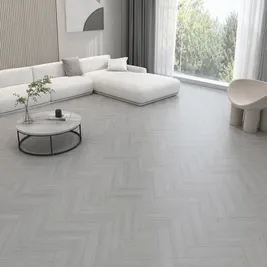
Herringbone vs. Chevron — Both Available

Herringbone
Rectangular planks that meet at a staggered V. The most recognized parquet pattern — broad market appeal across residential and commercial segments.

Chevron
Planks cut at an angle (typically 45° or 60°) so the ends meet in a clean point. More formal and contemporary — commands an even higher price point in Western Europe and Australia.
We produce both on the same lines with different profiling setups. If your market has demand for both patterns, they can be sourced together in a single container order.
Match Your Décor Preferences to Our Film Library
Send us your target species, grain character, and market — we'll match them to our 200+ film library and send physical samples before you commit to an order.
Market Segments Where Herringbone SPC Generates Premium Returns
The broad SPC market covers many product types. These are the specific channels where herringbone pattern vinyl flooring outperforms standard plank — where the pattern premium translates directly to margin for your business.

Residential Renovation and Remodel Distribution
Homeowners renovating living rooms, entryways, and open-plan spaces are willing to pay more for a pattern that looks like traditional parquet without the cost of real wood installation. For your distribution business, herringbone SPC in the renovation channel means higher per-square-meter revenue on the same shelf space.
The product moves through the same sales channels as standard plank — same installers, same subfloor requirements — but at a 20–40% price premium. Most of our distributors stock 3–5 herringbone décors alongside their standard plank range and see herringbone account for 10–15% of residential SPC revenue at disproportionately higher margin.

Hospitality and Commercial Fit-Out
Hotels, restaurants, boutique retail, and co-working spaces specify herringbone for the visual upgrade over standard plank flooring. The pattern signals design intent — it tells the space's occupants that someone made a deliberate aesthetic choice.
For your project contracting or commercial distribution business, hospitality herringbone projects tend to be larger per-order (500–2,000 sqm per property) with repeat potential across hotel chains or restaurant groups. Specify 0.5mm or 0.7mm wear layer for commercial traffic, and the click-lock installation means your project timeline stays shorter than glue-down parquet alternatives.

Multi-Family and Build-to-Rent Development
Property developers building rental units use herringbone SPC as a value-engineering play: the pattern elevates the perceived quality of the unit, supporting higher rental rates, while the installed cost stays well below real wood parquet. Click-lock installation means faster unit completion. Waterproof rigid core means no swelling claims from tenant-caused water damage.
For your business, multi-family herringbone projects are high-volume, repeatable orders — a single development can require 5,000–20,000 sqm across multiple buildings, and developers who see the rental premium tend to specify herringbone on subsequent projects.

European and Australian Retail Markets
Herringbone has deeper market penetration in Europe and Australia than in North America. European buyers — particularly in the UK, Netherlands, Germany, and Scandinavia — have a long tradition of parquet flooring, and herringbone SPC is the modern, waterproof replacement. Australian buyers have followed the same trend.
If you distribute into these markets, herringbone SPC is not a niche add-on — it's a core catalog requirement. We ship more herringbone to the UK and Australia combined than to any other region. The pattern preference is strong enough that some of our European distributors carry more herringbone SKUs than standard plank.
Tell us your target market and segments
We'll recommend a herringbone SKU mix matched to your channel, volume, and margin targets.
Parquet SPC Flooring vs. Traditional Parquet — Your Margin Comparison
Your buyers are choosing between herringbone SPC and traditional wood parquet. Understanding the cost structure helps you position the product and protect your margin.
| Factor | Herringbone SPC Flooring | Traditional Wood Parquet |
|---|---|---|
| Material cost | Lower — rigid core composite vs. solid or engineered hardwood | Higher — real wood species pricing, volatile with lumber markets |
| Installation method | Click-lock, tool-free, floating installation | Glue-down or nail-down, requires skilled parquet installer |
| Installation labor cost | Standard flooring installer rates | Premium parquet installer rates (30–50% higher in most markets) |
| Subfloor preparation | Minimal — SPC tolerates minor subfloor imperfections | Extensive — requires flat, dry, clean subfloor |
| Moisture performance | Zero water absorption rigid core | Vulnerable to moisture — swelling, cupping, gaps |
| Maintenance cost | Standard vinyl floor care | Periodic sanding and refinishing required |
| Warranty claim risk | Low — waterproof, dimensionally stable | Higher — moisture damage, seasonal movement |
The Total Installed Cost Argument
For your business, the comparison lands on total installed cost and warranty exposure. Herringbone SPC delivers the parquet visual at roughly 40–60% of the total installed cost of real wood parquet, with near-zero moisture-related warranty claims.
That's the pitch your downstream buyers use to close the sale, and it's the reason parquet SPC flooring has been taking share from traditional wood in every market we ship to.
Lower Warranty Exposure
Waterproof rigid core eliminates the moisture-damage claims that drive warranty costs on real wood parquet. Dimensionally stable under temperature cycling means fewer gap and cupping complaints.
Standard Installer Pool
Click-lock floating installation means any standard flooring installer can lay herringbone SPC. You're not dependent on the smaller, more expensive pool of skilled parquet installers.
Predictable Material Pricing
Rigid core composite pricing is stable compared to real wood species, which tracks volatile lumber markets. Easier to quote projects and protect margin across a full season.
Faster Project Completion
Minimalsubfloor prep and click-lock installation means faster project turnaround. Less time on site reduces labor cost and lets your customers move in sooner.
Where Herringbone SPC Performs Best
The pattern works in almost every residential and light commercial setting. These are the rooms where your buyers see the strongest sell-through and the fewest post-installation issues.
Living Rooms
The herringbone pattern anchors open-plan living spaces and creates a focal point without requiring rugs or feature walls. High-traffic durability means the floor holds up under daily family use.
- AC4 wear layer handles furniture legs and pet claws
- Underfloor heating compatible — stable under temperature cycling
- Wide plank formats elongate smaller rooms visually
Kitchens
Waterproof rigid core makes herringbone SPC one of the few pattern floors that can go directly into a kitchen without moisture risk. Spills, steam, and humidity are non-issues.
- 100% waterproof — no swelling around dishwashers or sinks
- Stain-resistant wear layer wipes clean easily
- Runs continuously from kitchen into open-plan dining — no transition strips
Bathrooms
A herringbone pattern in a bathroom reads as a deliberate design choice — the kind of detail that photographs well and drives word-of-mouth referrals for your buyers.
- Waterproof core handles wet zones and steam
- Warmer underfoot than tile — no cold floor complaints
- Smaller plank formats suit compact bathroom layouts
Hallways & Entryways
Herringbone is a classic hallway pattern — the diagonal lines draw the eye forward and make narrow corridors feel wider. High foot traffic and tracked-in dirt are handled by the AC4/AC5 wear layer.
- Scratch-resistant surface stands up to grit and shoe traffic
- Diagonal layout visually widens narrow hallways
- Continuous run from entry through living area — no breaks
Bedrooms
Acoustic underlayment options make herringbone SPC a comfortable bedroom floor — quieter underfoot than tile and warmer than stone. The pattern adds character without overwhelming smaller rooms.
- Pre-attached or add-on underlayment for sound reduction
- Underfloor heating compatible for master suite applications
- Consistent look across entire home — no style breaks between rooms
Light Commercial
Boutique retail, hospitality, and office fit-outs are a growing segment for herringbone SPC. AC5-rated wear layers meet light commercial specifications, and the pattern elevates the space without a custom tile budget.
- AC5 wear layer rated for light commercial foot traffic
- Fast installation minimizes business downtime during fit-out
- Consistent batch availability for large commercial orders
The Whole-Home Continuity Advantage
Because herringbone SPC is waterproof, it can run continuously from living areas through kitchens, bathrooms, and hallways — no transition strips, no style breaks, no different flooring categories to manage. That's a significant selling point for new builds and full renovations, and it simplifies your buyer's specification process.
Customization for Your Herringbone SPC Line
We do full OEM/ODM on herringbone SPC — same capability as our standard SPC range, with a few herringbone-specific options. Every parameter below is configurable from a single 1,000 sqm order.
Plank Dimensions
Standard tooling covers 120mm × 600mm and 150mm × 750mm. Custom dimensions available on orders of 1,000 sqm or more per SKU.
Pattern Type
Both patterns use click-lock installation. Chevron requires a different profiling setup — we recommend committing to one pattern type per production run to keep unit cost efficient.
Décor and Surface
Full access to our 200+ décor film library. Custom décor development available. EIR texture plates can be developed to match your specific décor — the plate becomes exclusive to your account at container-volume orders.
Core and Wear Layer
We'll recommend the configuration based on your target market and price positioning.
Packaging
Private-label cartons with your branding, UPC barcodes, multilingual care instructions, moisture barrier wrapping for humid-climate destinations.
Herringbone cartons are typically smaller than standard plank cartons — shorter planks mean a smaller carton footprint, which can be an advantage for retail shelf display.
MOQ & Sample Lead Time

Container Loading and Freight for Herringbone SPC
Herringbone planks are shorter than standard SPC planks, which changes the container loading math in your favor. Here's what that means for your landed cost per square meter.
Loading Efficiency Comparison
Herringbone SPC typically loads 5–10% more square meters per 40HQ container than equivalent-thickness standard plank, because the shorter cartons fill container space more efficiently with less dead air between pallets. That's a meaningful difference on your landed cost per square meter.
Dual-Origin Production Routing
Both our Changzhou (China) and Rayong (Thailand) facilities produce herringbone SPC. The product is identical from both plants. Route your order based on the same tariff and freight logic that applies to our full SPC range.
Changzhou, China
Origin AStandard routing to North America and Europe. Use for markets without anti-dumping duties on Chinese flooring.
Rayong, Thailand
Origin BFor markets with anti-dumping duties on Chinese flooring. Thailand origin provides duty-advantaged routing with identical product quality.
The product is identical from both plants. Your choice of origin is purely a tariff and freight optimization decision — not a quality tradeoff.


Get a Loading Plan and Landed Cost Estimate
Tell us your destination port, target thickness, and preferred origin. We'll send back a container loading plan with estimated sqm per 40HQ and a landed cost breakdown so you can model your margin before committing.
Quality Control Specific to Herringbone Production
Our category-wide QC process — raw material inspection, inline monitoring, 100% visual inspection, pre-shipment AQL audit — applies to every product we make. The SPC flooring overview covers that in detail. Here's what we add specifically for herringbone SPC production.
Profile Assembly Testing
Beyond single-plank click-lock testing, we assemble a 6-plank herringbone panel from every profiling batch. The panel gets measured at all 90° intersections for joint gap, surface lippage, and locking engagement strength. This catches tolerance stack-up issues that single-plank testing misses.
Décor Pattern Alignment Check
On herringbone planks, the wood grain direction is critical — every plank in a carton must have the grain running the same way so the installer can create the alternating pattern. We check grain direction consistency during the visual inspection station.
A single reversed-grain plank in a carton creates a visible defect in the installed floor that requires pulling up and replacing planks.
Why this checkpoint exists: This sounds like a minor detail, but we caught it as a recurring issue in our first year of herringbone production. Now it's a dedicated checkpoint.
Dimensional Consistency Within Carton
Herringbone installation is less forgiving of plank-to-plank dimensional variation than straight-run installation. We tighten the within-carton dimensional tolerance to ±0.05mm on length and width — tighter than our standard ±0.15mm width tolerance — because the 90° joint amplifies any size inconsistency.

Three Herringbone-Specific QC Checkpoints
If Herringbone Isn't the Right Fit — Other SPC Lines Worth Considering
Herringbone SPC occupies a specific position: premium pattern, higher margin, design-driven markets. If your business needs point in a different direction, here's where to look within our SPC range.
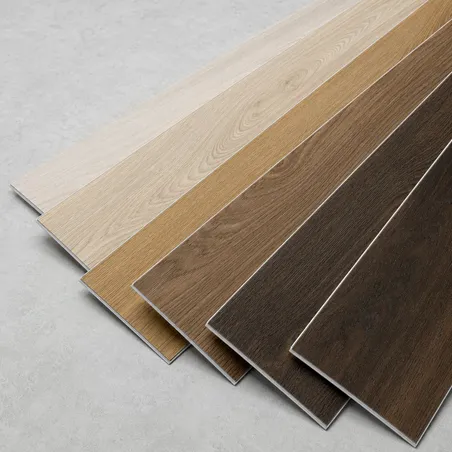 Highest Volume
Wood-Look SPC Flooring
Need volume at a lower price point?
The bread-and-butter line — 200+ décors, standard plank dimensions, the highest-volume product in residential and light commercial distribution.
View Wood-Look SPC →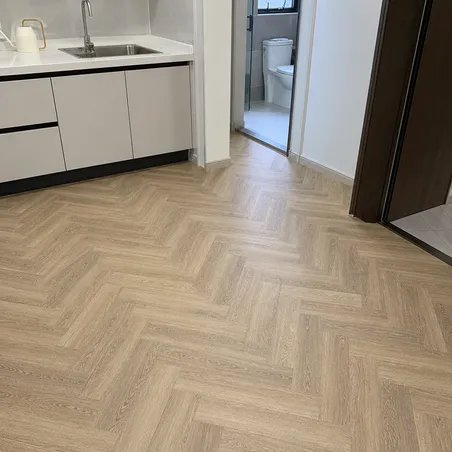 Wet-Area Fit
Waterproof SPC Flooring
Need waterproof performance as the primary selling point?
Positioned for wet-adjacent spaces — kitchens, bathrooms, laundry rooms — where the zero water absorption core is the lead feature rather than the pattern.
View Waterproof SPC →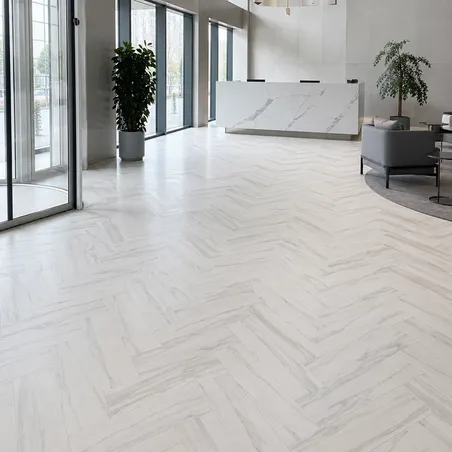 Commercial
Marble SPC Flooring
Need stone-look for commercial lobbies and retail?
Targets segments where ceramic tile has traditionally dominated, with faster installation and no grout maintenance.
View Marble SPC →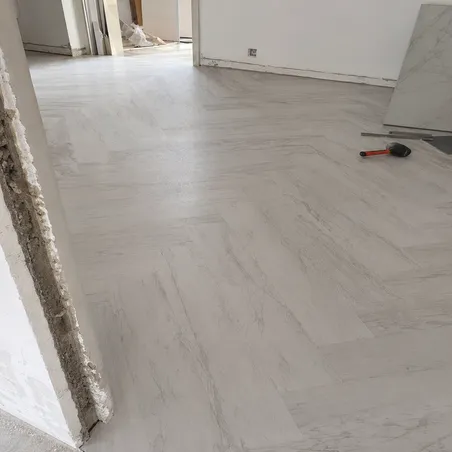 Renovation Fit
8mm SPC Flooring
Need maximum thickness for renovation projects?
Handles imperfect subfloors that thinner products would telegraph — strong fit for remodel distribution channels.
View 8mm SPC →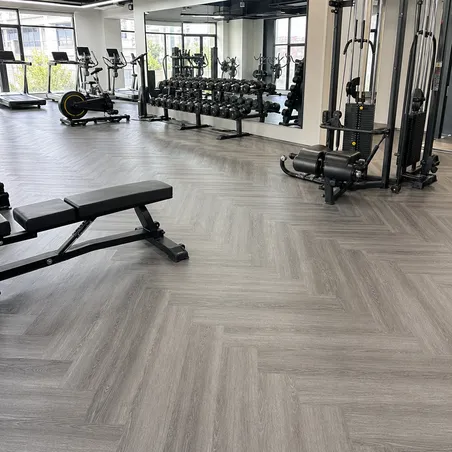 Fitness & Rec
Gym SPC Flooring
Need commercial gym or fitness flooring?
Enhanced indentation resistance for the fitness and recreation segment — built for the load demands of commercial gym environments.
View Gym SPC →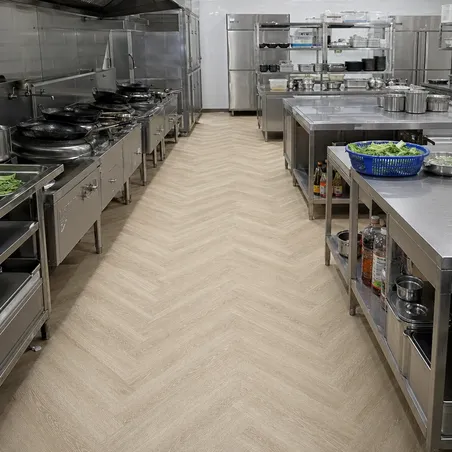 Food Service
Kitchen SPC Flooring
Need wet-area commercial flooring?
Slip-rated surfaces for food service and commercial kitchen applications — where wet-area safety compliance is the primary specification driver.
View Kitchen SPC →One Manufacturer. Seven SPC Product Lines.
All seven product lines are produced under the same QC standards across our dual-factory setup. You can source your full SPC catalog from one manufacturer — one quality system, one logistics relationship, one point of contact.
Frequently Asked Questions About Herringbone SPC Flooring
Decision-support answers for distributors, importers, and commercial fit-out buyers evaluating herringbone SPC for the first time or scaling an existing line.
Can herringbone SPC flooring be installed without glue using click-lock?
Yes. Our herringbone SPC uses precision-milled click-lock profiles that allow floating installation — no glue, no nails, no adhesive. The planks engage at 90° angles through the locking mechanism.
The key is profile tolerance: our ±0.05mm CNC-milled profiles ensure tight engagement at the herringbone intersections. If you've seen herringbone products that require glue-down, those are typically using less precise profiles that can't maintain a gap-free joint through mechanical locking alone.
Buyer implication: Click-lock herringbone means your buyers' installation labor cost stays at standard flooring installer rates, not premium parquet installer rates.
What is the difference between herringbone and chevron SPC flooring?
Rectangular planks in a staggered V-pattern — short end meets long edge. Traditional, textured feel. Broader market demand.
Angled-cut planks (45° or 60°) meeting in a clean pointed V. More formal, geometric. Slightly higher retail price, lower volume demand.
Both use click-lock installation and the same core/wear layer configurations. We produce both — if you're testing the pattern category, start with herringbone for broader market appeal, then add chevron as a premium tier.
How does herringbone SPC compare to herringbone laminate for distribution?
Three advantages for your business:
Herringbone laminate swells when exposed to moisture, generating warranty claims in kitchens, bathrooms, and any space with water exposure. Herringbone SPC has zero water absorption.
SPC's rigid core doesn't expand and contract with humidity changes the way laminate's HDF core does, so you see fewer gapping and peaking complaints.
5mm herringbone SPC with pad is thinner than most herringbone laminate — more square meters per container and lower freight cost per unit.
Trade-off: Laminate has a lower material cost per square meter. But when you factor in warranty claim rates and freight efficiency, SPC typically wins on total cost of ownership for the distributor.
What wear layer thickness should I specify for herringbone SPC in commercial projects?
Offices, boutique retail, hotel rooms. Supports 10–15 year commercial warranty. Most herringbone buyers targeting hospitality specify this as default — balances cost against warranty position.
Hotel lobbies, restaurant dining rooms, high-traffic retail. Supports 15–20 year commercial warranty. Reserve for accounts that specifically require heavy commercial ratings or extended warranty periods.
What is the minimum order for custom-décor herringbone SPC?
Same as our standard collections — roughly half a 40HQ container for 5mm herringbone SPC.
From design confirmation. Evaluate click-lock engagement, surface texture, and décor accuracy before committing to production.
Typically a light oak, a medium walnut, and a grey contemporary — to test which colorways move in your market before scaling to container volumes.
You can test a custom décor in your market without committing to a full container of a single pattern. Most new herringbone buyers start at minimum quantity, then scale to container volumes on reorder once they know which colorways perform.
Source Herringbone SPC Flooring from Elefloor
You've seen the specs, the production details, and the market positioning. Here's how to move forward.
Already know your requirements?
If you already know your herringbone requirements — décor preferences, thickness, wear layer, target volume — send them over. We'll come back with pricing, a sample timeline, and a production schedule. Samples ship within 7 days so you can evaluate the click-lock engagement, surface texture, and décor accuracy in hand before committing to a production order.
Adding herringbone to your catalog for the first time?
Tell us your target market, your current plank SPC price positioning, and the segments you're selling into. We'll recommend a starter herringbone SKU selection based on what's performing for our existing distributors in similar markets.
