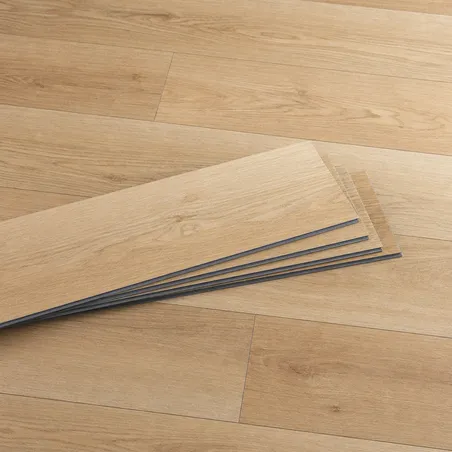
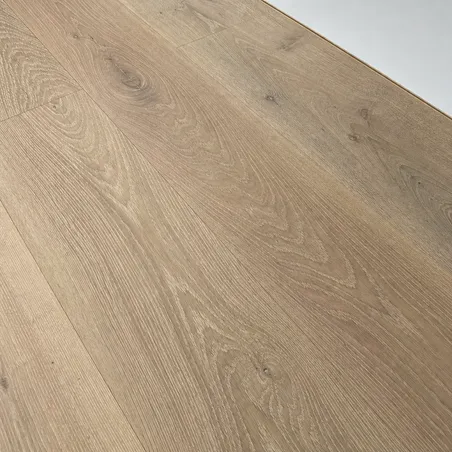
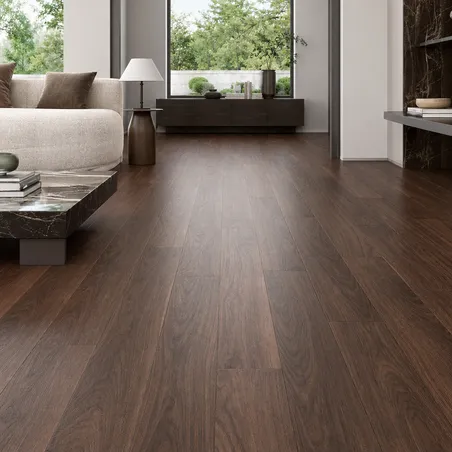
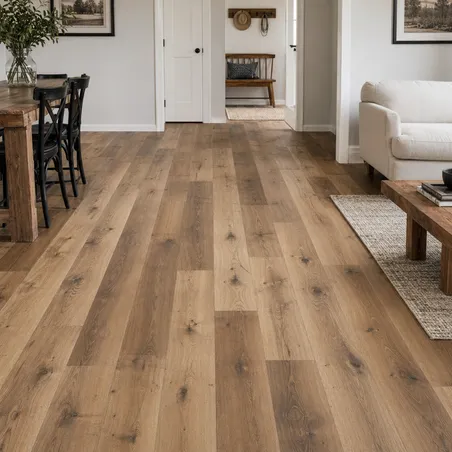
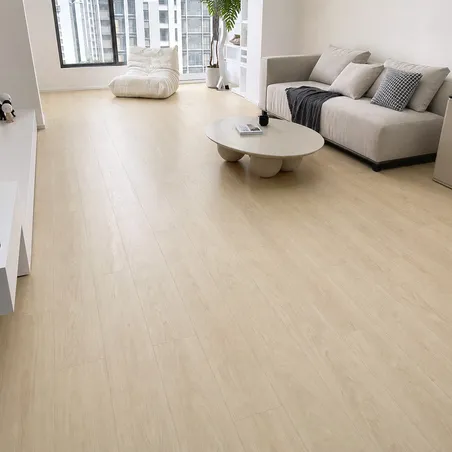
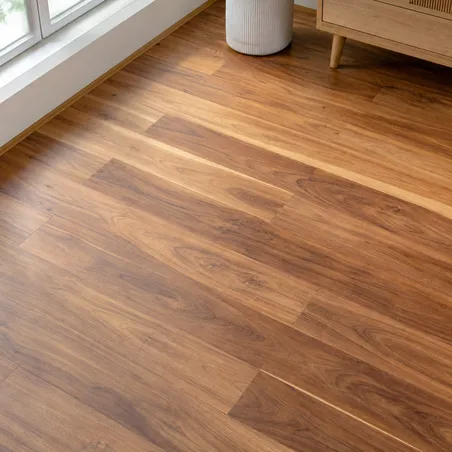
Real wood veneer bonded to a waterproof SPC core — hardwood aesthetics with rigid-core stability.
Your customers get the look and feel of solid hardwood. You get zero moisture claims, lower landed cost than engineered hardwood, and a product that opens both residential and commercial channels.
Hardwood SPC flooring is a real wood veneer face layer permanently bonded to a stone-polymer composite core. The veneer is typically 0.6mm of sliced hardwood — oak, walnut, hickory, maple, acacia — laminated under heat and pressure onto the same rigid SPC substrate we've been producing since 2012. Underneath, the core is the same calcium-carbonate-and-PVC formulation that makes standard SPC waterproof and dimensionally stable. On top, it's genuine wood grain you can sand lightly and refinish once, with the natural color variation and tactile depth that no print film replicates.
The commercial logic is straightforward. Engineered hardwood sells at premium price points but carries moisture risk, subfloor prep requirements, and warranty exposure in wet-adjacent spaces. Standard SPC with printed décor film handles moisture but can't match real wood on touch or visual depth — experienced buyers and end users notice the difference. Hardwood SPC flooring sits in the gap: waterproof hardwood SPC flooring that gives your downstream customers the hardwood experience while giving you the claim profile of rigid-core vinyl. You stock one product that covers kitchens, bathrooms, basements, and living areas without splitting your SKU list into "wet zone" and "dry zone" categories.
We started developing our hardwood SPC line in 2019, after several North American distributors asked us to solve the same problem — they wanted to sell into the hardwood replacement market but kept eating warranty claims on engineered wood in below-grade and wet-area installations. The first production runs taught us that veneer bonding on SPC is a different discipline than standard SPC lamination. The adhesive system, press temperature, and press dwell time all had to be recalibrated because the wood veneer expands and contracts differently than PVC décor film.
We went through four adhesive formulations before settling on the polyurethane-reactive system we use now — the earlier EVA-based adhesives delaminated under thermal cycling tests.
For your product line, hardwood SPC flooring opens a pricing tier above standard printed SPC and below solid or engineered hardwood. Distributors we work with typically position it at 30–50% above their best-selling wood-look SPC, with margins that reflect the real-material premium. Contractors use it on projects where the architect specified hardwood but the budget or site conditions don't support it — the spec substitution conversation is easier when you can hand them an actual wood surface.

We ship within 7 days so you can evaluate veneer quality and click-lock fit before committing to volume.
Premium price point. Moisture risk, subfloor prep requirements, warranty exposure in wet-adjacent spaces.
Real wood surface. Waterproof SPC core. One SKU covers kitchens, bathrooms, basements, and living areas. 30–50% above printed SPC pricing.
Handles moisture. Can't match real wood on touch or visual depth — experienced buyers and end users notice the difference.
These numbers matter when you're filling out a project spec sheet or building a comparison against engineered hardwood. The SPC core gives you the dimensional stability and water resistance numbers that engineered hardwood can't match — your spec comparison lands in your favor on every moisture-related parameter.
| Parameter | Typical Specification |
|---|---|
| Overall thickness | 5.5mm – 7.5mm (veneer + SPC core + attached pad) |
| Wood veneer face layer | 0.6mm sliced hardwood veneer (oak, walnut, hickory, maple, acacia) |
| SPC core thickness | 4.0mm – 5.5mm rigid stone-polymer composite |
| Core density | 1,900 – 2,100 kg/m³ |
| Attached underlayment | 1.0mm – 1.5mm IXPE or EVA acoustic pad |
| Plank dimensions | 1,220mm × 180mm (standard); 1,500mm × 190mm (long plank) available |
| Click-lock system | Unilin-type or Valinge-type drop-lock profile, CNC-milled |
| Wear rating | AC4 (residential heavy / moderate commercial) |
| Surface treatment | UV-cured lacquer over natural wood veneer, 4–6 coats |
| Water resistance | SPC core: 0% water absorption; veneer face: UV lacquer sealed |
| Dimensional stability | < 0.1% length/width change after 6 hours at 80°C (EN 434) |
| Formaldehyde emission | E1 or E0 class; FloorScore compliant (CDPH Section 01350) |
| Fire rating | Bfl-s1 (EN 13501-1) |
| Thermal conductivity | Compatible with underfloor heating systems up to 28°C surface temperature |
Specifications shown are industry-standard values for this product type. Actual specifications may vary by SKU and veneer species. Contact us for detailed product data sheets.
The SPC core absorbs zero water. Engineered hardwood can't make this claim. Every moisture-related spec comparison lands in your favor.
Compatible with radiant heating systems up to 28°C surface temperature. Real wood warmth, modern heating compatibility — a combination engineered hardwood struggles to match.
Rated for residential heavy use and moderate commercial traffic. Spec it into multi-family, boutique retail, or hospitality projects with confidence.
E1/E0 formaldehyde class and CDPH Section 01350 compliance. Clears the indoor air quality requirements for LEED and WELL projects without extra documentation work.
The veneer species is the first thing your customer sees and touches. Each species carries a distinct grain character, color range, and hardness profile. Knowing the differences lets you match the right SKU to the right project — and gives your sales team a credible story to tell at the point of sale.
Best for: Residential new builds, multi-family, hospitality, retail
Best for: High-end residential, boutique hospitality, design-led retail
Best for: Rustic residential, mountain/lodge hospitality, pet-friendly homes
Best for: Urban apartments, Scandinavian-style residential, commercial offices
Best for: Luxury residential, resort hospitality, statement commercial spaces
Need a species not listed here — teak, ash, cherry, or a regional hardwood for a specific market? We work with veneer mills across Southeast Asia, Europe, and North America. Minimum order quantities apply for custom species development.
Discuss Custom Species4–6 coats UV-cured lacquer. Clean, contemporary look. Easy to maintain. Most common finish for residential and commercial projects.
StandardMechanical brushing opens the grain texture before lacquering. Adds tactile depth and a more natural, aged appearance. Hides minor surface wear.
Popular UpgradeSimulated hand-scraping creates an artisan, reclaimed-wood aesthetic. Each plank has a unique surface profile. Strong appeal in rustic and farmhouse styles.
PremiumLow-sheen finish reduces glare and fingerprint visibility. Preferred by interior designers for high-end residential and hospitality projects where a natural look is required.
Popular UpgradeThe SPC core eliminates most of the subfloor prep headaches that come with engineered hardwood. No acclimation period. No glue-down requirement. Floating click-lock installation over virtually any existing subfloor. Here's what your installers and end customers need to know.
Check for flatness: maximum 3mm deviation over a 1.8m span. SPC's rigidity bridges minor imperfections that would telegraph through thinner LVP. Grind down high spots; self-level low spots exceeding tolerance.
Compatible subfloors: Concrete slab, plywood, OSB, existing ceramic tile, existing vinyl. Remove carpet and carpet pad before installation.
Unlike engineered hardwood, hardwood SPC does not need to acclimate to the room's humidity before installation. The SPC core is dimensionally stable regardless of ambient moisture conditions. Open the boxes and install.
Installer time saving: Eliminates the 48–72 hour acclimation wait standard with engineered hardwood. Faster project turnaround for contractors.
Use the drop-lock (angle-angle or fold-down) method. Stagger end joints by a minimum of 200mm between adjacent rows. Maintain a 10mm expansion gap at all fixed vertical surfaces — walls, door frames, cabinets, and columns.
Max continuous run
15m without expansion break (length or width)
Expansion gap
10mm minimum at all fixed vertical surfaces
Hardwood SPC is waterproof at the core level. For bathrooms, laundry rooms, and kitchens, seal the expansion gap at walls with a flexible silicone sealant rather than leaving it open. Do not install in areas with standing water or direct water immersion.
Note: The veneer layer itself is not waterproof. Prolonged surface water exposure can raise grain or cause edge swelling. Wipe spills promptly. Silicone-seal perimeter joints in wet areas.
Compatible with both electric mat and hydronic underfloor heating systems. Maximum surface temperature must not exceed 27°C. Ramp heating up gradually over 7 days when commissioning a new system beneath hardwood SPC.
Max floor temp
27°C surface temperature limit
Commissioning
7-day gradual ramp-up for new systems
Install matching T-moldings at doorways and transition strips where the floor meets other flooring types. Fit skirting boards or scotia beading to cover the expansion gap at walls. Remove spacers only after all perimeter trim is secured.
Trim accessories: Matching species T-moldings, end caps, stair nosings, and reducer strips available to order alongside flooring. Confirm species and finish when placing your order.
Most of our hardwood SPC ranges include a pre-attached IXPE or cork underlay on the back of each plank. No separate underlay purchase is required in most cases.
If installing over hydronic underfloor heating, confirm the underlay's thermal resistance (tog rating) with your heating engineer to ensure adequate heat transfer.
Full installation manual with diagrams, subfloor prep specs, and warranty conditions available on request.
Request Installation ManualBuyers frequently ask how hardwood SPC stacks up against traditional engineered hardwood and solid hardwood flooring. The honest answer depends on the application. Here's a direct comparison across the factors that matter most to importers, contractors, and end users.
| Feature | Hardwood SPC | Engineered Hardwood | Solid Hardwood |
|---|---|---|---|
| Water Resistance | 100% Waterproof Core | Water-resistant (not waterproof) | Not water-resistant |
| Dimensional Stability | Excellent | Good (some movement) | Significant seasonal movement |
| Real Wood Surface | Yes (0.5–3mm veneer) | Yes (2–6mm layer) | Yes (full thickness) |
| Refinishing | Limited (veneer thickness dependent) | 1–3 times (layer dependent) | Multiple times |
| Installation Method | Click-lock float | Float, glue, or nail/staple | Nail/staple or glue-down |
| Acclimation Required | No | 48–72 hours | 5–7 days minimum |
| Subfloor Compatibility | Concrete, tile, vinyl, ply | Plywood preferred; concrete with DPM | Plywood / timber subfloor only |
| Below-Grade Installation | Yes | Not recommended | Not suitable |
| Underfloor Heating | Compatible | Compatible (check spec) | Limited / not recommended |
| FOB Price Range (USD/m²) | $8–$22 | $12–$35 | $18–$60+ |
| Perceived Value | High (real wood look) | High | Premium |
This is where hardwood SPC flooring either works or fails. If you've been burned by delamination on cheaper veneer products, this section is worth reading carefully.
Wood is hygroscopic — it absorbs and releases moisture, expanding and contracting across the grain. SPC is dimensionally inert. Bond those two materials together with the wrong adhesive or the wrong process, and thermal cycling pulls them apart.
We've seen competitor samples where the veneer lifts at the edges after 30 days in a humidity chamber. The product looks fine on the showroom floor and fails in the field.
We use a polyurethane-reactive (PUR) hot-melt adhesive applied between the veneer and the SPC core surface. PUR cross-links after application, forming a bond that's both flexible enough to accommodate the veneer's micro-movement and strong enough to pass peel-strength testing at elevated temperatures.
We apply adhesive at controlled film thickness — too thin and you get dry spots that become delamination points, too thick and the adhesive bleeds through the veneer grain. The press runs at 120–140°C with a dwell time calibrated to each veneer species. Oak is more forgiving; walnut needs a shorter dwell to avoid surface darkening.
After pressing, the veneer surface receives 4–6 coats of UV-cured lacquer. Each coat is cured individually under UV lamps before the next is applied. The lacquer seals the wood surface against moisture penetration from above (spills, mopping) and provides the scratch and abrasion resistance that raw wood veneer lacks.
The finished surface passes ASTM D4060 Taber abrasion testing at levels consistent with AC4 wear ratings. The lacquer serves two purposes simultaneously: moisture sealing from above and mechanical wear resistance.
The cross-cut adhesion test — we score the veneer surface in a grid pattern and apply tape pull per ASTM D3359. Every production batch gets tested. If adhesion drops below a 4B rating, we stop the line and recalibrate press temperature and adhesive application.
This test catches problems that visual inspection misses — a veneer can look perfectly bonded and still have weak adhesion that shows up six months after installation.
A properly bonded hardwood SPC plank with sealed veneer performs like standard SPC in wet environments — your warranty exposure on moisture-related failures drops to near zero compared to engineered hardwood, while you're selling a product with genuine wood on the surface.
We maintain a library of veneer species and stain finishes covering major design trends across North American, European, and Asia-Pacific markets. Species selection isn't just aesthetic — each wood has different grain characteristics, hardness, and color range that affect which market segments respond to it.
Volume Leader
Tight, consistent grain with natural color ranging from pale straw to warm honey. Takes stain well for custom color programs. If you're entering the hardwood SPC category for the first time, white oak is the safe starting point — it moves in every channel.
Slightly wider grain pattern than white oak, with more pronounced cathedral figuring. Popular in European and Oceanian markets where the rustic-modern aesthetic drives residential specification.
Premium
Rich chocolate-brown tones with distinctive grain contrast. Higher perceived value supports premium pricing. Walnut veneer is more expensive to source — your margin per square meter is typically higher even at lower volume.
Bold, varied grain with significant color range within a single plank. Strong in the North American market, particularly for rustic and farmhouse design trends. The natural variation means fewer complaints about plank-to-plank color matching — buyers expect the variation.
Fine, uniform grain with a light, clean appearance. Moves well in commercial and modern-residential channels where a minimalist aesthetic is specified.
Dramatic grain movement with warm amber-to-brown tones. Growing demand in Southeast Asian and Middle Eastern markets. Acacia veneer sources are stable and cost-effective compared to walnut.
Clear UV coat over raw veneer color. Preserves the natural wood tone and grain character without color modification.
Textured grain for a hand-scraped feel. Adds tactile depth and visual interest while maintaining the natural wood appearance.
Ammonia-treated for deeper color without stain. Produces rich, even tones that penetrate the wood fiber rather than sitting on the surface.
Matched to your sample or Pantone reference. MOQ applies. Ideal for OEM buyers building a branded collection with proprietary colorways.
We can develop custom veneer programs — you select the species, stain, and surface texture, and our R&D team produces samples within 7 days. For OEM buyers building a branded collection, we typically recommend starting with 3–5 SKUs across two species to test market response before expanding the range.
Every SPC product is waterproof at the core level. What makes waterproof hardwood SPC flooring different is that the surface is real wood — and wood, by nature, is not waterproof. The engineering challenge is sealing the veneer surface thoroughly enough that the plank performs like standard SPC in wet environments while preserving the natural wood look and feel.
Surface + all four edges
Our UV lacquer system seals the veneer face and all four edges of the plank. The click-lock joint is tight enough to prevent water from reaching the core through the seams under normal conditions — standing water on the surface for up to 24 hours produces no swelling, cupping, or delamination in our lab testing.
We test this on every new veneer species because different woods absorb lacquer at different rates — a porous species like oak needs more lacquer penetration than a tight-grained maple.
Engineered hardwood manufacturers explicitly exclude wet areas from their warranties. You can sell hardwood SPC flooring into kitchens, bathrooms, laundry rooms, and below-grade basements — spaces where engineered hardwood distributors lose the sale or accept the warranty risk.
That's not a marginal advantage; it's an entire category of projects that opens up when you switch from engineered hardwood to hardwood SPC in your catalog.
Hardwood SPC flooring is not rated for full submersion or outdoor use. The veneer surface, even sealed, will degrade under prolonged UV exposure and standing water beyond 24 hours. Position it as waterproof for indoor residential and commercial use — that's the honest claim, and it's more than enough to win the specification against engineered hardwood in every indoor application.
Four channels account for the majority of hardwood SPC volume. Each has a distinct buyer profile, order size, and reorder pattern — understanding the mix helps you build a catalog and pricing structure that serves all of them without cannibalizing margin.
The largest volume channel. Homeowners and their contractors want hardwood floors but face budget constraints or site conditions — concrete slab, below-grade, radiant heat — that make solid or engineered hardwood impractical. Hardwood SPC flooring is the specification alternative: real wood surface, click-lock installation over any flat subfloor, no acclimation period, no moisture barrier required on grade-level concrete.
Distributors serving the residential renovation market report that hardwood SPC is replacing engineered hardwood in 20–40% of projects where moisture is a concern.
Hotels, restaurants, and retail spaces that specify hardwood for aesthetic reasons but need commercial-grade durability and moisture resistance. A boutique hotel lobby with 200 sqm of real oak flooring that's also waterproof and click-lock installed — that's a project your sales team can quote confidently without worrying about the maintenance and moisture claims that follow traditional hardwood in high-traffic commercial spaces.
Property developers building mid-to-high-end apartments and condominiums use hardwood SPC flooring to deliver a hardwood finish across hundreds of units without the installation complexity and moisture risk of engineered hardwood. The click-lock system cuts installation time by 30–40% compared to glue-down engineered hardwood, which matters when you're fitting out 200 units on a construction schedule.
Developers order in bulk and they reorder the same SKU for subsequent phases — one successful project creates a multi-year supply relationship.
Corporate offices and co-working spaces that want the warmth of wood flooring in reception areas, executive suites, and meeting rooms. The SPC core handles rolling chair loads and high foot traffic better than engineered hardwood, and the waterproof core means no damage from spilled coffee or cleaning protocols.
Commercial office is a specification-driven channel — once your product is written into an architect's spec library, it generates repeat orders across multiple projects.
Order size, reorder pattern, and primary buyer by channel
| Segment | Typical Order | Reorder Pattern | Primary Buyer |
|---|---|---|---|
| Residential Renovation | Variable | Seasonal (spring/fall) | Homeowner / contractor |
| Boutique Hospitality & Retail | 500–2,000 sqm | Project-based, longer lead | Hotel / F&B operator |
| Premium Multi-Family | 5,000–20,000 sqm | Phase reorders, multi-year | Property developer |
| High-End Commercial Office | Project-dependent | Cross-project, spec-driven | Architect / fit-out contractor |
We'll recommend a starter SKU mix matched to your channel — whether you're entering residential renovation, targeting hospitality projects, or building a multi-family supply relationship.
We're direct about what's configurable and what isn't. Below is the full picture — so you can scope your project accurately before we get into sample development.
We can source, but lead time extends to 3–4 weeks for veneer procurement and sample development.
Possible but requires tooling adjustment. MOQ increases to 3,000 sqm.
Our CNC profiling machines can adjust locking tension and angle, but profile changes require engineering review — typically 5–7 days.
The thermal expansion differential becomes too large for reliable long-term bonding. We've tested it. The math doesn't work above 1.0mm without compromising dimensional stability.
The UV lacquer system is formulated for indoor use. Outdoor UV exposure degrades the veneer surface within 12–18 months regardless of coating thickness.
| Order Type | MOQ per SKU | Production Lead Time | Notes |
|---|---|---|---|
| Standard species & finishes | 1,000 sqm | 15–20 days after sample approval | — |
| Custom stain or new species | 2,000 sqm | 25–30 days | Includes veneer sourcing and sample iteration |
| Sample lead time | — | Within 7 days | From specification confirmation |
Ready to scope your project?
Send your customization requirements — species, dimensions, finish, volume — and we'll respond with a detailed proposal.
If you're already carrying engineered hardwood or standard SPC, you're evaluating where hardwood SPC flooring fits in your catalog — whether it replaces an existing line or opens a new tier.
| Dimension | Engineered Hardwood | Hardwood SPC Flooring | Standard Printed SPC |
|---|---|---|---|
| Surface material | 0.6mm–4mm solid wood veneer | 0.6mm solid wood veneer on SPC core | PVC décor film (printed) |
| Water resistance | Limited — wood core absorbs moisture | Full — SPC core is waterproof | Full — SPC core is waterproof |
| Dimensional stability | Moderate — affected by humidity swings | High — SPC core is inert | High — SPC core is inert |
| Refinishability | Yes (1–3 times depending on veneer thickness) | Yes (1 light sand-and-refinish) | No |
| Installation method | Glue-down, nail-down, or floating | Click-lock floating only | Click-lock floating only |
| Subfloor requirements | Moisture barrier required on concrete | Direct over flat concrete, no barrier needed | Direct over flat concrete, no barrier needed |
| Underfloor heating | Limited compatibility | Compatible up to 28°C surface temp | Compatible up to 28°C surface temp |
| Wet area suitability | Not recommended | Yes — kitchens, bathrooms, basements | Yes |
| Typical retail price tier | $$$ | $$ | $ |
| Warranty claim risk | Higher (moisture, cupping, gapping) | Low — SPC core eliminates moisture claims | Low |
Hardwood SPC flooring doesn't replace your entire engineered hardwood line — it replaces engineered hardwood in every application where moisture, subfloor conditions, or installation speed matter.
And it upgrades your standard SPC offering for buyers who want real wood but won't accept the risk profile of engineered hardwood.
You end up with three tiers instead of two, and the middle tier captures the customers who were previously choosing between "too expensive and risky" and "not premium enough."
Three-Tier Catalog Structure
Engineered Hardwood
Dry areas, nail-down/glue-down, refinishable multiple times
Hardwood SPC Middle Tier
Real wood surface, waterproof core, any room, fast install
Standard Printed SPC
Printed décor film, waterproof, entry-level price point
If your market responds to specific industry terminology, WSPC flooring (wood stone plastic composite) and VSPC flooring (veneer stone polymer composite) are the same core technology with naming conventions that vary by region. We produce all three under the same process and QC standards — the difference is branding and market positioning, not product construction.
Hardwood SPC flooring ships in retail-ready cartons or bulk palletized packaging, configured to your destination market requirements.
6–8 planks per carton, approximately 1.3–1.8 sqm per carton depending on plank dimensions
48–60 cartons per pallet, shrink-wrapped with corner protectors
Approximately 1,200–1,400 sqm
Approximately 2,600–3,000 sqm
Private-label cartons with your brand, product name, UPC/EAN barcodes, and installation instructions
Multilingual care instructions — English, Chinese, Thai, French, German, Spanish, Arabic, and others on request
FBA-ready labeling and carton dimensions for Amazon sellers
Extra moisture barrier wrapping for shipments to humid port destinations
Hardwood SPC flooring is heavier per square meter than standard printed SPC — the wood veneer adds weight. Plan for approximately 8–12 kg/sqm depending on total thickness and core density.
The weight difference is marginal on a per-container basis but worth factoring into your landed cost model. Freight cost per sqm runs slightly higher than standard printed SPC.
Our dual-factory setup — Changzhou, China and Rayong, Thailand — gives you origin flexibility. For markets with anti-dumping duties on Chinese-origin flooring, the Thailand facility produces identical product with Southeast Asian origin documentation.
Your landed cost calculation may shift significantly depending on which facility ships your order. We can quote both origins so you can compare.
Request a Landed Cost Comparison
Hardwood SPC flooring from our production carries the same certification framework as our full SPC range — with additional VOC scrutiny specific to the wood veneer and PUR adhesive layers.
Quality management system certification covering our full production process
European market access compliance for flooring products
North American indoor air quality compliance — critical for this product given the wood veneer and PUR adhesive
EU chemical safety compliance with SGS testing on production batches
The wood veneer and PUR adhesive introduce organic materials that standard all-PVC SPC doesn't contain, so VOC testing is more critical for this product. Our hardwood SPC flooring passes CDPH Section 01350 testing — the same standard required for LEED v4 credit EQ 2 (Low-Emitting Materials).
Green-certified commercial projects: If you're bidding on LEED v4 projects, the FloorScore documentation is ready to attach to your submission.
The product achieves Bfl-s1 classification under EN 13501-1, which satisfies most European commercial building codes for floor coverings.
North American fire code compliance varies by jurisdiction. We provide the test reports; your local code consultant confirms applicability.
If your market requires a specific standard not listed above — CARB Phase 2, Singapore Green Label, Korean KS certification — tell us during the quoting process. We can arrange testing through SGS or Bureau Veritas.
Results typically available within 3–4 weeks.
Available on request — arrange via SGS or Bureau Veritas
Results within 3–4 weeks from sample submission
Production batches tested by SGS for consistent quality assurance across shipments
All certification documents available for project submissions, tenders, and compliance audits
Learn more about our complete certification and quality control process
Technical and commercial questions we hear most from flooring buyers, distributors, and project specifiers evaluating hardwood SPC flooring for the first time.
Yes, with a surface temperature limit of 28°C. The SPC core is dimensionally stable under heat, and the PUR adhesive bond between veneer and core is tested through thermal cycling at temperatures above this threshold.
Set the heating system to ramp gradually — no more than 3°C per hour — and maintain relative humidity between 35–65% to keep the veneer surface stable. We provide specific installation guidelines for radiant heat applications with every order.
The UV-lacquered veneer surface handles normal kitchen and bathroom moisture — splashes, spills, regular mopping — without issue. The sealed surface and waterproof SPC core mean standing water up to 24 hours causes no damage in our testing.
The practical difference from printed SPC is that wood veneer can show wear patterns over time in very high-traffic zones, which some end users consider character and others consider a defect.
Recommendation: For bathrooms with heavy shower splash zones, we recommend printed SPC. For kitchens and powder rooms, hardwood SPC performs well and commands a higher retail price.
These are different market names for the same core technology — real wood veneer bonded to an SPC substrate.
We manufacture all three under identical processes and QC standards. The choice of terminology depends on your market's familiarity — WSPC flooring and VSPC flooring pages have more detail on regional naming conventions.
Delamination happens when the adhesive bond between veneer and SPC core fails under thermal stress or moisture cycling. The root causes are typically:
Our approach: We use PUR hot-melt adhesive that cross-links after application, creating a permanent bond. Every batch undergoes cross-cut adhesion testing (ASTM D3359) and thermal cycling testing before release. Our rejection threshold is 4B adhesion rating — anything below gets scrapped, not reworked.
We can ship samples within 7 days of specification confirmation, so you can evaluate before committing to production volume. Start with a sample request.
Our hardwood SPC flooring is FloorScore certified, which satisfies LEED v4 credit EQ 2 (Low-Emitting Materials) for indoor air quality. The SPC core production recycles approximately 95% of manufacturing waste by weight.
For programs beyond LEED, we provide the emissions test data and material composition documentation your certification consultant needs to assess compliance.
Most buyers new to hardwood SPC flooring start the same way: a sample set of 3–5 veneer species to evaluate surface quality, click-lock engagement, and overall plank feel. We ship sample sets within 7 days of your specification — enough planks to install a small test area and show to your downstream customers or project specifiers.
We'll come back with a detailed quote, sample timeline, and landed cost comparison from both our China and Thailand production facilities.