

Wood Veneer SPC Flooring Real Hardwood Surface, Waterproof SPC Core
Genuine hardwood on rigid core, built for commercial distribution. Three product lines covering sliced veneer, rotary-cut veneer, and full hardwood face configurations. Dual-factory production in China and Thailand with 12M sqm annual SPC capacity.

What Wood Veneer SPC Flooring Actually Is — and Why It Sells
The structural logic, the manufacturing challenge, and the commercial case — explained for distributors who need to position this category accurately.
Wood veneer SPC flooring bonds a real hardwood surface layer — typically 0.3mm to 0.6mm of sliced or rotary-cut wood — onto a rigid stone-polymer composite core. The result is a plank that looks and feels like solid hardwood underfoot but carries the dimensional stability and waterproof performance of SPC. For your product line, this is the category that lets you sell into the hardwood market without the hardwood headaches: no cupping in humid climates, no gapping in dry winters, no subfloor moisture barriers required.
From the Production Floor
We started producing wood veneer SPC flooring in our Changzhou facility after watching the category gain traction in European and North American markets around 2019. The early challenge was adhesion — bonding a natural wood layer to a calcium carbonate-heavy SPC core without delamination under temperature cycling. We went through three adhesive systems before settling on a PUR (polyurethane reactive) hot-melt process that holds through the 80°C heat-aging test without edge lift. That adhesion step is still the single most critical QC checkpoint on our WSPC and VSPC lines.
If a factory tells you veneer SPC is "just like regular SPC with a wood layer glued on," they haven't dealt with the failure modes yet.
The commercial opportunity is straightforward: real wood veneer SPC flooring occupies the price band between printed-film SPC and engineered hardwood. Your margin per square meter is higher than standard SPC because the perceived value of a genuine wood surface commands a premium at retail. And your warranty exposure is lower than engineered hardwood because the SPC core doesn't react to moisture.

Higher Margin
Genuine wood surface commands retail premium over printed-film SPC
Lower Risk
SPC core eliminates moisture-related warranty claims vs. engineered hardwood
Market Position
Fills the price band between commodity SPC and engineered hardwood
Higher margin, lower risk — that combination is why distributors are adding this category. You sell into the hardwood market without the hardwood headaches.
Three Product Lines, One Sourcing Relationship
We manufacture three distinct wood veneer SPC configurations. Each targets a different price point and market positioning, so you can build a tiered collection or focus on the line that fits your channel. All three share the same SPC core platform, click-lock profile system, and attached IXPE underlayment option — your logistics and installation training stay consistent across the collection.
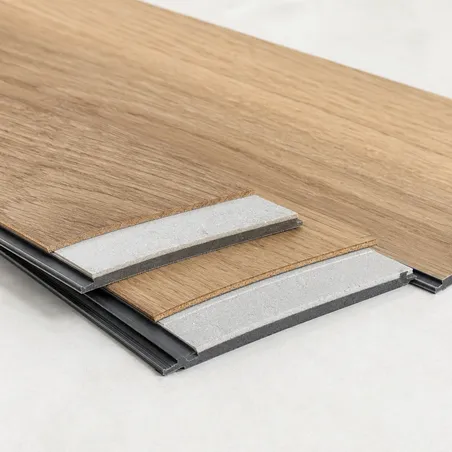 Entry Tier
Wood Stone Plastic Composite
Uses a sliced hardwood veneer face, typically 0.3mm–0.5mm, laminated onto a standard SPC rigid core. This is the entry point of the real wood veneer SPC category: genuine wood grain and texture at a landed cost that stays competitive with premium printed-film SPC.
Best suited for: Distribution channels where you need the "real wood" selling point without pushing into engineered hardwood pricing.
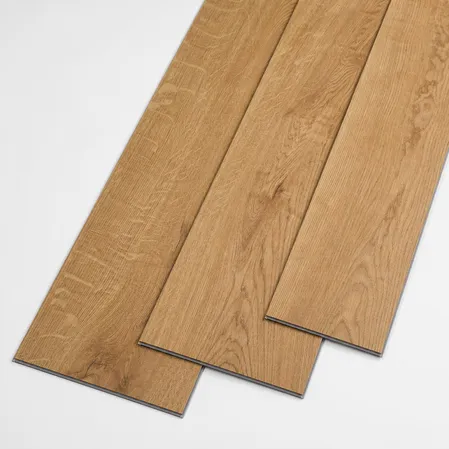 Mid Tier
Popular
Mid Tier
Popular
Veneer Stone Polymer Composite
Uses a rotary-cut or sliced veneer with a slightly thicker face layer and more pronounced grain character. The visual depth is noticeably richer than WSPC, positioning it as a mid-tier offering for buyers who want to differentiate from commodity SPC without the cost structure of full hardwood face products.
Available species: Oak, walnut, ash, and hickory. Custom species available on ODM orders.
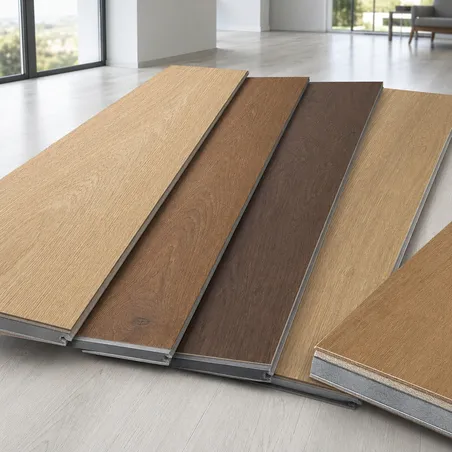 Premium Tier
Waterproof Hardwood SPC
Uses a thicker sawn-cut wood face — 0.5mm to 0.6mm — that can be sanded lightly and refinished once. This is the premium tier: waterproof hardwood SPC flooring that competes directly with engineered hardwood on appearance and feel, while eliminating moisture-related claims.
Best suited for: High-end residential and hospitality project channels where the spec calls for "real hardwood" but site conditions demand waterproof performance.
One Shared Platform Across All Three Lines
All three lines share the same SPC core platform, click-lock profile system, and attached IXPE underlayment option. Your logistics and installation training stay consistent across the collection — whether you stock one line or all three.
What's Inside Every Board
Understanding the layer stack helps you answer specification questions from architects, designers, and commercial buyers. Here's how each component contributes to the finished product's performance.
Layer Stack — Cross Section
From top surface to subfloor contact
Aluminum oxide–reinforced UV finish. AC3–AC5 rating depending on specification. Scratch and stain resistance layer.
Sliced or rotary-cut hardwood veneer. Species-specific grain, texture, and color variation. This is the layer that makes it real wood.
Stabilizes the veneer-to-core bond and prevents cupping. Critical for dimensional stability across humidity cycles.
Stone plastic composite — limestone powder, PVC resin, and stabilizers. 100% waterproof, dimensionally stable, dent-resistant. The structural backbone of the plank.
Pre-attached cross-linked polyethylene foam. Acoustic dampening, minor subfloor irregularity compensation, and thermal comfort underfoot. Optional — available on all three lines.
Standard Specification Range
Applies across WSPC, VSPC, and Hardwood SPC lines unless noted
Custom Specifications Available
Plank dimensions, veneer thickness, core thickness, wear layer rating, and surface texture are all adjustable on ODM orders. Minimum order quantities apply per specification. Contact us with your target spec and we'll confirm feasibility and MOQ.
Surface Texture Options
All textures are applied during the UV coating process and work with any veneer species
Open grain texture that emphasizes natural wood character. Most popular finish across all three lines.
Irregular surface relief that mimics traditional hand-worked hardwood. Strong in rustic and farmhouse aesthetics.
Clean, low-sheen surface. Preferred for contemporary and Scandinavian design directions.
Texture aligned to the veneer grain pattern. Available on select species. Adds tactile realism to the surface.
Performance Claims Buyers Actually Ask About
Distributors and retailers field the same questions from their customers. Here's how wood veneer SPC answers them — and what certifications back those answers up.
100% Waterproof Core
The SPC core does not absorb water. Planks can be installed in kitchens, bathrooms, laundry rooms, and below-grade spaces where solid hardwood and standard engineered wood are excluded.
Note: The veneer face itself is sealed by the UV coating. Prolonged standing water on unsealed edges should still be avoided.
Dimensional Stability
SPC cores expand and contract at a fraction of the rate of wood-based cores. This allows larger continuous installation areas without expansion breaks, and reduces gapping and peaking complaints in climates with wide seasonal humidity swings.
Typical linear expansion: <0.05% across 20°C temperature range.
Dent & Impact Resistance
The rigid SPC core resists point-load denting from furniture legs and high heels — a common failure mode in LVP and softer-core products. The veneer face adds no structural softness to the plank.
Tested to EN 1534 (Brinell hardness). Results available on request per product line.
Acoustic Performance
With the pre-attached IXPE underlayment, impact sound reduction reaches IIC 50–54 depending on subfloor conditions. Suitable for multi-family residential and hospitality applications where acoustic specs are part of the project requirement.
Third-party acoustic test reports available for specification submissions.
Radiant Heat Compatible
Compatible with hydronic and electric underfloor heating systems. Maximum recommended surface temperature is 27°C (80°F). The SPC core's low thermal resistance allows efficient heat transfer without the delamination risk present in thicker wood-based products.
Thermal resistance (R-value): approximately 0.09 m²K/W for standard 6mm plank.
Indoor Air Quality
Formaldehyde emissions certified to CARB Phase 2, E0, and E1 standards depending on the market destination. FloorScore and GREENGUARD certifications available on select product configurations for projects requiring low-VOC documentation.
Specify your target certification at inquiry stage and we'll confirm availability for that line.
Available Certifications & Test Standards
P2
CARB Phase 2
E1
EU Formaldehyde
Score
FloorScore IAQ
GUARD
GREENGUARD Gold
Mark
CE Marking (EU)
9001
ISO 9001 QMS
Certification availability varies by product line and destination market. Full test reports provided with samples or on request.
Category-Level Specifications
The table below covers the general parameter ranges across our wood veneer SPC flooring lines. Exact specifications for each product are on their respective pages.
| Parameter | Range / Value |
|---|---|
| Total plank thickness | 5mm – 8mm (core + veneer + underlayment) |
| SPC core thickness | 4mm – 6mm rigid core |
| Wood veneer face | 0.3mm – 0.6mm real hardwood |
| Plank dimensions | 1220 × 183mm (standard); custom widths available on ODM |
| Click-lock system | Unilin-type and Valinge-type, CNC-milled |
| Attached underlayment | IXPE 1.0mm–1.5mm (optional, pre-attached) |
| Wood species available | Oak, walnut, ash, hickory, maple, teak (varies by line) |
| Surface finish | UV lacquer, natural oil, matte, brushed |
| Waterproof rating | 100% waterproof core; 24-hour water immersion test passed |
| Dimensional stability | EN 434 compliant; ≤0.1% length change, ≤0.15% width change |
| Fire rating | Bfl-s1 (EN 13501-1) |
| VOC compliance | FloorScore (CDPH Section 01350), REACH |
Real Hardwood Face
0.3mm–0.6mm sliced or sawn-cut veneer delivers authentic grain, texture, and warmth that no printed film can replicate. Species availability varies by product line.
100% Waterproof Core
The SPC rigid core passes 24-hour water immersion testing. Dimensional stability meets EN 434: ≤0.1% length change, ≤0.15% width change — critical for heated subfloor installations.
Market-Ready Certifications
FloorScore (CDPH Section 01350) and REACH compliance cover North American and European market entry. Fire rating Bfl-s1 per EN 13501-1 for commercial specification.
The Veneer Bonding Process — Where This Category Succeeds or Fails
If you're evaluating wood veneer SPC suppliers, the bonding process is the single most important thing to understand. A beautiful oak veneer means nothing if it delaminates after six months on a heated subfloor.
PUR Hot-Melt Adhesive System
We use PUR (polyurethane reactive) hot-melt adhesive applied on a dedicated lamination line separate from our standard SPC décor film press. PUR is a moisture-curing adhesive — once it cross-links, the bond is permanent and heat-resistant.
Standard EVA hot-melt can soften again at elevated temperatures. Wood veneer SPC flooring often goes over underfloor heating systems where surface temperatures reach 27–28°C continuously. EVA-bonded veneer products in that environment are a delamination claim waiting to happen.
Calibrated Press Parameters Per Veneer Thickness
Our lamination line runs at controlled temperature and pressure profiles calibrated to each veneer thickness. A 0.3mm sliced veneer needs different press parameters than a 0.6mm sawn-cut face.
Too much pressure crushes the wood grain and kills the natural texture. Too little leaves micro-voids in the adhesive layer that become delamination initiation points.
Per-Batch Peel Strength Testing
We run peel-strength tests on samples from every production batch, pulling the veneer off the core on a tensile tester.
Multi-Coat Finish and Edge Sealing
After lamination, the veneer surface gets a UV lacquer or oil finish — 4 to 6 coats depending on the finish type, each cured individually. The finish protects the wood surface from wear and moisture ingress, and locks down the veneer edges where moisture could otherwise wick into the wood layer and cause edge lifting.
We added an extra edge-seal coat after seeing edge-lift issues on early production runs destined for a Southeast Asian distributor. Humid port storage was the culprit — the fix was straightforward, but only if you know to look for it.
Three Questions to Ask Any Veneer SPC Supplier
For your sourcing evaluation, ask any veneer SPC supplier these three questions. The answers tell you everything about whether their product will survive in the field.
What adhesive system do they use? PUR hot-melt is the correct answer for heated subfloor applications. EVA is a risk.
Do they test peel strength per batch? Batch-level testing — not just type approval — is what catches production variation before it ships.
How do they handle edge sealing? An extra edge-seal coat is the difference between a product that survives humid port storage and one that arrives with edge lift.

Where Your Buyers Profit from Wood Veneer SPC
This isn't a lifestyle product — it's a commercial category with specific market segments where the margin math works.

High-End Residential Renovation & New Build
Volume SegmentHomeowners want real hardwood floors. Builders want waterproof, dimensionally stable products that won't generate callbacks. Real wood veneer SPC flooring gives both sides what they want. Your margin sits between standard SPC and engineered hardwood, and your claim rate drops because the SPC core eliminates moisture-related failures. This is the volume segment for most distributors entering the category.

Hospitality & Boutique Commercial
Project Contractor SegmentHotels, restaurants, and retail spaces that spec hardwood for aesthetics but need waterproof performance for maintenance reality. A boutique hotel corridor sees spills, rolling luggage, and heavy foot traffic — engineered hardwood in that environment means refinishing every 18 months. Waterproof hardwood SPC flooring handles the abuse without the maintenance cycle, so your project contractor clients can bid with confidence on the flooring spec.

Underfloor Heating Projects
Northern Europe · North America · NE AsiaAny market where radiant floor heating is standard is a natural fit. The SPC core's dimensional stability under heat cycling is the technical advantage, and the real wood surface is the aesthetic requirement. Engineered hardwood over underfloor heating works but requires careful species selection and acclimation. Wood veneer SPC skips that complexity entirely.

Premium Multi-Family & Property Development
Developer SegmentDevelopers building mid-to-high-end apartments and condominiums need a flooring product that photographs well for sales brochures, installs fast across hundreds of units, and doesn't generate warranty claims from new owners. WSPC and VSPC flooring check all three boxes at a lower installed cost than engineered hardwood.
Not sure which segment fits your market?
Tell us which segment you're targeting — we'll recommend the right product line and spec.
Dual-Origin Production and What It Means for Your Landed Cost
We produce wood veneer SPC flooring at both our Changzhou, China facility and our Rayong, Thailand facility. Same equipment manufacturers, same core formulations, same QC protocols, same veneer suppliers — the product is identical regardless of origin.
Changzhou, China
Primary FacilityRayong, Thailand
Secondary FacilityCombined Annual Capacity

The Tariff Arithmetic
Anti-dumping and countervailing duties on Chinese-origin flooring products into the United States have pushed duty rates that fundamentally change the landed cost equation. A container of wood veneer SPC flooring shipped from Changzhou versus Rayong can differ by 15–25% in total landed cost depending on the current duty schedule and your importer's specific rate.
We handle the origin planning with you during the quoting stage — you tell us the destination market, and we route production through whichever facility gives you the better number.
Clean Certificate of Origin
Both facilities are set up for the full veneer SPC production sequence: SPC core extrusion, veneer lamination, UV/oil finishing, click-lock profiling, and packaging.
We don't extrude cores in China and laminate veneer in Thailand or any split-process arrangement — each plant runs the complete process independently, so your certificate of origin is clean.
Full Production Sequence — Both Facilities
Each plant runs the complete process independently. No split-origin arrangements.
Lead time varies by veneer species availability and order size.
Current lead time: 25–35 days from order confirmation
OEM/ODM: Building Your Own Wood Veneer SPC Brand
Most of our wood veneer SPC volume ships under our buyers' private labels. The OEM/ODM process for this category has a few specific considerations beyond standard SPC — here's what to expect at each stage.

R&D Team Behind Every ODM Project
Our 15+ engineers manage core formulation adjustments for specific thickness requirements, click-lock profile tuning, and new veneer species qualification. You focus on your market requirements; we handle the manufacturing engineering.
MOQ: 1,000 sqm per SKU
Standard species and configurations. Custom species or non-standard plank dimensions may require higher minimums depending on veneer sourcing constraints.
Veneer Species Selection
We maintain stock of oak, walnut, ash, and hickory from approved mills. Market-specific species — teak for Southeast Asia, maple for North America, acacia for Australia — sourced on an ODM basis.
+7–10 days to sample timeline for new species. Adhesion tests are mandatory — different porosity and oil content affect PUR bond strength. We don't skip this step even if the species "should" work on paper.
Surface Finish Customization
Natural oil finish, UV lacquer in matte or semi-gloss, brushed texture, hand-scraped effect. Finish choice changes market positioning significantly.
Matte oil finish — premium European positioning
Semi-gloss UV lacquer — North American retail expectations
Samples in your specified finish within 7 days of design confirmation.
Packaging & Branding
Private-label cartons with your brand, UPC/EAN barcodes, installation instructions in your market's language, and pallet configuration matched to your warehouse racking.
We handle packaging design in-house. Send us your brand guidelines and we produce print-ready artwork.
MOQ & Minimums
1,000 sqm per SKU for standard species and configurations.
Custom species or non-standard plank dimensions may require higher minimums depending on veneer sourcing constraints. Confirm requirements when submitting specs.
Ready to start an OEM/ODM project?
Send your specs or reference samples and our R&D team will scope the project with you.
Quality Control Specific to Veneer SPC Production
Our ISO 9001:2015 QC system applies across all SPC production, but wood veneer SPC adds category-specific inspection points that don't exist on standard printed-film SPC lines. Here's what runs on every production batch.
1 Veneer-Specific Inspection Points
Incoming Veneer Inspection
Every veneer shipment is inspected for:
- Thickness consistency ±0.05mm tolerance across the sheet
- Moisture content target 8–10% for lamination
- Grain direction uniformity
- Surface defects — knots, splits, mineral streaks, color variation
Veneer graded A, B, C. A-grade → premium hardwood SPC lines; B-grade → WSPC/VSPC standard collections; C-grade rejected or diverted to non-flooring applications. Rejection rate: 8–12% — higher than the 3–5% on standard SPC raw materials because natural wood is inherently more variable than synthetic inputs.
Post-Lamination Peel Test
Samples pulled from every production run, tested on a tensile machine for peel strength.
Any batch below threshold gets re-laminated or scrapped.
Thermal Cycling Test
Samples from each new species or adhesive batch go through accelerated aging — 50 cycles between −10°C and 60°C — to verify bond integrity under temperature stress.
This catches adhesive compatibility issues that wouldn't show up in a room-temperature peel test.
Surface Finish Inspection
Visual inspection under standardized lighting for finish uniformity, orange peel texture, bubbles, and missed spots.
Gloss meter readings on UV-lacquered products to verify consistency within ±2 gloss units across the batch.

Standard SPC QC Also Applies
All veneer SPC runs also pass through our full standard SPC inspection protocol.
- Inline thickness monitoring ±0.1mm
- Core density checks
- Click-lock engagement testing
- Dimensional stability testing per EN 434
- 100% visual inspection before packing
Third-party inspection — SGS or Bureau Veritas available on request.
Common Failures in Wood Veneer SPC — and the Manufacturing Decisions That Prevent Them
If you've sourced veneer SPC before, or if you're entering the category for the first time, these are the failure modes worth understanding. They're also the reasons we run the QC steps described above.
Veneer Delamination
- Wrong adhesive type (EVA instead of PUR)
- Insufficient press temperature or pressure during lamination
- Veneer moisture content too high at bonding
- PUR hot-melt adhesive (not EVA)
- Calibrated press parameters per veneer thickness
- Incoming veneer moisture testing
- Batch peel-strength verification
If you're comparing suppliers, ask for their peel-strength test data — any factory serious about veneer SPC tracks this number.
Edge Lifting
- Moisture wicks into wood veneer from exposed plank edges
- Veneer swells and lifts at the perimeter
- Edge-seal UV coat applied after profiling
- PUR adhesive layer acts as inherent moisture barrier
Plank edges submerged in water for 24 hours, lift measured with dial gauge.
Color Variation Between Batches
Natural wood veneer varies in color from log to log. If your buyer orders 500 sqm of oak veneer SPC today and reorders 500 sqm in three months, the color needs to be close enough to install side by side.
- Source veneer from the same log batch for linked orders when possible
- Color reference samples maintained for each SKU
- For large ongoing programs: veneer inventory reserved from a single log run
This is one of those details that doesn't seem important until a contractor calls you because the second shipment doesn't match the first.
Click-Lock Failure at the Veneer Edge
- Veneer layer adds thickness and rigidity at the plank edge where click-lock profile is milled
- Profiling parameters not adjusted for veneer → locking tongue too stiff or too brittle
- Snapping during installation
- Click-lock profiles milled in-house on CNC machines
- Cutting parameters adjusted specifically for veneer SPC — different feed rates and cutter geometries than standard printed-film SPC
- Every profiling run includes a fit test on a sample panel before full production proceeds
Evaluating Suppliers? Ask for the Data
Peel-strength test data, edge-lift test results, and click-lock fit test records are the three numbers that separate factories that understand veneer SPC from those that treat it as standard SPC with a different surface. Any serious veneer SPC manufacturer tracks all three.
Shipping Veneer SPC: Packaging That Protects a Natural Surface
Wood veneer SPC flooring needs more packaging attention than standard SPC because the natural wood surface is more susceptible to scratching, denting, and moisture damage during transit and warehouse storage.
Plank-Level Protection
Each plank is separated by a PE foam interleaf to prevent surface-to-surface contact scratching.
Why this matters: Veneer surfaces are softer than printed-film wear layers — a scratch on a UV-lacquered oak surface is visible and permanent, unlike a scratch on a 0.3mm wear layer that might buff out.
Carton Configuration
Planks packed face-to-face in pairs, then stacked in cartons. Carton dimensions configured per destination market.
Retail-ready cartons with UPC barcodes
Sized for standard pallet racking
Pallet and Container Loading
Standard pallet stacking with corner protectors and stretch wrap. For markets with humid port storage conditions (Middle East, Southeast Asia), a moisture barrier bag is added over each pallet.
Approximately 1,800–2,200 sqm of wood veneer SPC flooring depending on plank thickness and carton configuration. Exact loading plans provided during quoting so you can calculate per-square-meter freight cost accurately.

Dual-Origin Shipping
Your freight cost and transit time optimize automatically based on production origin — no manual routing decisions required on your end.
Routes through our Rayong facility for shorter transit times
Ships from Changzhou via Shanghai port
Ready to discuss packaging and logistics for your program?
We provide exact loading plans and per-sqm freight estimates during the quoting stage.
Frequently Asked Questions
Technical and commercial questions we hear most often from importers, distributors, and OEM buyers evaluating wood veneer SPC for the first time or switching suppliers.
What is the difference between WSPC, VSPC, and hardwood SPC flooring?
All three use a real wood veneer bonded to an SPC rigid core, but they differ in veneer thickness and cut method.
- WSPC uses a thinner sliced veneer (0.3–0.5mm) for an entry-level real wood product.
- VSPC uses a rotary-cut or sliced veneer with more pronounced grain character, positioned as mid-tier.
- Hardwood SPC uses a thicker sawn-cut face (0.5–0.6mm) that can be lightly sanded and refinished once — the premium tier competing directly with engineered hardwood.
Can wood veneer SPC flooring be installed over underfloor heating?
Yes. The SPC core's dimensional stability under heat cycling is one of the primary advantages over engineered hardwood in heated subfloor applications.
We test our veneer SPC products through 50 thermal cycles between -10°C and 60°C to verify both core stability and veneer bond integrity. Surface temperature should stay below 28°C per standard recommendations — the same limit that applies to most floating floor installations over radiant heat.
How does the waterproof performance compare to engineered hardwood?
The SPC core is 100% waterproof — calcium carbonate and PVC don't absorb water. The veneer surface layer is sealed with UV lacquer or oil finish, and plank edges receive an additional seal coat.
For kitchens, bathrooms, basements, and any project where moisture exposure is a concern, waterproof hardwood SPC flooring eliminates the risk that engineered hardwood carries.
What is the MOQ for custom wood veneer SPC orders?
Standard species covered at this MOQ: oak, walnut, ash, hickory.
Custom species or non-standard dimensions may require higher minimums depending on veneer sourcing — we confirm exact MOQ during the quoting stage. Sample lead time is within 7 days from design confirmation for standard configurations.
How do you manage color consistency between production batches?
Natural wood varies from log to log, so batch-to-batch color matching requires active management. Our approach:
- Source veneer from the same log batch for linked orders when possible
- Maintain color reference samples for each active SKU
- Reserve veneer inventory from a single log run for large ongoing programs
- Send production samples for your approval before full-run commitment on initial orders
If your project requires tight color matching across multiple shipments, flag this during the quoting stage and we'll plan veneer procurement accordingly.
What certifications does your wood veneer SPC flooring carry?
Our SPC production holds the following certifications, which apply across our SPC product lines including the wood veneer SPC category:
FloorScore (CDPH Section 01350 VOC compliance) and REACH compliance mean your product arrives pre-qualified for North American and European indoor air quality requirements — no scrambling for test reports after the container lands. Third-party inspection by SGS or Bureau Veritas is available on request for pre-shipment audits.
Start With Samples, Scale When Ready
If you're evaluating wood veneer SPC flooring for your product line, the most practical next step is samples. Tell us your target market, preferred wood species, and price positioning — we'll recommend the right product line, produce samples within 7 days, and include a detailed quote with landed cost estimates for your destination.
Already sourcing veneer SPC and looking for a second supplier or better origin options? Send us a reference sample or spec sheet from your current product. We'll match it, quote both China and Thailand origin pricing, and let you compare.
Contact Elefloor Direct
Explore Product Lines
Not sure which tier fits your market? Review each product line before requesting samples.
Elefloor — SPC flooring manufacturer since 2012, operating dual production hubs in Changzhou, China and Rayong, Thailand.