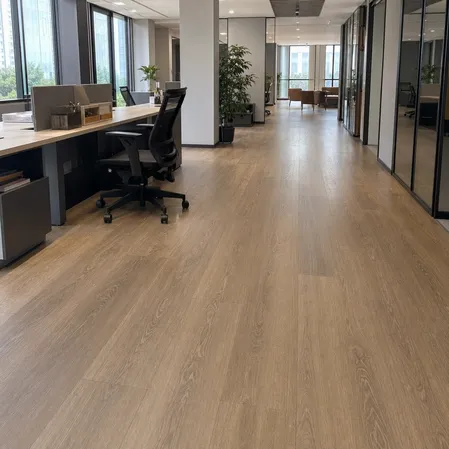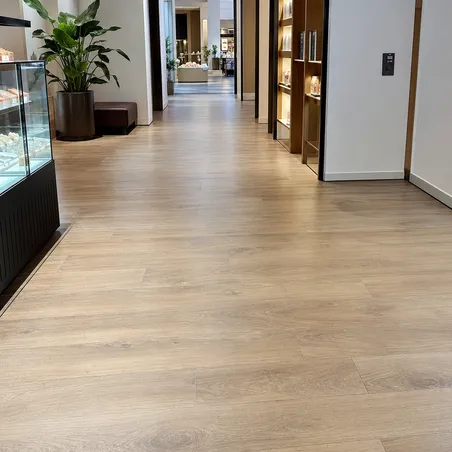

Wood-Look LVT Flooring — The Volume Line
LVT wood flooring in oak, walnut, hickory, and ash — the décor category that moves the most volume for our distribution partners worldwide.
Available in light, mid-tone, and dark colorways with grain textures from smooth satin to hand-scraped. Click-lock and dry-back formats, 2mm–5mm thickness, wear layers from 0.2mm to 0.7mm. Produced on our own calender lines in Changzhou and Rayong.
What Wood-Look LVT Does for Your Product Mix
Wood grain LVT flooring is the single highest-volume subcategory in luxury vinyl tile. Not because it's exciting — because it's what your customers reorder.
Oak in three shades, walnut in two, a hickory and an ash to round out the range, and you've covered the décor preferences that account for 60–70% of residential vinyl flooring sales in most markets we ship to.
Continuous Production on Core SKUs
We keep our most popular wood-look décors in continuous production. That means your reorders pull from active inventory rather than waiting for a new print run to be scheduled, approved, and queued. For your supply chain, continuous production on core SKUs translates to shorter lead times and fewer stockout gaps on your best sellers.
We learned early on that running wood-look décors in campaign batches — produce a big run, then switch to something else — created exactly the kind of reorder delays that push distributors to dual-source. Continuous production solved that.
Where this line sits relative to our other LVT collections: wood-look is the mid-catalog workhorse. It doesn't carry the premium pricing of our luxury LVT line or the specialty-margin positioning of geometric LVT. It carries volume. If you're building or expanding an LVT catalog, wood-look is where you start because it's where your sell-through is most predictable.
Predictable Reorder Cycles
Wood-look is what your customers reorder. Predictable sell-through means predictable purchasing — easier inventory planning for your team.
Active Inventory, Not Print Queues
Core SKUs stay in continuous production. Reorders ship from live stock — no waiting for a new run to be scheduled and approved.
Mid-Catalog Anchor
Not the premium tier, not the specialty margin play — the volume foundation. Build your LVT catalog here first, then layer in luxury and geometric lines.
60–70% of Residential Sales
Wood-look décors account for the majority of residential vinyl flooring sales in most markets we ship to. The demand base is broad and stable.
Décor Range and Colorway Strategy
We produce wood grain LVT flooring across four species families and three tonal ranges. The species aren't just visual labels — each one has a distinct grain structure, knot pattern, and color variation that affects how the product is perceived at point of sale and which end-use segments it sells into.
Best Seller
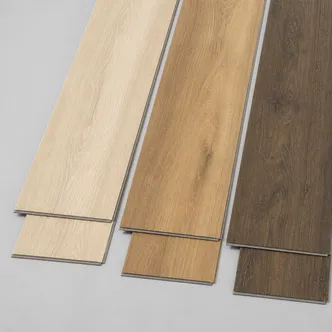
Oak — The Broadest Family
The universal seller. Works in every market, every application, every price tier.
Blonde, natural, whitewashed — dominates Northern European & Oceanian markets
Honey, classic, warm grey — the universal seller across all markets
Smoked, espresso, charcoal — strong in contemporary residential
If you're testing a new market with a limited SKU count, mid-tone oak is your safest first order.
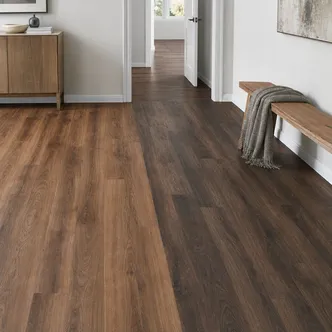
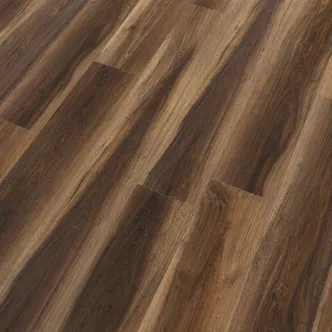
Walnut — Warm & Rich
Runs warmer and richer than oak, with more pronounced grain contrast. North American buyers pull walnut harder than any other region.
Fits traditional and transitional interior styles dominant in U.S. & Canadian renovation
Works in both residential and light commercial settings
Primary demand: North America — traditional and transitional interior styles.
Premium Visual
Hickory — Most Dramatic Grain
Wide variation between heartwood and sapwood tones, heavy grain movement, visible knot features. Commands a slight premium at retail.
Heavy grain movement, visible knots — reads as more "natural" at point of sale
Textured surface variant with enhanced tactile character
Visual complexity reads as more "natural" and less "printed" — supports slight retail premium.
Ash — Clean & Contemporary
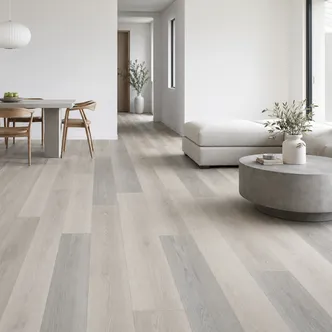
Tight, straight grain with minimal knot variation. Reads as clean and modern — strong in Scandinavian-influenced and minimalist interior styles.
Almost white-blonde — dominant in Nordic, Japanese, and Australian contemporary markets
Cool-toned, pairs with white walls and concrete finishes — strong in new-build residential
Preferred species for minimalist and Scandi-influenced interiors across Europe and Oceania.
How We Approach Colorway Strategy
We don't produce every possible colorway — we produce the ones that move. Each décor in our range has been validated against actual sell-through data from distributor partners across at least two markets before it enters the standard catalogue. Slow-moving colorways get retired on a rolling basis.
If you're building a range for a specific market, we can advise on which species and tonal combinations have the strongest track record in that region. We can also produce custom colorways at sufficient volume — typically 5,000 m² minimum per décor for a bespoke print run.
| Species | Light Tones | Mid Tones | Dark Tones | Primary Markets |
|---|---|---|---|---|
| Oak | Blonde, whitewashed, natural | Honey, classic, warm grey | Smoked, espresso, charcoal | All regions |
| Walnut | — | Natural warm-brown | Dark formal | North America, UK |
| Hickory | — | Rustic mid-tone | Dark hand-scraped | North America |
| Ash | Light natural, grey-washed | — | — | Europe, Oceania |
Construction and Technical Specification
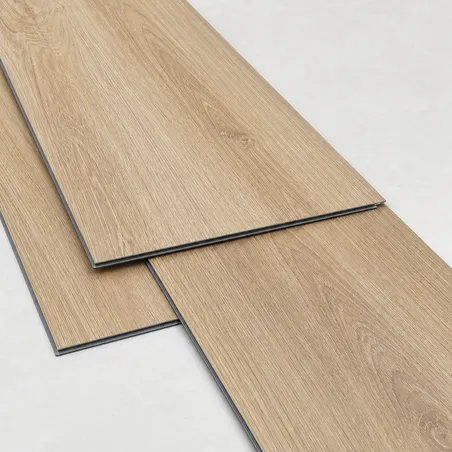
LVT is a layered composite product. Each layer has a specific function, and the specification choices you make — wear layer thickness, core type, locking system — determine which applications the product can be sold into and at what price point.
Product Layer Structure
Wear Layer Thickness Guide
Suitable for low-traffic residential areas — bedrooms, guest rooms. Lower cost, thinner protection. Not recommended for kitchens, hallways, or any commercial use.
Typical warranty: 10–15 years residential
The standard specification for full-home residential and light commercial. Covers kitchens, living areas, hallways, and low-traffic retail. This is the wear layer most distributors stock as their core SKU.
Typical warranty: 20–25 years residential / 5–10 years light commercial
Specified for medium-to-heavy commercial environments — offices, hospitality, healthcare, retail. Carries the wear layer thickness required by most commercial project specifications and FM contracts.
Typical warranty: 10–15 years commercial
Core Type Comparison
SPC Core
Stone Plastic Composite
Limestone powder and PVC binder. Extremely rigid, 100% waterproof, dimensionally stable under temperature fluctuation. The dominant core type in our range and in the global market.
- Best dimensional stability
- Suitable over radiant heat
- Thinner profile, lower weight
- Harder underfoot than WPC
WPC Core
Wood Plastic Composite
Wood fibre and PVC with a foamed core structure. Softer and warmer underfoot than SPC. Preferred in markets where comfort underfoot is a key selling point — particularly North America.
- Softer, warmer underfoot
- Better acoustic performance
- Slightly less dimensionally stable
- Heavier, thicker profile
Rigid PVC Core
Standard Rigid
Traditional rigid LVT without the mineral filler of SPC. Still widely specified in commercial projects and glue-down applications. Lower cost than SPC at equivalent thickness.
- Lower cost per m²
- Proven in glue-down commercial
- Less stable than SPC
- More sensitive to temperature
Installation Methods
Click-Lock Floating
The dominant installation method for residential and light commercial. No adhesive required. Planks interlock via a tongue-and-groove click system — faster to install, easier to replace individual planks. Compatible with most SPC and WPC cores.
Glue-Down
Full-spread adhesive bonding to the subfloor. Preferred in commercial applications where floor stability under heavy rolling loads is required. Also used in renovation projects where height restrictions prevent a floating installation.
Loose Lay
Heavy backing creates friction with the subfloor — no adhesive, no click system. Fast installation and easy removal. Suited to temporary installations, rental properties, and situations where the floor may need to be lifted periodically.
Technical Specifications for Wood-Look LVT
Standard specification ranges for our wood-look LVT line. Exact values depend on the specific SKU configuration — wear layer, format, and installation method.
| Parameter | Standard Range | Notes |
|---|---|---|
| Overall thickness | 2.0mm – 5.0mm | 2.0–3.0mm for dry-back; 4.0–5.0mm for click-lock with pad |
| Wear layer | 0.2mm – 0.7mm | 0.2–0.3mm residential; 0.5–0.7mm commercial |
| Plank width | 152mm – 228mm | Wide-plank (228mm) available for premium positioning |
| Plank length | 914mm – 1524mm | Longer planks reduce visible seams, improve visual realism |
| Installation method | Click-lock / Dry-back | Click-lock for retail; dry-back for commercial glue-down |
| Surface texture | EIR, hand-scraped, satin, matte | EIR aligns grain texture with printed pattern |
| Attached underlayment | IXPE or EVA, 1.0–1.5mm | Pre-attached on click-lock SKUs |
| Dimensional stability | ≤0.15% (EN 434, 6h at 80°C) | Tested per batch before production release |
| Fire rating | Bfl-s1 (EN 13501-1) | Standard for European commercial specification |
| Slip resistance | R9–R10 (DIN 51130) | R10 on hand-scraped and textured surfaces |
| VOC emissions | FloorScore / CDPH 01350 | Required for LEED-contributing projects |
| Residual indentation | ≤0.10mm (EN 433) | Commercial-grade performance across all wear layers ≥0.5mm |
Specifications shown are industry-standard values for this product type. Actual specifications may vary by SKU and production run.
Request Product Data SheetsHow Wear Layer Drives Your Margin and Warranty Strategy
The LVT category page covers wear layer selection at the category level. Here's what matters specifically for wood-look LVT, where wear layer choice directly shapes your product positioning and warranty exposure.
Entry-Level Price Point
Bedroom and light-traffic residential — the segment where your competition is laminate and low-cost vinyl plank. Margins are thinner per square meter, but volume is high and reorder cycles are short because residential renovation is a continuous market.
Choose 0.3mm over 0.2mm even for budget lines. The per-square-meter cost difference is marginal, but 0.3mm lets you offer a 10-year residential warranty instead of 5 — which meaningfully affects sell-through at the retail shelf.
The Margin Sweet Spot
Covers residential kitchens, hallways, and all light commercial applications — offices, small retail, serviced apartments. Position as "commercial grade" and price it 20–30% above the 0.3mm tier while your actual cost increase is closer to 10–12%.
Heavy Commercial Specification
Hotel corridors, restaurant dining areas, retail chains with high foot traffic. Buyers in this segment purchase on project specs, not retail price comparison — so price sensitivity is lower and your margin per square meter is the highest in the range.
Volume per order depends on project pipeline rather than steady retail pull. We produce 0.7mm wood-look LVT in a narrower décor selection (oak and walnut only) — commercial specifiers prioritize performance documentation over décor variety.
Wear Layer at a Glance
- Bedroom & light traffic
- High volume, short reorder cycles
- 5-yr warranty (0.2mm) / 10-yr (0.3mm)
- Thinner margins per m²
- Kitchens, hallways, light commercial
- Price 20–30% above 0.3mm tier
- Cost increase only 10–12%
- "Commercial grade" positioning
- Hotels, restaurants, retail chains
- Highest margin per m²
- Spec-driven, low price sensitivity
- Oak & walnut décors only
Surface Texture: The Difference Between "Looks Like Wood" and "Sells Like Wood"
We produce wood-look LVT with four surface treatments. The choice affects your retail positioning more than most spec decisions.
Embossed-in-Register (EIR)
EIR is our strongest recommendation for any wood-look LVT you plan to position above entry level. The surface grain physically aligns with the printed wood pattern underneath — run your hand across the plank and the ridges follow the grain lines in the image.
We develop EIR texture plates in-house, matched to each specific décor film, using CNC-engraved steel rollers with grain depth of 0.3–0.5mm. The alignment precision matters: misregistered EIR — where the texture doesn't match the print — actually looks worse than a flat surface because the mismatch is visible under raking light.
We check registration alignment on every production run and reject planks where the offset exceeds 0.5mm.
EIR is the single most effective way to justify a higher retail price point on wood-look LVT because the tactile realism is immediately obvious to anyone who touches the sample. Distributors report their retail close rate went up noticeably after switching from flat-press to EIR on their oak range. The product essentially sells itself off the sample board.
Hand-Scraped Texture
Creates an irregular, artisan-look surface that works particularly well with hickory and rustic oak décors. The texture is deeper and more random than EIR — it reads as "reclaimed" or "heritage" flooring, which is a distinct retail niche with premium pricing potential.
Secondary embossing pass after the standard calender process.
Satin Finish
Mid-RangeStandard option for budget and mid-range positioning. Satin has a slight sheen that photographs well for e-commerce listings — an underrated advantage when your buyers are evaluating products online before ordering samples.
E-commerce catalog photography. Budget to mid-range retail positioning.
Matte Finish
Current TrendThe current trend in contemporary interiors. Matte hides micro-scratches better than any gloss finish, which reduces the appearance of wear over time — fewer complaints from your downstream customers about floors "looking tired" after a year of use.
Conceals micro-scratches. Reduces post-sale complaints. Aligns with contemporary interior design trends.
Light LVT and Victorian LVT — Two Segments Worth Understanding
Two search patterns in the wood-look LVT space represent distinct buyer segments with different commercial dynamics. Understanding both helps you position SKUs and set pricing expectations before you place an order.
Light LVT
Light LVT is the dominant aesthetic in Northern Europe, Oceania, and increasingly in North American new construction. The demand driver is interior design trends: open-plan living spaces with light floors that make rooms feel larger.
For your catalog, light LVT in oak and ash tones should be your lead SKUs if you distribute into these markets. We produce light wood-look LVT across the full wear layer range, with whitewashed oak and natural ash as our highest-volume light décors.
Light tones show dirt less than dark floors in high-traffic settings, which matters for commercial maintenance — a selling point your contractor customers can use when specifying for offices, retail, and hospitality.
Victorian LVT
Victorian LVT targets the heritage and period-property renovation market — a niche but high-margin segment. Victorian-style wood floors feature rich, dark-toned species (walnut, mahogany-look, dark oak) often in narrower plank widths that reference traditional strip flooring proportions.
We produce Victorian LVT in 152mm-wide planks with deep EIR grain texture and warm, saturated colorways. The buyers in this segment are typically renovation contractors and interior designers working on period properties where the floor needs to reference historical aesthetics without the maintenance burden of actual reclaimed wood.
Order volumes per project are smaller, but per-square-meter pricing is premium, and the segment has almost no price competition from commodity LVT because the décor specificity creates a natural barrier.
Segment Comparison at a Glance
- Volume per project
- Price competition
- Primary buyer
- Lead décors
- Plank width
- High — new construction projects
- Moderate — broad market
- Developers, distributors, retail
- Whitewashed oak, natural ash
- Standard range
- Smaller — per-project niche
- Low — décor specificity barrier
- Renovation contractors, designers
- Walnut, mahogany-look, dark oak
- 152mm narrow strip
Market Segments Where Wood-Look LVT Generates Reorders
Wood-look outsells tile-effect and geometric LVT combined in residential channels. Here's where it specifically outperforms other visual categories — and why these segments sustain repeat purchasing for your business.
Residential Renovation & New Construction
Continuous, non-cyclical demand
Wood-look outsells tile-effect and geometric LVT combined in residential channels because wood floors are the default aesthetic preference in most Western markets. Reorder frequency is high because residential renovation is a continuous, non-cyclical market — there's always someone replacing carpet or aging laminate.
What your retail & contractor customers want
- 3–5 oak colorways
- 1–2 walnut options
- Click-lock format with attached pad
Multi-Family & Rental Housing Development
Standardized décors across entire projects
Property developers standardize on 2–3 wood-look décors across entire projects — sometimes hundreds of units. They buy on landed cost per square meter and delivery reliability across project phases.
Why our capacity matters here
Our 12M sqm annual capacity means we can supply multi-phase developments without production gaps between phases — so your pricing stays consistent and your developer client doesn't need to re-approve samples mid-project.
Hospitality — Hotels, Serviced Apartments, Boutique Accommodations
Warmth of hardwood, none of the refinishing cycle
Interior designers in this segment want specific species and tones matched to their design concept. Hospitality projects have longer sales cycles but higher per-square-meter margins and strong repeat potential across property portfolios.
Your competitive advantage
Our ODM capability and 200+ décor film library let you match specific species and tones to any design concept — giving you a differentiated offer that commodity distributors can't replicate.
Commercial Office & Co-Working Spaces
Replacing carpet tile in common areas and corridors
The shift from carpet tile is driven by maintenance cost — LVT doesn't stain, doesn't need extraction cleaning, and replacement is plank-by-plank rather than full-area. For your commercial specification business, wood-look LVT in 0.5mm+ wear layer covers the documentation requirements that facility managers need to see in a tender response.
Tender documentation covered
Customization: What You Can Specify, What Has Limits
Every parameter below is independently specifiable per SKU. Understanding the limits upfront saves time in the quoting process — and helps you build a product ladder that's genuinely differentiated in your market.
Décor Selection
Choose from our existing library of 200+ wood-look décor films, or we develop a custom visual from scratch. Existing décors ship faster because the films are in stock.
Custom décor note
Custom décor development adds lead time for film sourcing and EIR plate production, but gives you exclusivity in your market. Exclusivity agreements available on custom-developed patterns.
Plank Dimensions
Adjustable within our tooling range. Non-standard dimensions are possible on ODM orders — we've produced 235mm-wide planks for a European distributor who wanted to match an engineered hardwood format.
Standard widths
Standard lengths
Non-standard sizes require min. 2,000 sqm per SKU — profiling tooling must be set up specifically.
Wear Layer Thickness
Selectable per SKU. Run the same décor across multiple wear layer tiers to create a good-better-best product ladder under your brand without developing separate visuals for each tier.
Available thicknesses
Surface Treatment
Specified per décor: EIR, hand-scraped, satin, or matte. EIR requires a matched texture plate, so switching an existing décor from satin to EIR involves plate development.
EIR plate availability
We stock EIR plates for our 30 most popular wood décors. Other décors require new plate production — factor this into your development timeline.
Attached Underlayment
IXPE or EVA, 1.0mm or 1.5mm — specified on click-lock SKUs. EVA is the budget option; IXPE provides better sound dampening and moisture resistance.
Distributor default
Most of our distributors default to 1.5mm IXPE because the cost difference is small and it simplifies their product story at retail.
Private-Label Packaging
Your brand, your carton design, your care instructions, your barcodes. We handle carton printing and pallet configuration to your warehouse receiving specs.
Included in scope
- Brand & carton design
- Care instructions
- Barcodes & pallet config
What We Can't Customize
Core formulation is standardized across the wood-look line. We don't run custom PVC/CaCO₃ ratios for individual orders because formulation changes require extensive testing before production release.
If you need a fundamentally different core — lighter weight, higher density — that's a separate development project with its own timeline and MOQ. Raise this early in the quoting conversation so we can scope it correctly.
Standard Collections
1,000 sqm per SKU
Flexible MOQ for standard collections. Ideal for testing new colorways or building out a tiered product range without heavy upfront commitment.
Custom ODM Projects
2,000–3,000 sqm per SKU
Typical starting MOQ for initial ODM orders. Covers custom décor development, non-standard dimensions, and exclusive pattern agreements.
Ready to specify your SKUs?
Send us your spec requirements — décor, dimensions, wear layer, surface, underlayment, and packaging — and we'll return a detailed quote with lead times.
How We Print and Press Wood Grain — Process Details That Affect Your Product
The category page covers LVT construction layer by layer. Here's what's specific to wood-look production and why it matters for the product you receive.
Rotogravure Printing at Up to 180 DPI
Décor film — the visual identity layer
Wood-look LVT lives or dies on print quality. The décor film is where the product gets its visual identity, and wood grain is the most demanding visual category to print convincingly — the human eye is exceptionally good at detecting fake wood.
We print décor films using rotogravure at up to 180 DPI with 4-color process. The critical variable isn't resolution alone — it's color registration between print passes. A 0.1mm registration drift between the brown grain layer and the background tone layer creates a visible "halo" effect around grain lines that makes the floor look printed rather than natural.
Real-time correction: Our press operators monitor registration in real time and the line auto-corrects drift before it reaches the lamination stage.
Dedicated Primer Coat Between Core and Décor Film
Adhesion + color fidelity — two functions, one layer
After printing, the décor film bonds to the core under heat and pressure. For wood-look specifically, we apply a dedicated primer coat between the core and the décor film. The primer serves two purposes:
- Adhesion strength — prevents delamination over the product's life.
- Uniform white base layer — makes printed colors more vivid and consistent. Without it, the grey tone of the PVC core bleeds through lighter décors.
Particularly noticeable on light oak and ash visuals where the background color is pale. We've seen competitor samples where the light oak looks muddy because they skipped the primer step — it's a cost-saving shortcut that shows up immediately on light LVT décors.
6–8 Individually Cured UV Coating Layers
With ceramic-bead enhancement on commercial-grade SKUs
The UV coating on wood-look LVT gets 6–8 individually cured coats. On our commercial-grade SKUs (0.5mm+ wear layer), we add ceramic-bead-enhanced UV coating for additional scratch resistance.
The ceramic beads are microscopic — they don't affect the visual appearance or the feel of the EIR texture — but they measurably extend the floor's scratch resistance, which is what keeps warranty claims from eroding your margin on commercial installations.
Certifications Your Wood-Look LVT Ships With
Our wood-look LVT carries the same certification suite as our full LVT range — tested and documented before your container ships. For the complete certification overview, see our LVT category page.
FloorScore
CDPH Section 01350Indoor air quality — North American market
Required for LEED-contributing projects and increasingly a baseline expectation from North American distributors. Wood-look LVT is the most commonly specified vinyl flooring in residential and light commercial LEED projects, so having FloorScore documentation ready eliminates a common bottleneck in your sales cycle.
CE Marking
EN 16511European market compliance
Dimensional stability, residual indentation, and slip resistance testing for European market compliance. Required for import and distribution across EU member states.
REACH
EU Chemical SafetyEU, Oceania, Middle East
EU chemical safety compliance. Non-negotiable for European import, and increasingly referenced by Oceanian and Middle Eastern buyers as a quality signal.
ISO 9001:2015
Quality ManagementChangzhou & Rayong facilities
Quality management system covering both Changzhou and Rayong production facilities. Consistent process standards across both manufacturing sites.
Test Reports Available Same-Day
Test reports are organized by product line and batch. Your compliance team can request what they need and receive it same-day.
What Matters by Target Market
Choosing Between Wood-Look LVT and Sibling Product Lines
If you're evaluating our full LVT range, here's how wood-look fits relative to the other lines — and when a different line might be the better fit for your specific market.
| If your market needs… | Consider… | Why |
|---|---|---|
| Maximum décor realism and premium positioning | Luxury LVT | Thicker wear layers (0.5mm+), widest plank formats, full EIR — positions against engineered hardwood |
| Stone, marble, or concrete visuals | Tile-Effect LVT | Square and large-format rectangular tiles for commercial lobbies, retail, kitchens |
| Wet-area specific performance | Kitchen & Bathroom LVT | Enhanced slip resistance, tighter click tolerances for moisture-prone spaces |
| Statement patterns and specialty SKUs | Geometric LVT | Hexagons, herringbone, chevron — lower volume but higher margin per square meter |
| Broad residential and commercial coverage in wood tones | Wood-Look LVT This page | The volume line — predictable sell-through, continuous production, widest décor selection |
The Most Common Distributor Pairing
Most distributors carry wood-look as their base LVT line and add one or two specialty lines based on their market. Wood-look plus Luxury LVT is the most common pairing — it gives you a good-better product ladder in the same visual category.
Frequently Asked Questions About Wood-Look LVT
Practical answers to the sourcing, specification, and logistics questions we hear most from distributors evaluating wood-look LVT for the first time or expanding an existing range.
What wood species décors move the highest volume in wood grain LVT flooring?
Oak dominates globally — it accounts for roughly half of all wood-look LVT orders we ship. Within oak, mid-tone natural and honey colorways are the safest first order for any market. Walnut is the second-highest volume species, particularly strong in North America.
Hickory and ash are lower volume but command higher per-square-meter pricing because the décor complexity reads as premium. If you're launching a new wood-look LVT range, start with 3 oak tones, 1–2 walnut, and add hickory or ash once you've validated demand.
How does wood-look LVT compare to wood-look SPC for my product catalog?
Different price points, different performance profiles, different buyers. SPC has a rigid stone-polymer core — superior dimensional stability, better indentation resistance, stronger performance over uneven subfloors. LVT has a flexible vinyl core, thinner profiles, and lower per-square-meter cost.
For your catalog: SPC is the premium wood-look line, LVT is the volume wood-look line. We produce both on the same factory floor, so you consolidate your supply chain. Many of our distributors carry the same oak décor in both SPC and LVT formats — same visual, different price tier, different target buyer.
Can I get exclusive wood décors that my competitors can't source?
Yes. Our R&D team develops custom décor films — specific species, specific colorways, specific grain character — and we offer exclusivity agreements on custom-developed patterns.
The development process starts with your visual direction (reference images, Pantone targets, or competitor samples you want to differentiate from), and we produce samples within 7 days of design confirmation. Custom décor MOQ is typically 2,000–3,000 sqm for the initial order. Your investment in décor development stays yours.
What causes color variation between LVT wood production batches?
Batch-to-batch color variation in wood-look LVT comes from two sources: décor film print consistency and UV coating thickness. We control print consistency by running color density checks against a master reference at the start of every print run and at 30-minute intervals during production.
UV coating thickness is monitored inline — variation in coating thickness changes the perceived color because the coating acts as a filter over the printed image. Our tolerance is ±0.01mm on UV coat thickness, which keeps color shift within a range that's imperceptible when planks from different batches are installed side by side. For large projects spanning multiple containers, we recommend ordering the full quantity in a single production run to guarantee batch consistency.
What is the container loading capacity for wood-look LVT?
Depends on thickness and format. General guide:
We optimize carton dimensions and pallet configurations for maximum container utilization — our logistics team provides exact loading plans with every quotation so you can calculate landed cost per square meter before committing. If freight economics are a primary concern, thinner dry-back formats significantly improve your cost per container.
How do I prevent wood-look LVT from fading in direct sunlight?
UV-stabilized wear layers and coating are standard on all our wood-look LVT — they resist color shift under normal indoor UV exposure. The risk scenario is floor-to-ceiling south-facing windows with sustained direct sunlight on the same area for hours daily.
For those installations, we recommend specifying our ceramic-bead-enhanced UV coating (standard on 0.5mm+ wear layer SKUs) and advising end users to use UV-filtering window treatments. Fading claims are rare on our product — our UV coating formulation is tested for 500 hours of accelerated UV exposure per ASTM G154 — but setting correct expectations at the point of sale prevents the occasional callback.
Still have sourcing questions?
Our product team answers specification, MOQ, and logistics questions directly — no sales scripts, no runaround.
Start with Your Best-Selling Décors
Most new wood-look LVT partnerships start with samples. Tell us your target market, your price positioning, and whether you're leaning toward light, mid-tone, or dark colorways. We'll send production samples — not marketing mock-ups — within 7 days so you can evaluate print quality, grain texture, click engagement, and surface finish against whatever you're currently sourcing.
If You Already Know Your Specs
Send us the details and we'll come back with pricing, a sample timeline, and container loading calculations for your destination port.
- Species — oak, walnut, hickory, or your target décor reference
- Colorway direction — light, mid-tone, or dark
- Wear layer — 0.2 mm through 0.7 mm
- Format — plank dimensions and overall thickness
- Installation system — click-lock or dry-back
- Target volume — container quantity or annual m² estimate
What We Send Back
Pricing
FOB & CIF options for your destination port
Sample Timeline
Production samples dispatched within 7 days
Container Calc
Loading calculations for your port
Explore More LVT Product Lines
Luxury LVT Flooring
Premium-tier LVT with enhanced wear layers and refined surface finishes
View range →Tile-Effect LVT Flooring
Stone and ceramic looks in LVT format — grout-line options available
View range →Kitchen & Bathroom LVT
Waterproof LVT specified for wet-area residential and commercial use
View range →Geometric LVT Flooring
Pattern-cut and geometric formats for design-led commercial projects
View range →