Lvt Construction Guide Each one has a spec range, and each range has a floor
Two LVT samples can sit in the same box, look identical, and carry the same nominal thickness. One will hold up through three years of retail foot traffic. The other will start delaminating before the first warranty period ends. The difference isn't the décor film — it's the LVT construction spec underneath it.
LVT construction refers to the layer stack that determines how a product performs: its durability, dimensional stability, installation method, and ultimately your warranty exposure. This guide breaks down each layer, explains the three main construction types and their commercial consequences, and tells you what to verify before committing to a bulk order.
The LVT Layer Stack: Where Performance Is Built In
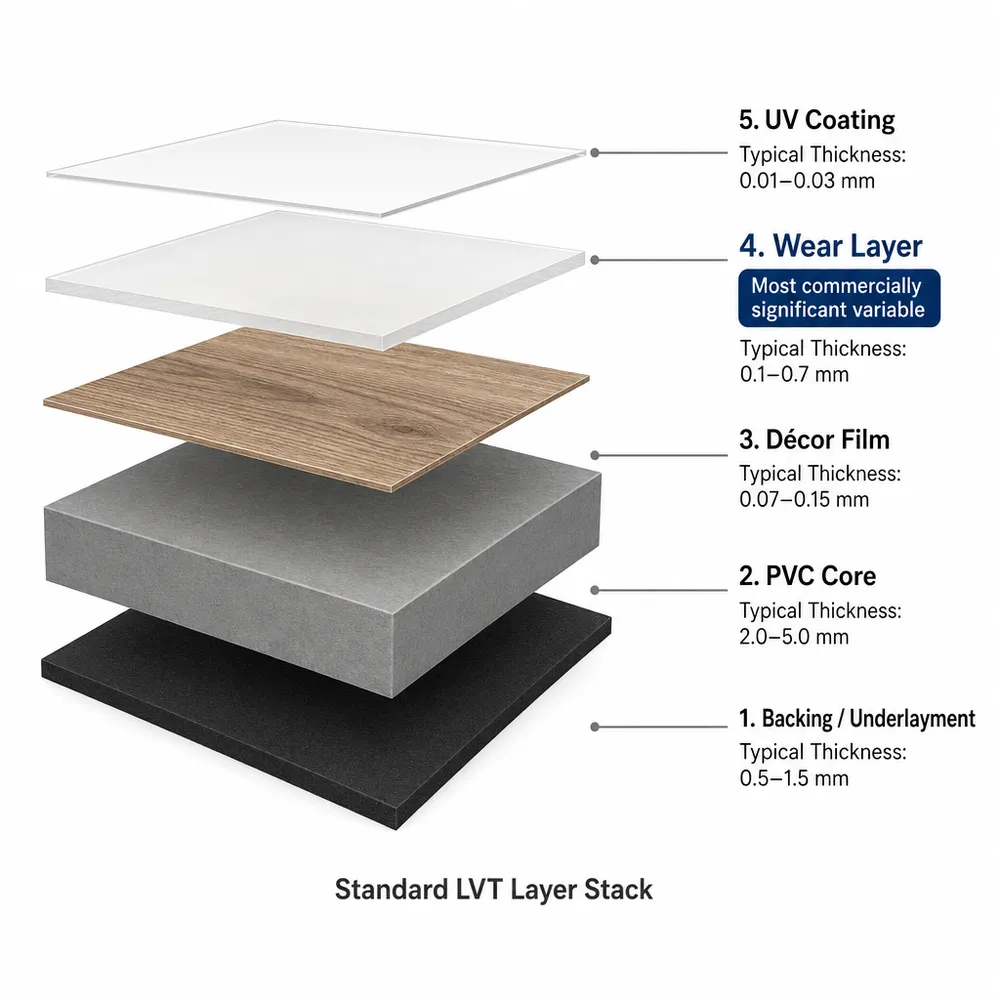
Standard LVT runs four to five layers. Each one has a spec range, and each range has a floor — below it, the product fails in ways that come back to you as returns, warranty claims, or lost accounts.
Backing layer sits at the bottom. It's either a fiberglass reinforcement sheet or a pre-attached foam underlayment (IXPE or EVA, typically 1mm–1.5mm). Fiberglass backing improves dimensional stability and is standard on glue-down products. Pre-attached IXPE reduces installer callbacks on click-lock products by adding acoustic damping and tolerating minor subfloor irregularities — worth specifying if your channel sells into residential renovation where subfloor prep is inconsistent.
Core is where most of the structural work happens. PVC-based cores run 2mm–5mm depending on total product thickness. Density matters more than thickness alone: a low-density core at 4mm will flex under point loads and cause click-lock profiles to disengage over time. For underfloor heating markets, core formulation is critical — a core that hasn't been tested to EN 434 will expand and contract unevenly, and you'll hear about it from your customers within one heating season.
Décor film is the printed layer that gives LVT its wood or stone appearance. Print resolution and emboss registration accuracy determine perceived quality. Misregistered emboss — where the surface texture doesn't align with the printed grain — is the most common visual defect on budget LVT and the fastest way to generate returns from design-conscious retail buyers.
Wear layer is the most commercially significant spec in the entire stack, and the most frequently misrepresented. It's a clear PVC film bonded over the décor layer. The market range runs from 0.1mm (essentially decorative) to 0.7mm+ for heavy commercial. Nominal thickness on a spec sheet and actual measured thickness after production are not always the same number — more on that in the sourcing section below.
UV coating is the topmost layer: a UV-cured finish that determines surface hardness, gloss level, and abrasion resistance. Abrasion class runs AC1 through AC5. The number of coats and whether each coat is individually cured (rather than stacked and cured once) affects adhesion durability. Products from lines that skip individual coat curing tend to show surface peeling within 12–18 months in high-traffic applications.
| Layer | Typical Spec Range | What Low-Spec Means for You |
|---|---|---|
| Backing | Fiberglass sheet or 1–1.5mm IXPE/EVA | Poor subfloor tolerance, higher installer callback rate |
| Core | 2mm–5mm PVC, density 1.6–2.0 g/cm³ | Click-lock disengagement, dimensional instability under heat |
| Décor film | 0.07mm–0.12mm, HD print | Misregistered emboss, visual returns from retail buyers |
| Wear layer | 0.1mm–0.7mm clear PVC | Premature surface wear, warranty claims, account loss |
| UV coating | AC1–AC5, 5–10 coats | Surface peeling, adhesion failure in high-traffic use |
If you're evaluating our LVT flooring range, the wear layer spec and core density are the two numbers worth asking about first.
Click-Lock, Glue-Down, Loose-Lay: A Product Configuration Decision, Not an Installation Guide
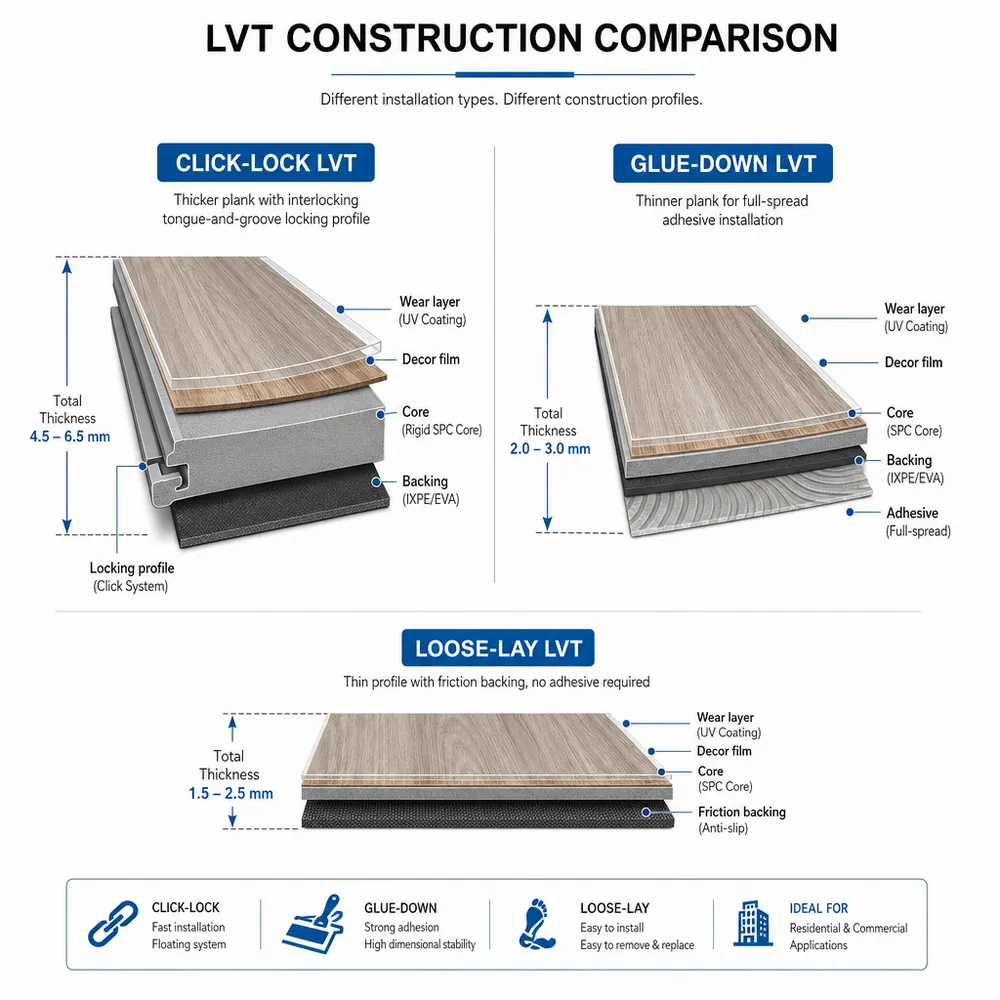
The three main LVT construction types aren't just different ways to install the same product. They're different product configurations with different core spec requirements, different cost structures, and different market segments. Choosing the wrong one for your channel creates problems that no amount of marketing fixes.
Click-lock LVT requires a stiffer, denser core to support the locking profile. The click geometry is machined into the core edges — if the core is too soft or inconsistent in density, the profile deforms under lateral load and planks separate. This is the primary driver of return rates on DIY retail channels. Click-lock suits residential distribution and DIY retail because it reduces installation labor cost for end users. Total thickness typically runs 4mm–8mm.
Glue-down LVT allows a thinner overall construction — sometimes as low as 2mm total — because the adhesive bond carries the structural load rather than the core. Lower material cost per square meter, but the installation cost is higher (adhesive, prep time, subfloor requirements). This construction type dominates high-traffic commercial: healthcare, education, retail fit-out. The reason is simple: when a plank fails in a hospital corridor, you need to replace one plank, not re-float an entire floating floor. Glue-down makes that possible.
Loose-lay LVT uses a weighted or friction-backed construction — typically a heavy fiberglass or rubber backing — to hold planks in place without adhesive or locking profiles. It's a niche construction type, but it's growing in hospitality renovation because it can be installed and removed without damaging the subfloor, which matters when a hotel needs to turn a room in 48 hours. The backing weight adds to freight cost, so landed cost per square meter is higher than it looks on the factory price sheet.
(Loose-lay is worth stocking if you have hospitality refurbishment accounts — the segment is underserved and the repeat order cycle is predictable.)
| Construction Type | Typical Total Thickness | Core Spec Requirement | Primary Market Segment | Installation Cost Implication |
|---|---|---|---|---|
| Click-lock | 4mm–8mm | High density, tight profile tolerance | Residential distribution, DIY retail | Low labor cost, higher product cost |
| Glue-down | 2mm–4mm | Moderate density, flat and stable | Healthcare, education, retail fit-out | Higher labor cost, lower product cost |
| Loose-lay | 4mm–6mm | Heavy backing (fiberglass/rubber) | Hospitality renovation, commercial refurb | Minimal labor, higher freight cost |
If you're comparing LVT against LVP for your product line, the construction type decision is part of that conversation — see our LVT vs LVP flooring guide for how the two categories differ at the spec level.
Where LVT Construction Quality Fails: The Sourcing Trap
The four failure modes below account for the majority of LVT warranty claims and return events. All four are preventable at the RFQ stage if you know what to ask for.
Wear layer misrepresentation is the most common. A spec sheet says 0.3mm. The actual measured thickness after production is 0.22mm. That gap is enough to cut the product's service life in half in a light commercial application. The fix: request a third-party wear layer thickness test report — EN 429 (European) or ASTM F1700 (North American) — from an accredited lab, not from the factory's own QC department. If a supplier can't produce one, treat that as a red flag.
Core density variation affects two things: dimensional stability under temperature cycling, and click-lock engagement strength. A core that varies in density across a production run will produce planks with inconsistent locking force — some too tight, some too loose. At the RFQ stage, ask for a dimensional stability test report (EN 434) and a locking strength test result. These are standard documents for any serious LVT manufacturer.
Delamination between the décor film and the core is a production temperature control problem. If the calender line runs too cool during lamination, adhesion between layers is incomplete. It doesn't show up immediately — it shows up six months later when the floor starts to bubble in areas with direct sunlight or underfloor heating. We run inline temperature monitoring on every calender pass and do 100% visual inspection before packing, specifically because delamination is invisible until it isn't.
UV coating adhesion failure is a line-speed problem. Factories running at maximum throughput sometimes stack multiple UV coats and cure them together rather than curing each coat individually. The result is a surface that looks fine in the sample box and starts peeling within 12–18 months in high-traffic use. Ask for the abrasion class certification (EN 660 or equivalent) and check whether it was tested on the actual production run, not a pre-production sample.
Before placing a bulk order, request these documents as a minimum:
- Wear layer thickness test report (EN 429 or ASTM F1700)
- Dimensional stability report (EN 434)
- Locking strength test (for click-lock products)
- Abrasion class certification (EN 660 or equivalent)
If you want to verify construction quality before committing to volume, request a sample or pre-shipment inspection — it's the fastest way to confirm the spec sheet matches the production reality.
Matching LVT Construction Spec to Market Segment
The right LVT construction spec depends on the segment you're selling into, not on a generic "residential vs commercial" split. Here's how the spec requirements map to the segments where LVT actually moves volume.
Residential distribution and DIY retail — 4mm–5mm total thickness, 0.3mm wear layer minimum, click-lock construction, pre-attached IXPE underlayment. The underlayment spec matters here: it reduces installer callbacks by tolerating minor subfloor irregularities, which is the most common source of post-installation complaints in DIY channels.
Light commercial (boutique retail, offices, showrooms) — 5mm–6mm total, 0.5mm wear layer, click-lock or glue-down depending on subfloor condition. At this spec level, the product can carry a 10-year commercial warranty without significant warranty exposure, which is the threshold most light commercial buyers need to close a project specification.
Heavy commercial (healthcare, education, hospitality) — 6mm+ total, 0.5mm–0.7mm wear layer, glue-down construction, homogeneous or reinforced core. Warranty exposure is the key driver here: a 0.5mm wear layer in a hospital corridor will outlast a 0.3mm wear layer by years, and the difference in product cost is marginal compared to the cost of a warranty replacement project.
Project contractors and specification buyers — specify by EN 649 / ISO 10582 wear class, not just thickness. Wear class (21, 22, 23 for residential; 31, 32, 33, 34 for commercial) is the language of project specifications and helps avoid disputes on delivery when the spec sheet and the purchase order need to match exactly.
| Market Segment | Recommended Total Thickness | Wear Layer Spec | Construction Type | Key Compliance Requirement |
|---|---|---|---|---|
| Residential / DIY retail | 4mm–5mm | 0.3mm minimum | Click-lock + IXPE | EN 649 Class 23 |
| Light commercial | 5mm–6mm | 0.5mm | Click-lock or glue-down | EN 649 Class 32 |
| Heavy commercial | 6mm+ | 0.5mm–0.7mm | Glue-down | EN 649 Class 33–34 |
| Project specification | Per spec | Per wear class | Per spec | EN 649 / ISO 10582 wear class |
For the heavy commercial and hospitality segments, our luxury LVT range is built to the 0.5mm+ wear layer spec with glue-down and click-lock configurations available.
FAQ: LVT Construction Buyer Questions
What wear layer thickness do I need for commercial LVT?
0.3mm is the minimum for residential distribution. Light commercial (offices, boutique retail) needs 0.5mm to support a credible 10-year warranty. Heavy commercial — healthcare, education, high-traffic hospitality — should be 0.5mm–0.7mm. The risk of under-specifying isn't just product failure; it's warranty claims that cost more to process than the margin you made on the original order.
What is the difference between click-lock and glue-down LVT construction for commercial projects?
Click-lock requires a denser, stiffer core to hold the locking profile under lateral load. It's faster to install and easier to replace individual planks, but it's less suitable for subfloors with significant moisture or temperature variation. Glue-down allows a thinner, lower-cost product construction and performs better in high-traffic environments where the adhesive bond prevents micro-movement under foot traffic. For commercial projects with controlled subfloor conditions, glue-down typically delivers lower total installed cost and better long-term performance.
How do I verify LVT wear layer thickness before placing a bulk order?
Request a third-party test report — EN 429 (Europe) or ASTM F1700 (North America) — from an accredited testing laboratory. A factory spec sheet is not verification; it's a claim. The test report should reference the specific production batch, not a pre-production sample. If the supplier can't provide a current batch report, request a pre-shipment inspection with wear layer measurement as a line item.
Does LVT construction affect dimensional stability under underfloor heating?
Yes, significantly. Core density and total thickness both affect how the product responds to temperature cycling. A low-density core will expand and contract more than a high-density core at the same temperature range, which causes gapping or buckling at plank joints over time. For UFH applications, specify EN 434 dimensional stability test results and confirm the product has been tested at the temperature range your market uses — typically 27°C–40°C surface temperature.
What is the minimum core thickness for click-lock LVT to avoid locking failure?
3.5mm core is the practical minimum for reliable click engagement under normal residential use. Below that, the locking profile geometry becomes too shallow to resist lateral separation, and you'll see disengagement in high-traffic areas or where furniture is moved frequently. (We've seen 3mm core click-lock products generate return rates of 8–12% in DIY retail channels — the cost of the returns erases the margin advantage of the lower product cost.)